No Centralising the Decentralised: Andhra Pradesh High Court Refuses YSRCP's Plea for District-Level Nomination Centres in Local Body Polls, but Lets Threatened Candidates Seek an Alternative Venue
Court / Authority
Andhra Pradesh High Court
Update / Judgement Date
16 Oct 2026
Date of Publication
27 Oct 2026
Case No.
WP30103/2026
Source
WCP News Bulletin
Author
Arshee Saifi — WCP Legal Desk
Reading Time
6 min read
View Count
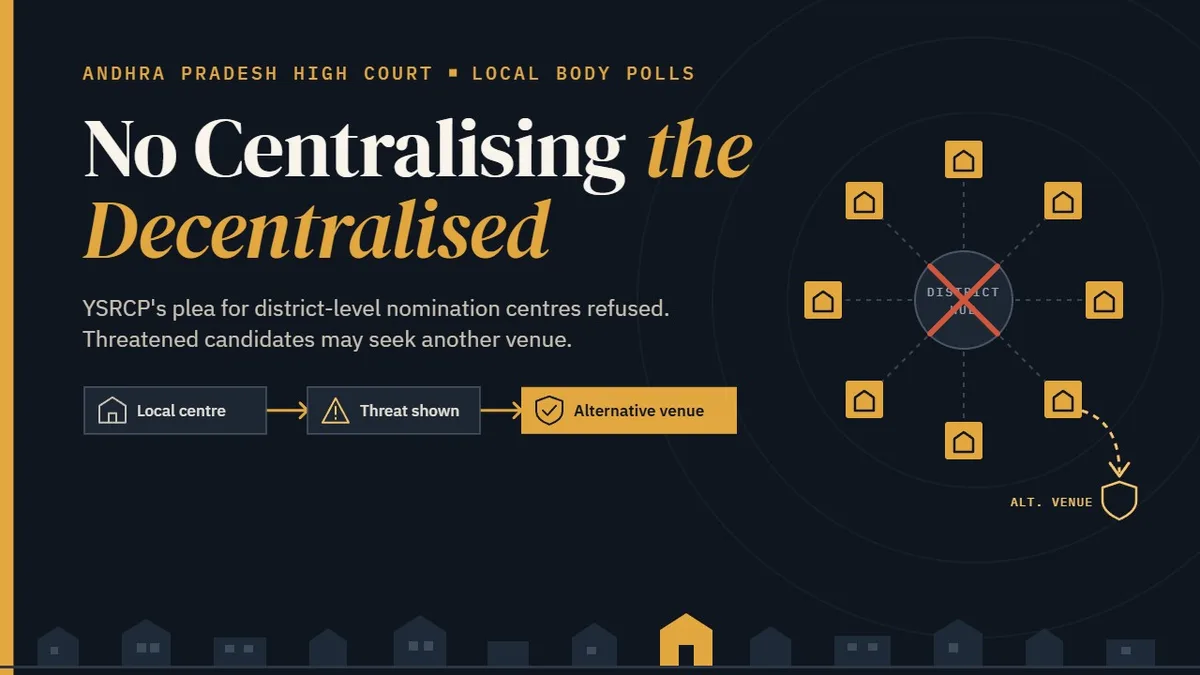
Key Proposition: An omnibus direction to the State Election Commission to open district-level nomination centres for local body elections cannot be issued on a political party's apprehension of intimidation, since the Election Officer designates nomination places under the election rules; but an individual candidate who faces threats may apply to the Election Officer for an alternative place within his jurisdiction, to be decided within the election schedule.
Background / Synopsis :
The petitioner is a recognised political party, in power in Andhra Pradesh from 2019 to 2024 and now the primary opposition party, intending to contest the 2026 elections to municipal corporations, urban local bodies, MPTCs and ZPTCs (Para 2).
Citing past incidents of violence and intimidation during nominations, it made a representation to the SEC dated 9 October 2026 and filed this writ seeking safe and free filing of nominations and an additional nomination facility at each District Headquarters (prayer; IA 1 of 2026).
The election notification was issued on 14 October 2026, shortly after the matter was taken up the previous day (Para 7).
Issues For Consideration :
- Whether the SEC can be directed to provide an additional and optional nomination facility at District Headquarters for all local bodies in a district.
- Whether any relief can be given to individual candidates who face threats, after issuance of the election notification.
Submissions Of Parties :
- Petitioner (YSRCP):
The SEC must provide a conducive atmosphere for filing nominations, as the ruling party often threatens opposition candidates; inaction violates Article 243ZA (Para 2).
As the authority overseeing local body elections, the SEC should permit nominations at district headquarters or other additional places (BJP v. State of West Bengal) (Para 2).
- Respondents (State and SEC):
The claim is premature and based on mere apprehension (Association for Democratic Reforms v. ECI) (Para 3).
Under Rule 6(d), the Election Officer, on the basis of the SEC's notification, fixes the places and hours for nominations in each ward; the SEC is not the authority for this (Para 3).
No omnibus direction can be issued without regard to specific incidents of violence (Para 3).
Court's Observations & Analysis :
- Re: Issue (i): District-level nomination centres
Local body elections exist to secure decentralised governance; a facility at the Collectorate to receive nominations for the whole district would centralise that process (Para 5).
Under the Rules, the Election Officer is empowered to designate nomination places; an omnibus direction cannot be issued to the SEC on mere apprehension (Para 5).
BJP v. State of West Bengal concerned untoward incidents after notification; no such circumstance was shown here (Para 5).
Held: No direction to designate the Collector's office as a nomination place. (Para 5)
- Re: Issue (ii): Relief for individual candidates
Under Ashok Kumar, a decision that subserves the progress of the election and facilitates its completion does not amount to 'calling in question an election' (Para 7).
The party's request cannot be considered as an omnibus request, but a candidate facing a threat may apply individually (Para 8).
Held: Liberty to individual candidates to approach the Election Officer, whose decision must fit the notified schedule. (Para 8)
Notable Observations:
"…the petitioner's request is for providing a facility at the District headquarters in the office of the District Collector, to enable contesting candidates of its Political Party to submit their nomination papers would amount to Centralizing the decentralization process." (Para 5)
Decision & Directions :
- Writ petition disposed of; no omnibus direction to the SEC to designate District Headquarters or the Collector's office for nominations. (Paras 5, 9)
- Any intending candidate facing a threat may apply to the Election Officer for designation of another place within his territorial jurisdiction; the Election Officer shall pass orders in accordance with law, and both the application and its disposal must conform to the notified election schedule. (Para 8)
Legal Provisions Discussed & Precedents Cited :
- Constitution of India – Articles 14, 19(1)(a), 21, 243K, 243ZA.
- AP Municipalities (Conduct of Elections of Members) Rules, 2005 – Rule 6, including Rule 6(d).
- Doctrines applied: decentralised local self-government; limited judicial interference during the election process.
- Election Commission of India v. Ashok Kumar – Relied on.
- Bharatiya Janata Party v. State of West Bengal – Distinguished.
- Association for Democratic Reforms v. Election Commission of India, 2025 (2) SCC 732 – Cited by the Advocate General.
Case Details :
- Case / Party Name: Yuvajana Sramika Rythu Congress Party (YSRCP) v. State of Andhra Pradesh & Ors.
- Case Number(s): Writ Petition No. 30103 of 2026 (CNR APHC010547582026)
- Coram / Judges: Kiranmayee Mandava, J. – Single Judge
- Counsel Appearances: For the Petitioner: Sri P. Veera Reddy, Senior Counsel (VMR Legal). For Respondents 1 to 3: Sri Dammalapati Srinivas, Advocate General, and the Assistant Government Pleader for Municipal Administration and Urban Development. For Respondent No. 4 (AP State Election Commission): Sri N. Ashwani Kumar, Standing Counsel.
Disclaimer: This summary is an editorial aid and does not form part of the judgment. Refer to the original judgment before citing.
Full Judgement / Attachment
Full Judgement
Frequently asked questions about Andhra Pradesh High Court
- Where does the Andhra Pradesh High Court sit and which areas does it cover?
- The Andhra Pradesh High Court sits at Amaravati (Nelapadu). It has jurisdiction over the State of Andhra Pradesh. It began functioning in its present form on 1 January 2019, after the common High Court at Hyderabad was bifurcated.
- Where can I find AP High Court orders and cause lists?
- The official website, aphc.gov.in, publishes daily cause lists, case status and judgements. Orders are also available on the eCourts High Court Services portal (hcservices.ecourts.gov.in) and searchable on the eCourts Judgments portal (judgments.ecourts.gov.in).
- What matters does the AP High Court commonly hear?
- Besides writ petitions under Article 226 against State action, it hears civil and criminal appeals from district courts across Andhra Pradesh, land acquisition and service matters, and income-tax appeals arising from the ITAT Visakhapatnam Bench on substantial questions of law.
- How is a single-judge order of the AP High Court challenged?
- An order of a single judge in a writ petition is challenged by a Writ Appeal before a Division Bench of the same court. A final judgement can then be taken to the Supreme Court by a Special Leave Petition under Article 136, ordinarily within 90 days.
- How can White Collar Professional help with a AP High Court matter?
- Post your requirement on White Collar Professional to receive proposals from verified Advocates, Chartered Accountants and Company Secretaries, compare them, and pay securely through the platform. This page also tracks the latest AP High Court judgements and legal updates as they are reported.