← back
Must-ReadGauhati High Court
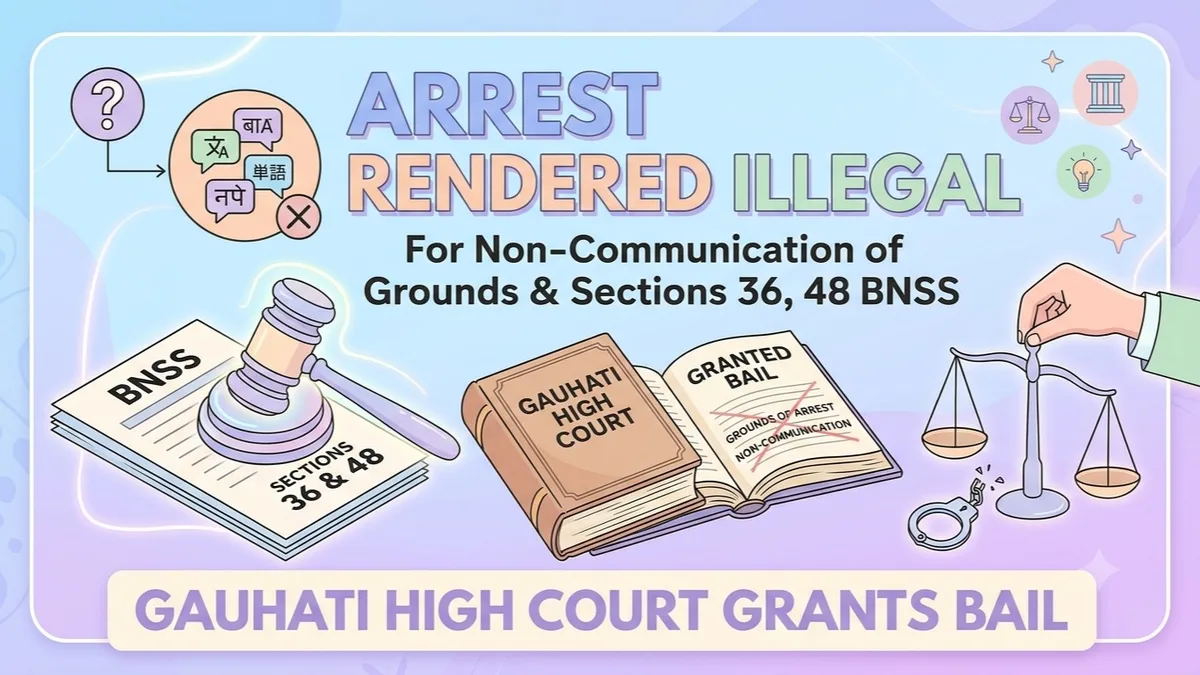
Failure to Communicate Specific Grounds of Arrest Violates Article 22(1): Bail Granted Under Section 47 BNSS
Court / Authority
Gauhati High Court
Update / Judgement Date
26 Oct 2026
Date of Publication
29 Oct 2026
Case No.
Bail Application No. 24/2026
Source
WCP News Bulletin
Author
Pranjal Jha — WCP Legal Desk
Reading Time
7 min read
View Count
2
Criminal Law
A. CASE HEADER
Key Proposition- Failure to communicate sufficiently specific, individualised grounds of arrest in writing under Section 47 BNSS may violate Article 22(1) of the Constitution and justify bail.
Petitioner / Applicant
Re: Issue (i): Sufficiency of grounds of arrest
Provision Relevance
- Case / Party Name: Chotsaba Sangtam v. The State of Nagaland
- Court Name: Gauhati High Court, Kohima Bench
- Case Number(s): Bail Application No. 24/2026
- Citation: 2026:GAU-NL:564
- Coram / Judges: Hon’ble Mrs Justice Helen Dawngliani, Single Judge
- Judgment Authored By: Justice Helen Dawngliani, order
- Date of Decision: 26 October 2026
- Nature of Proceedings: Bail application under Section 483 of the Bharatiya Nagarik Suraksha Sanhita, 2023 (BNSS)
- Letters Patent / Appeals: None
- Counsel Appearances: Toshitemjen Pongener for the petitioner; S. Mere, Public Prosecutor, for the State
- Outcome: Bail granted; application disposed of
Key Proposition- Failure to communicate sufficiently specific, individualised grounds of arrest in writing under Section 47 BNSS may violate Article 22(1) of the Constitution and justify bail.
Catchwords:
- BNSS, 2023 – Section 47 – Grounds of arrest – Whether generic information satisfies the statutory requirement – Held, prima facie no. (Paras 8–12)
- Constitution of India – Article 22(1) – Communication of grounds of arrest – Whether inadequate grounds infringe constitutional safeguards – Held, yes. (Paras 9–12, 14–15)
- BNSS, 2023 – Section 483 – Bail – Whether alleged non-compliance with arrest safeguards justified bail after an earlier refusal – Held, yes, in the circumstances. (Paras 13–16)
Headnote: The applicant sought bail in connection with a criminal case registered at Kiphire Women Police Station, Nagaland, alleging offences under Sections 74, 79, 109, 115(2) and 351(2) of the Bharatiya Nyaya Sanhita, 2023. The principal challenge concerned the sufficiency of the written grounds of arrest furnished under Section 47 BNSS. The Court examined the distinction between general reasons for arrest and specific grounds particular to the accused, relying on Supreme Court decisions concerning Article 22(1). It found prima facie non-compliance with Section 47 BNSS and held that the constitutional safeguard had been violated. Bail was granted subject to a bond of ₹1,00,000, one solvent surety, and specified conditions. (Paras 3–16)
C. BACKGROUND / SYNOPSIS
Key facts
- On 4 May 2026, the victim's father lodged an FIR at Kiphire Women Police Station, Nagaland.
- The case was registered under Sections 74, 79, 109, 115(2) and 351(2) BNS.
- The accused was arrested on 5 May 2026 at 11:00 hours.
- The grounds of arrest referred to physical assault and attempted murder but were challenged as insufficiently specific.
- The investigation had been completed and the charge-sheet filed, although the trial had not commenced. (Paras 3–4, 7–8)
- FIR registered on 4 May 2026.
- Accused arrested on 5 May 2026.
- Earlier bail application rejected by the trial court despite the objection concerning Section 47 BNSS.
- Fresh bail application filed before the Gauhati High Court under Section 483 BNSS.
- High Court granted bail on 26 October 2026. (Paras 3–7, 13–17)
- The applicant challenged the adequacy of the written grounds of arrest and sought release on bail. The State opposed the application, arguing substantial compliance and absence of prejudice.
- Whether the information supplied to the accused complied with Section 47 BNSS and adequately communicated the grounds of arrest.
- Whether inadequate communication of grounds of arrest violated Article 22(1) of the Constitution.
- Whether the alleged non-compliance justified granting bail despite the earlier rejection by the trial court.
Petitioner / Applicant
- The written grounds of arrest did not satisfy Section 47 BNSS.
- Failure to communicate adequate grounds violated Article 22(1) of the Constitution.
- Relied on Sakib Choudhury v. State of Assam, reported at 2025 (3) GLT 399.
- Relied on Pankaj Bansal v. Union of India, (2024) 7 SCC 576, and Prabir Purkayastha v. State (NCT of Delhi), (2024) 8 SCC 254, concerning communication of grounds of arrest.
- The earlier rejection of bail did not prevent reconsideration on the relevant legal grounds. (Paras 5, 9–10, 13)
- The Public Prosecutor argued that Section 47 BNSS had been substantially complied with.
- The State contended that no prejudice had been caused and that there was no delay in furnishing the notice.
- It submitted that the trial court had correctly rejected bail and requested dismissal of the application. (Paras 6, 8)
Re: Issue (i): Sufficiency of grounds of arrest
- The Court examined the written notice provided to the accused.
- It relied on the distinction between generic reasons for arrest and individualised grounds explaining the facts necessitating the arrest.
- The notice referred to physical assault and attempted murder but, in the Court's prima facie assessment, did not contain all the details required from the investigating officer.
- The Court considered the reasoning in Pankaj Bansal and Prabir Purkayastha. (Paras 8–12)
- Held: The information supplied appeared insufficient to satisfy Section 47 BNSS. (Paras 12, 14–15)
- The Court relied on the Supreme Court's interpretation of the constitutional right to be informed of the grounds of arrest.
- It treated meaningful communication as necessary to enable the arrested person to consult legal counsel, oppose custodial remand and seek bail.
- The Court considered the inadequacy of the written grounds a violation of the constitutional safeguard. (Paras 9–12, 14)
- Held: The alleged non-compliance with Section 47 BNSS infringed Article 22(1) in the circumstances of the case. (Paras 14–15)
- The Court noted that the earlier bail application had been rejected.
- It referred to Babu Singh v. State of U.P., (1978) 1 SCC 579, for the proposition that a previous refusal does not necessarily prevent a subsequent bail application based on further material or different considerations.
- The Court considered the arrest-related violation sufficient to grant bail in the circumstances. (Paras 13–16)
- Held: Bail was granted subject to specified conditions. (Paras 15–16)
G. DECISION & DIRECTIONS
- The bail application was disposed of by granting bail to Repongli. Conditions imposed (para 16):
- The accused must attend court regularly.
- The accused must not influence witnesses or tamper with evidence.
- The accused must not commit any offence or similar offence while on bail.
- The accused must not leave the trial court's jurisdiction without prior permission.
- Bond: ₹1,00,000 with one solvent surety for the like amount, to the satisfaction of the trial court.
- Costs: None specified.
- Separate opinions: None.
Provision Relevance
- Constitution of India, Article 22(1): Constitutional safeguard requiring communication of grounds of arrest.
- BNSS, 2023, Section 47: Statutory obligation concerning information about grounds of arrest.
- BNSS, 2023, Section 48, mentioned in the discussion of the requirement to provide written information about grounds of arrest.
- BNSS, 2023, Section 483, provision under which the bail application was filed.
- BNS, 2023, Sections 74, 79, 109, 115(2), and 351(2) provisions under which the FIR was registered.
- Doctrines / principles: Meaningful communication of grounds of arrest; distinction between reasons for arrest and grounds of arrest; reconsideration of bail on subsequent or different considerations.
- Sakib Choudhury v. State of Assam, 2025 (3) GLT 399- Relied on by the applicant. (Para 5)
- Pankaj Bansal v. Union of India, (2024) 7 SCC 576 - Relied on for meaningful written communication of grounds of arrest. (Para 9)
- Prabir Purkayastha v. State (NCT of Delhi), (2024) 8 SCC 254 - Relied on for distinguishing reasons for arrest from individualised grounds of arrest. (Paras 10–12)
- Babu Singh v. State of U.P., (1978) 1 SCC 579 - Relied on regarding subsequent bail applications based on additional material or different considerations. (Para 13)
Full Judgement / Attachment
Full Judgement
Frequently asked questions about Gauhati High Court
- Where does the Gauhati High Court sit and which areas does it cover?
- The Gauhati High Court has its principal seat at Guwahati, with outlying benches at Kohima, Aizawl and Itanagar. It has jurisdiction over Assam, Nagaland, Mizoram and Arunachal Pradesh. Established in 1948 as the High Court of Assam, it was renamed the Gauhati High Court in 1971.
- How do I check case status at the Gauhati High Court or its outlying benches?
- The official website, ghconline.gov.in, covers the principal seat at Guwahati and the Kohima, Aizawl and Itanagar benches, with cause lists, case status and orders. The same data is on the eCourts High Court Services portal (hcservices.ecourts.gov.in).
- Which matters does the Gauhati High Court hear?
- It hears writs, civil and criminal appeals for Assam, Nagaland, Mizoram and Arunachal Pradesh, including matters involving customary law and Sixth Schedule areas. It also hears income-tax appeals arising from the ITAT Guwahati Bench.
- How is a Gauhati High Court single-judge order appealed?
- A single-judge writ order is challenged by a Writ Appeal before a Division Bench of the court. A final judgement can be taken to the Supreme Court by a Special Leave Petition under Article 136, ordinarily within 90 days.
- How can White Collar Professional help with a Gauhati High Court matter?
- Post your requirement on White Collar Professional to receive proposals from verified Advocates, Chartered Accountants and Company Secretaries, compare them, and pay securely through the platform. This page also tracks the latest Gauhati High Court judgements and legal updates as they are reported.