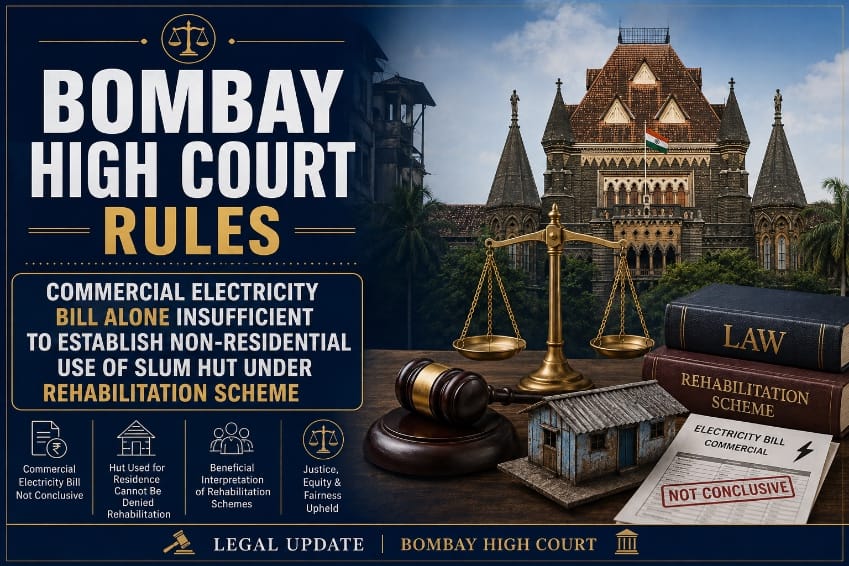
Bombay High Court Rules Commercial Electricity Bill Alone Insufficient to Establish Non-Residential Use of Slum Hut Under Rehabilitation Scheme
Court / Authority
Bombay High Court
Update / Judgement Date
01 Sept 2026
Source
WCP News Bulletin
Author
Team — WCP Legal Desk
Reading Time
4 min read
Ganpat Krishna Parte v. High Power Committee, Govt. of Maharashtra & Ors. | Bombay High Court, Civil Appellate Jurisdiction | 28 August 2026
The Bombay High Court dismissed a writ petition challenging the High Power Committee's rejection of the petitioner's claim that his slum hut (Sr. No. 55) was eligible for commercial, rather than residential, protection under the Slum Rehabilitation Authority scheme. Interpreting the Government Resolution dated 16 May 2015, the Court held that while an electricity connection record is relevant to prove existence of a hutment, a distinct category of proof (such as a Gumasta licence, restaurant licence, or tax receipt) is required to establish actual commercial, professional or industrial use. Since the petitioner produced only a commercial electricity bill and municipal records described the premises as residential, the rejection of his commercial-eligibility claim was upheld.
Background
- The petitioner's brother was issued a Pitch Card in 1976 for Hut No. 85/6; the petitioner separately resided in Hut No. 478 from 1985 and began a canteen business in the same hut in 1992, obtaining a Commercial Electricity Connection.
- In the 2000 Annexure-II for the Slum Rehabilitation Scheme, Hut No. 55 (based on the 1976 Pitch Card) was shown as residential in the name of the petitioner's wife.
- The petitioner sought a change of user from residential to commercial for Hut No. 55, relying on the commercial electricity connection obtained in 1992, which Reliance Energy Ltd. confirmed on two occasions (2008 and 2012) was still running in his name.
- The Assistant Commissioner ('N' Ward) and, on appeal, the Secretary, Slum Rehabilitation Authority rejected the petitioner's claim, holding the electricity bill to be only secondary proof.
- The High Power Committee, Government of Maharashtra dismissed the petitioner's Application No. 292 of 2013 by order dated 1 August 2015, which was challenged in the present writ petition.
- Respondent No. 5 (developer) submitted that rehabilitation of the project was substantially complete, with residential and commercial PAP tenements already handed over to the Slum Rehabilitation Authority's Estate Department.
Court's Observations
- The Court held that the Government Resolution dated 16 May 2015 distinguishes between documents proving mere existence of a hutment (including electricity records) and documents proving non-residential/commercial use (such as Gumasta permits, restaurant licences or tax receipts).
- A commercial electricity connection has evidentiary value in showing the hutment existed and that such a connection was provided, but does not by itself satisfy the separate, specific requirement of proving commercial use.
- Municipal Corporation records showed the hut as residential, recorded the petitioner's residence there before 1 January 1995, and noted absence of any Gumasta licence; income-tax returns for 2003-04 and 2004-05 also described the premises as 'Residential.'
- The Court rejected the submission that mere existence of two separately metered huts established that one of them was being used commercially, holding that separate existence and commercial use are distinct questions requiring distinct proof.
- The Court held that the applicable qualifying date under the 2015 Government Resolution was 1 January 2000, following the notification dated 2 May 2014, though this did not affect the outcome since proof of commercial use was independently unmet.
- Since eligibility could not be decided on a single document in isolation, and the electricity bill could not substitute for the prescribed proof of commercial use, the impugned rejection order was upheld and the petition dismissed with no order as to costs.
Legal Provisions Discussed
- Government Resolution dated 16 May 2015 (Slum Rehabilitation Authority eligibility criteria).
- Regulation 33(10), Development Control and Promotion Regulation, 1991.
- Maharashtra Slum Areas (Improvement, Clearance and Redevelopment) Act — qualifying date provisions, as amended by Gazette Notification dated 2 May 2014.
Case Details :
Court Name: High Court of Judicature at Bombay
Case Number: Writ Petition No. 7099 of 2016
Case / Party Name: Ganpat Krishna Parte v. High Power Committee, Govt. of Maharashtra & Ors.
Court: Bombay High Court, Civil Appellate Jurisdiction
Coram / Judges: Amit Borkar, J.
Date of Decision: 28 August 2026
Letters Patent / Appeals (if any): None; Writ Petition under Article 226 challenging High Power Committee order
Single-Judge decision applying and clarifying documentary-proof requirements under a specific Government Resolution; primarily fact-specific with limited but useful interpretive value for SRA eligibility disputes.
Full Judgement / Attachment
Full Judgement