&K High Court Upholds BSF Rule Restricting Supply of Trial Copies Until Confirmation, Holding It Does Not Violate Article 21
Court / Authority
J&K and Ladakh High Court
Update / Judgement Date
21 Oct 2026
Date of Publication
27 Oct 2026
Case No.
LPA No. 107/2022
Source
WCP News Bulletin
Author
Dipanshi Bansal — WCP Legal Desk
Reading Time
6 min read
View Count
1
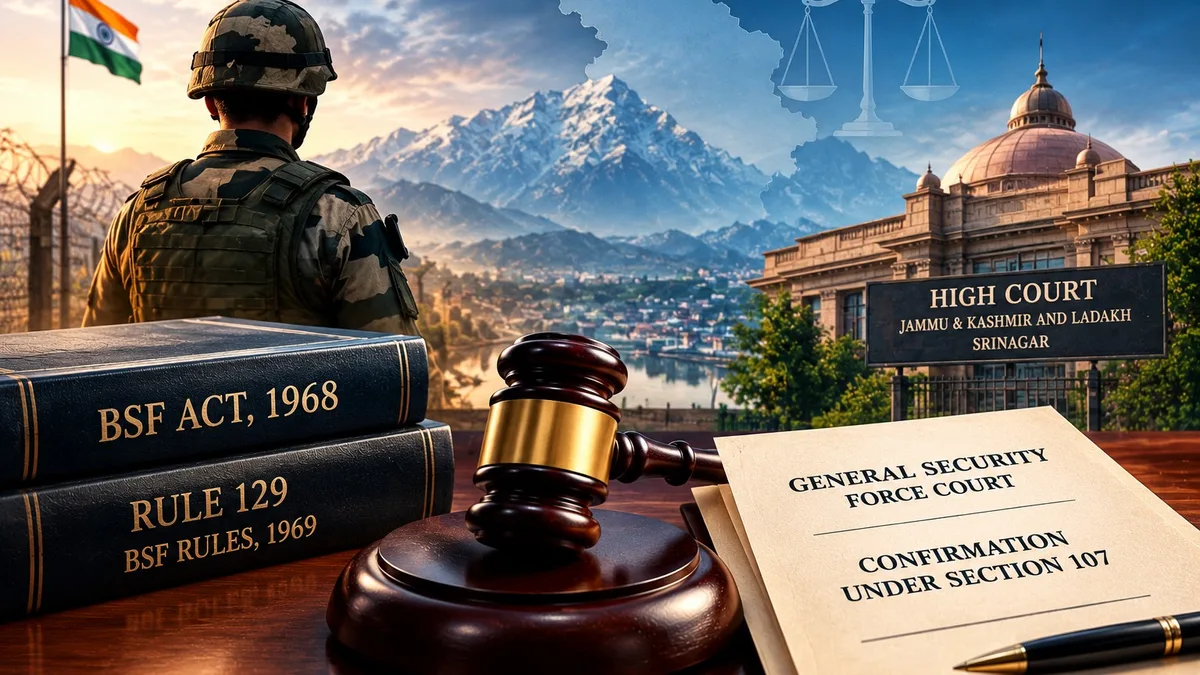
The Division Bench of the High Court of Jammu & Kashmir and Ladakh reversed a Single Judge decision that had struck down Rule 129 of the Border Security Force Rules, 1969. The case concerned a BSF constable tried by a General Security Force Court for the alleged shooting death of a colleague. During the trial he sought certified copies of the proceedings and prosecution witness statements, but Rule 129 postponed the entitlement to copies until confirmation of the finding and sentence. The Division Bench held that Rule 129 forms part of a complete special statutory scheme: the accused can inspect proceedings under Rule 120, participate in the trial, cross-examine witnesses and seek review, while confirmation under Sections 107–108 of the BSF Act determines when the finding and sentence become valid. The Court held that non-supply of certified copies before confirmation, by itself, does not violate Article 21. The appeal was allowed and Rule 129 was upheld.
Key Proposition: Rule 129 of the Border Security Force Rules, 1969 is constitutionally valid when read with the BSF Act and allied rules; postponing certified copies of Security Force Court proceedings until confirmation does not, by itself, violate the accused's Article 21 right to a fair trial where meaningful inspection and other procedural safeguards remain available.
- Constitution – Article 21 – Fair trial – Whether an accused before a General Security Force Court has an absolute constitutional right to certified copies during trial – Held, no; inspection and other safeguards may constitute sufficient procedural protection.
- Constitution – Article 33 – Armed forces – Whether special procedural restrictions may operate against members of the BSF – Held, Parliament may restrict fundamental rights to the extent constitutionally connected with discipline and proper discharge of duties.
- BSF Rules, 1969 – Rule 129 – Copies of proceedings – Whether postponement until confirmation is manifestly arbitrary or unconstitutional – Held, no.
- BSF Rules, 1969 – Rule 120 – Inspection – Whether inspection, together with representation, cross-examination, review and confirmation safeguards, is sufficient – Held, yes.
Background / Synopsis :
- The respondent was a BSF member accused of shooting Head Constable Chander Bhan at the BSF campus, Bandipora, on 27 November 2017; an FIR under Section 302 RPC was registered. (Para 2)
- The competent authority opted for trial before a General Security Force Court, and the respondent was tried under Section 302 RPC read with Section 46 of the BSF Act and for leaving his picket without orders. (Paras 2–3)
- The GSFC found him guilty and awarded life imprisonment and dismissal from service; the finding and sentence required confirmation under Section 107 of the BSF Act. (Para 3)
- The respondent sought certified copies during the trial, but his request was declined under Rule 129; he challenged the rule under Article 21. (Paras 3–5)
- The Single Judge had struck down Rule 129 and directed that the GSFC restart from the stage after prosecution evidence. (Para 1)
Issues For Consideration :
- Whether Rule 129, by postponing supply of certified copies until confirmation, violates Article 21.
- Whether Article 33 and the special statutory framework governing Security Force Courts justify the procedural restriction.
- Whether inspection under Rule 120 and the other safeguards in the BSF Act and Rules provide an effective opportunity to defend.
Submissions Of Parties :
Union of India / BSF:
- The right to obtain copies is not an absolute component of fair trial; Rule 120 permits inspection during trial and Rule 129 only regulates when copies can be obtained.
- The BSF Act and Rules form a self-contained statutory regime for a disciplined armed force.
- Reliance was placed on Union of India v. Ex. Flt. Lt. G.S. Bajwa to submit that inspection at reasonable times can satisfy natural justice.
Rovinder Singh:
- The absence of certified copies impaired preparation and conduct of an effective defence and therefore violated Article 21.
- Inspection was said to be inadequate compared with possession of copies of witness statements and proceedings.
Court's Observations & Analysis :
Re: Article 21 and fair trial
- The Court held that Article 21 guarantees a fair procedure but does not prescribe one universal procedural format. (Paras 48–50)
- The accused was not denied representation, participation, cross-examination, inspection or the opportunity to lead a defence. (Paras 48–50)
- The possibility that physical copies may be useful does not make possession of copies at every stage a constitutional requirement. (Para 49)
Re: Article 33 and special military procedure
- The BSF is an armed force to which Article 33 applies. Restrictions must have a rational connection with discipline and proper discharge of duties. (Paras 42–43)
- Rule 129 could not be examined in isolation from Rules 119–130 and Sections 87, 107 and 108 of the BSF Act. (Paras 41–43, 53–56)
- The special statutory classification of Security Force Court proceedings was held to have an intelligible differentia and rational connection with the legislative object. (Para 42)
Re: Constitutional validity of Rule 129
- Rule 129 does not prevent participation in proceedings, cross-examination or presentation of a defence; it regulates the stage at which copies become obtainable. (Para 40)
- No actual constitutional prejudice was demonstrated: there was no showing that inspection was denied or that the respondent was prevented from cross-examining a material witness or raising a specific defence. (Para 52)
- The Court therefore held Rule 129 constitutionally valid and not ultra vires Part III, particularly Article 21. (Para 56)
Decision & Directions :
- The appeal was allowed.
- The Single Judge's judgment dated 28 April 2022 in WP(C) No. 255/2020 was set aside.
- Rule 129 of the BSF Rules, 1969 was held constitutionally valid when harmoniously read with Sections 87, 107 and 108 of the BSF Act and Rules 120, 121, 128 and 130.
- Non-supply of certified copies before confirmation does not, by itself, violate the fundamental right to a fair trial under Article 21.
- The competent authorities were directed to proceed in accordance with the BSF Act and Rules; the Court clarified that it expressed no opinion on the merits of the criminal accusation.
Legal Provisions Discussed & Precedents Cited :
- Constitution of India – Article 21: fair procedure and fair trial.
- Constitution of India – Article 33: permits Parliament to restrict fundamental rights of members of armed forces to ensure discipline and proper discharge of duties.
- Border Security Force Act, 1968 – Sections 64, 68, 72, 87, 107 and 108: Security Force Courts, jurisdiction, application of evidence law subject to the Act, and confirmation mechanism.
- Border Security Force Rules, 1969 – Rules 120, 121, 128, 129 and 130: inspection, review, preservation, copies and security-related withholding.
- Indian Penal Code / Ranbir Penal Code context – Section 302 RPC was the substantive charge referred to in the case.
- Union of India v. Ex. Flt. Lt. G.S. Bajwa, (2003) 9 SCC 630 – relied upon for the proposition that inspection at reasonable times may satisfy natural justice and there is no absolute right to day-to-day copies.
- Nahar Singh Yadav v. Union of India, (2011) 1 SCC 307 – discussed on fair trial and sufficient facilities for defence.
Full Judgement / Attachment
Full Judgement
Frequently asked questions about J&K and Ladakh High Court
- Where does the High Court of Jammu and Kashmir and Ladakh sit and which areas does it cover?
- The High Court of Jammu and Kashmir and Ladakh functions from two wings, at Srinagar and Jammu; in August 2026 the Union Cabinet approved a further bench in Ladakh. It has jurisdiction over the Union Territories of Jammu and Kashmir and Ladakh. First established in 1928, it took its present name in 2021 as the common High Court for both Union Territories.
- How do I check cases at the Srinagar and Jammu wings?
- The official website, jkhighcourt.nic.in, publishes separate cause lists and orders for the Srinagar and Jammu wings. Case status is also available on the eCourts High Court Services portal (hcservices.ecourts.gov.in). Matters from Ladakh are currently listed at one of the two existing wings.
- What kinds of cases does the J&K and Ladakh High Court hear?
- It hears writ petitions, including habeas corpus petitions against preventive detention, service and land matters, and civil and criminal appeals from both Union Territories. It also hears tax appeals on substantial questions of law.
- How is a J&K High Court single-judge judgement appealed?
- Certain single-judge judgements can be challenged before a Division Bench by a Letters Patent Appeal (LPA). A final judgement can be taken to the Supreme Court by a Special Leave Petition under Article 136, ordinarily within 90 days.
- How can White Collar Professional help with a J&K High Court matter?
- Post your requirement on White Collar Professional to receive proposals from verified Advocates, Chartered Accountants and Company Secretaries, compare them, and pay securely through the platform. This page also tracks the latest J&K High Court judgements and legal updates as they are reported.