Property Inherited by a Father on Partition Was Not Coparcenary Property in Which His Sons Could Claim a Present Share
Court / Authority
Madhya Pradesh High Court
Update / Judgement Date
26 Oct 2026
Date of Publication
29 Oct 2026
Case No.
Second Appeal No. 264 of 2015
Source
WCP News Bulletin
Author
Dipanshi Bansal — WCP Legal Desk
Reading Time
4 min read
View Count
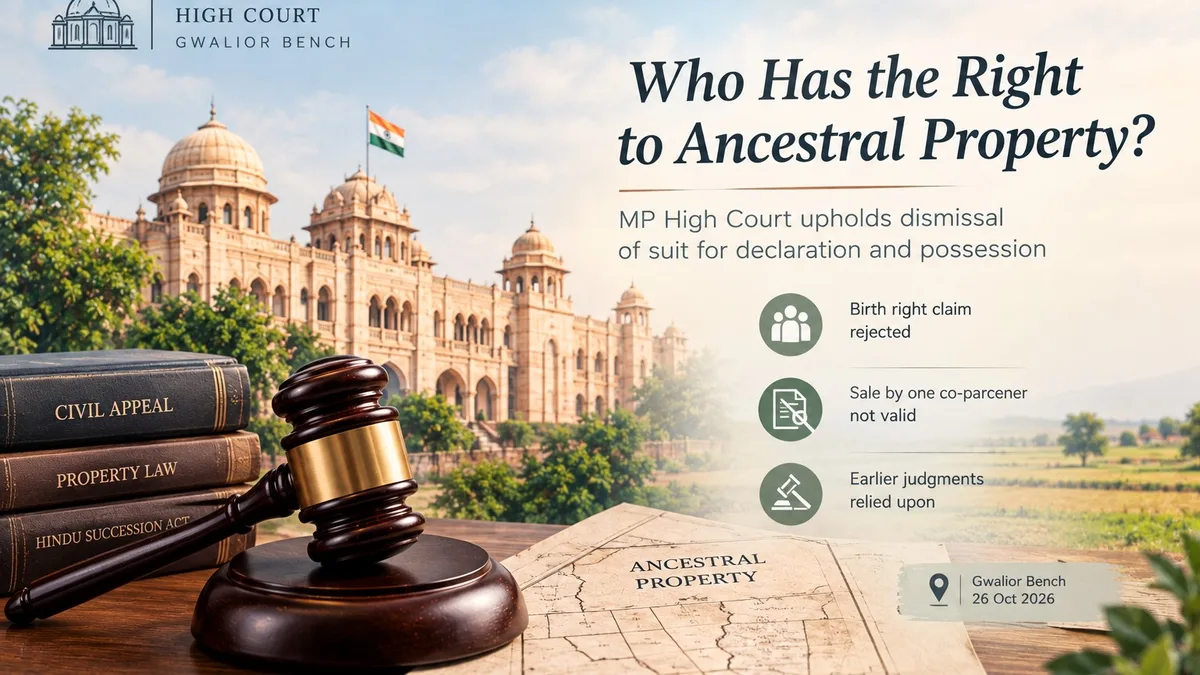
Where the father received property in partition from his own father and it thereby became his separate property, his wife and sons could not claim a present coparcenary share in it during his lifetime on the pleadings in this case.
Key Proposition: Where the father received property in partition from his own father and it thereby became his
separate property, his wife and sons could not claim a present coparcenary share in it during his lifetime on the
pleadings in this case.
- Hindu Succession Act, 1956 — Section 8 and principles governing inherited property — Whether property received by the father on partition remained coparcenary property in which descendants had a birthright — Held, no on the facts pleaded.
- Code of Civil Procedure, 1908 — Section 100 — Second appeal — Whether a substantial question of law arose — Held no.
- Hindu joint family property — Coparcenary and separate property — Suit for declaration, possession and injunction dismissed.
Background / Synopsis :
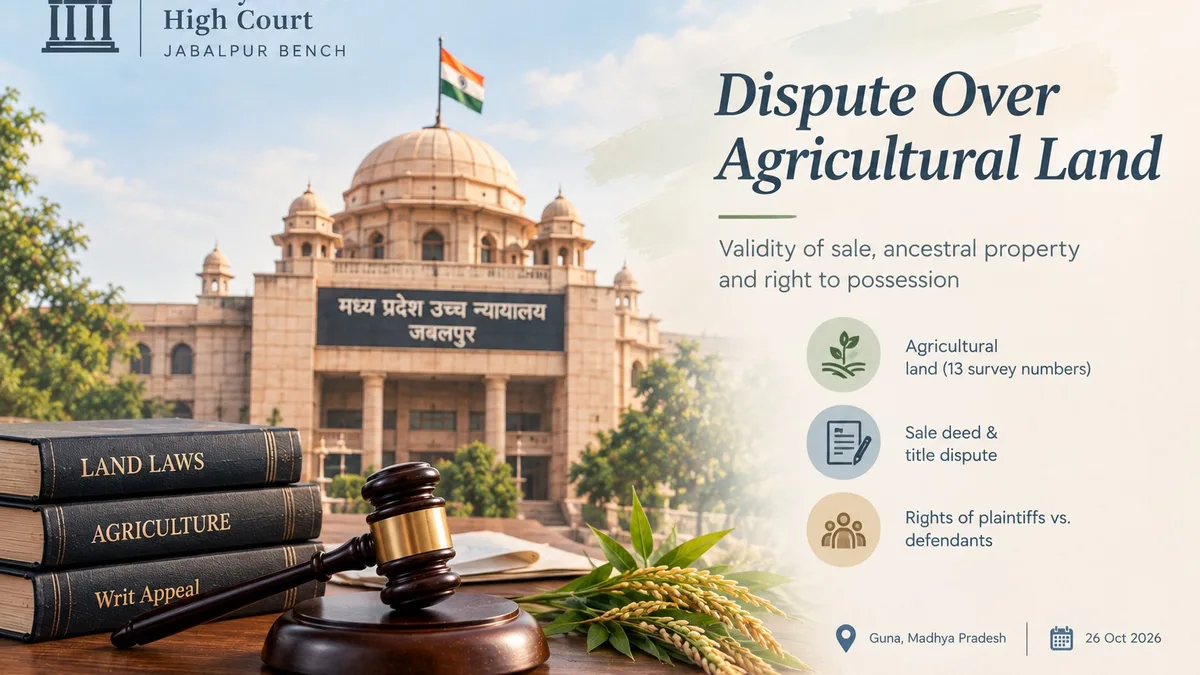
- The plaintiffs were the wife and sons of defendant No. 1. The disputed land comprised 13 survey numbers with a total are of 5.908 hectares in Baskhedi village, Guna district.
- The plaintiffs sought declaration of title and possession and a permanent injunction, asserting a share in land described as ancestral property. Their pleadings stated that defendant No. 1 had received the land in partition from his father.
- The trial court dismissed the suit on 17 May 2012. The First Additional District Judge, Guna, affirmed that decision on 16 May 2015. The plaintiffs then filed the second appeal.
Issues for Consideration :
- Whether the land received by defendant No. 1 in partition from his father remained coparcenary property in which the plaintiffs could claim a share during his lifetime.
- Whether the concurrent judgments disclosed any illegality or substantial question of law warranting interference under Section 100 CPC.
Submissions of Parties :
Petitioner / Appellant:
- The plaintiffs challenged the dismissal of their claim to title, possession and injunction and sought recognition of their share in the property.
- The arguments addressed the legal character of property received on partition and the effect of authorities concerning Hindu succession and coparcenary rights.
Respondent / State:
- The order does not record a detailed respondent-side argument beyond the defence of the judgments under appeal.
Court's Observations & Analysis :
Re: Issues considered
• The Court relied on the plaintiffs’ own pleading that defendant No. 1 received the property in partition from his father.
• On that footing, the property became the separate property of defendant No. 1; the plaintiffs could not claim a present share
in it during his lifetime merely by reason of their relationship.
• The Court upheld the appellate court’s conclusion, though for the reasons set out in its own analysis.
• Held: No substantial question of law arose and the second appeal was dismissed.
Notable Observations: None reproduced as a separate verbatim quotation.
Decision & Directions :
- The judgment and decree of the First Additional District Judge, Guna, were upheld.
- The second appeal was dismissed as devoid of a substantial question of law.
- Separate or dissenting opinion: None.
Legal Provisions Discussed & Precedents Cited :
- Hindu Succession Act, 1956 — Section 8 and related succession principles, as discussed in the judgment.
- Code of Civil Procedure, 1908 — Section 100: jurisdiction in second appeal, requiring a substantial question of law.
- Hindu law — distinction between coparcenary property and separate property received on partition.
- Uttam v. Saubhag Singh — discussed in relation to the legal character of property and succession under the Hindu Succession Act.
- Chander Sen — discussed concerning the status of property inherited under Section 8 of the Hindu Succession Act.
- Other precedents are discussed in the judgment; the summary identifies only the principal authorities evident in the operative reasoning.
Full Judgement / Attachment
Full Judgement
Frequently asked questions about Madhya Pradesh High Court
- Where does the Madhya Pradesh High Court sit and which areas does it cover?
- The Madhya Pradesh High Court has its principal seat at Jabalpur, with benches at Indore and Gwalior. It has jurisdiction over the State of Madhya Pradesh. It took its present form in 1956, when the State of Madhya Pradesh was reorganised.
- How do I check MP High Court cases at Jabalpur, Indore or Gwalior?
- The official website, mphc.gov.in, publishes bench-wise cause lists, case status and orders for the principal seat at Jabalpur and the Indore and Gwalior benches. Records are also on the eCourts High Court Services portal (hcservices.ecourts.gov.in).
- What kinds of cases does the MP High Court hear?
- It hears writs, civil and criminal appeals from across Madhya Pradesh, and income-tax appeals arising from the ITAT Jabalpur and Indore Benches. Cases are listed at the bench that has territorial jurisdiction over the district where they arise.
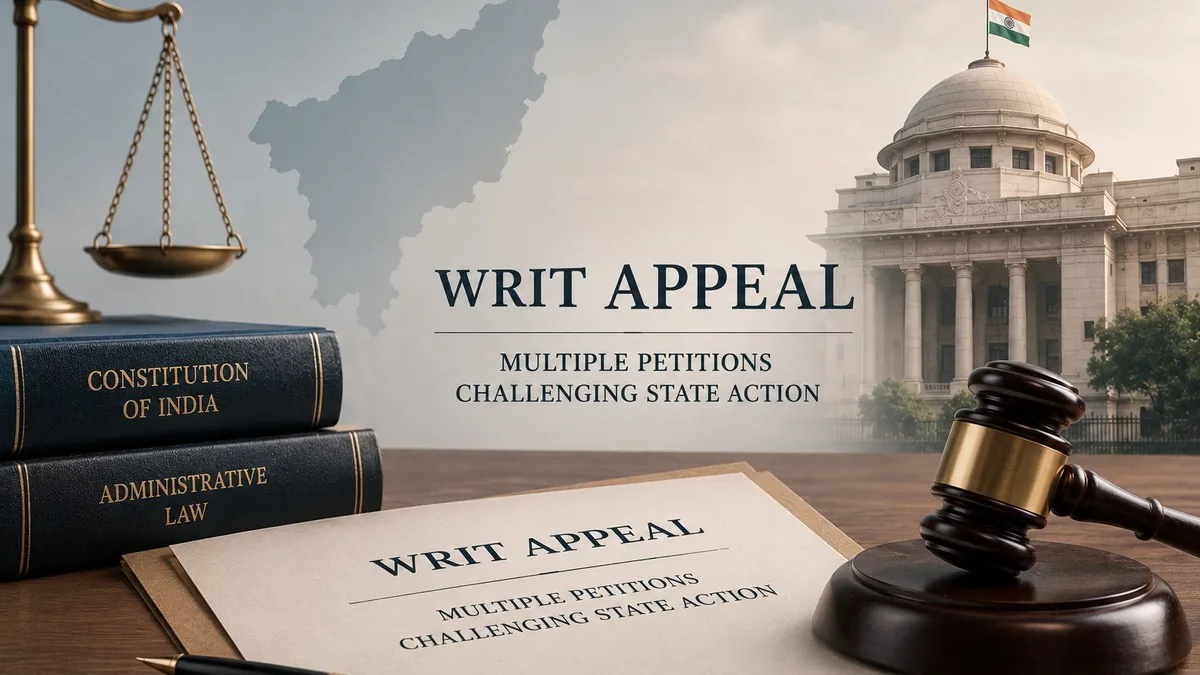
- What is a Writ Appeal in the MP High Court?
- Under the Madhya Pradesh Uchcha Nyayalaya (Khand Nyaya Peeth Ko Appeal) Adhiniyam, 2005, certain single-judge writ orders can be appealed to a Division Bench as a Writ Appeal. A final judgement can be taken to the Supreme Court by a Special Leave Petition under Article 136, ordinarily within 90 days.
- How can White Collar Professional help with a MP High Court matter?
- Post your requirement on White Collar Professional to receive proposals from verified Advocates, Chartered Accountants and Company Secretaries, compare them, and pay securely through the platform. This page also tracks the latest MP High Court judgements and legal updates as they are reported.