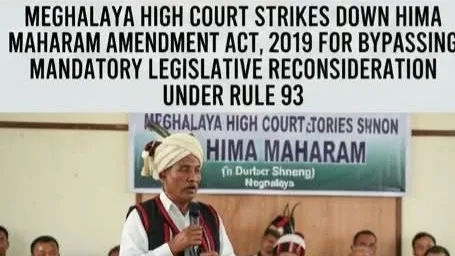
Meghalaya High Court Strikes Down Hima Maharam Amendment Act, 2019 for Bypassing Mandatory Legislative Reconsideration Under Rule 93
Court / Authority
Meghalaya High Court
Update / Judgement Date
17 Nov 2026
Date of Publication
19 Nov 2026
Case No.
Case Number WP(C) No. 383 of 2023
Source
WCP News Bulletin
Author
Soumya Gupta — WCP Legal Desk
Reading Time
10 min read
View Count
Background / Synopsis :
• The Khasi Hills Autonomous District (Nomination and Election of the Syiem, Deputy Syiem and Electors of Hima Maharam) Act, 2006 (Principal Act of 2006) was enacted under Paragraph 3 of the Sixth Schedule to the Constitution of India and published on 19 December 2006 after receiving the Governor's assent (Paras 2, 13).
• On 22 July 2019, the Deputy Chief Executive Member of the Khasi Hills Autonomous District Council (KHADC) notified the introduction of an Amendment Bill proposing to restrict the Principal Act in Raid Saw Symper to village administration (excluding land administration), equate the traditional post of Myntri with Rangbah Shnong (Headman), and fix a three-year term with election procedures for the post (Para 3).
• On 25 July 2019, the KHADC passed the Amendment Bill by voice vote during its Summer Session and notified it on 2 August 2019 (Paras 4, 8, 13).
• Following written objections submitted by the Maharam Syiemship against granting assent, the State Government's District Council Affairs Department (Respondent No. 2) informed the KHADC on 17 October 2019 and formally communicated on 15 February 2021 that the Bill had not received the Governor's assent and required reconsideration (Paras 4, 13, 15).
• After the KHADC clarified that the term 'land regulation' in Section 1(2) was a technical error for 'land administration', the State Law Department on 25 August 2023 advised omitting Clauses 2 and 3 of the Bill (Paras 4, 13).
• On 1 September 2023, the KHADC Executive Committee unilaterally agreed to the Law Department's observations, omitted Clause 2 while retaining Clauses 3 and 4, and resubmitted the modified Bill under Rule 92(1) of the Rules of 1951 without placing it before the full District Council (Paras 5, 8, 13, 17).
• The Amendment Act received the Governor's assent on 15 September 2023 and was published in the Extraordinary Gazette of Meghalaya on 26 September 2023, prompting the petitioners to file WP(C) No. 383 of 2023 seeking a declaration that the Amendment Act, 2019 was ultra vires (Paras 1-2, 13).
Issues For Consideration :
Whether the procedure established under Rules 92(2) and 93 of the Assam and Meghalaya Autonomous Districts (Constitution of District Councils) Rules, 1951 was followed in obtaining the Governor's assent, and whether deviation from such procedure rendered the Amendment Act, 2019 illegal, ab initio, and ultra vires.
Whether the High Court had jurisdiction to examine the validity of the legislative process and whether the Governor's assent granted to a modified Bill not placed before the House was invalid.
Submissions Of Parties :
Petitioner / Appellant:
• Under Rule 73(2) of the Rules of 1951, the Amendment Bill of 2019 was introduced without consulting the Dorbar Hima, contrary to the enactment process of the Principal Act of 2006 and traditional custom, as a Myntri in Maharam Syiemship was not equivalent to a Rangbah Shnong (Headman) (Para 3).
• The return of the Bill by the Governor for reconsideration was a formal statutory act under Rule 93 of the Rules of 1951, requiring the Chairman of the House to place the returned Bill and recommended modifications before the full District Council for fresh discussion and voting in the same manner as a new Bill (Paras 4-5).
• The Executive Committee acted beyond its authority by selectively omitting Clause 2 while retaining Clause 3 (contrary to the Law Department's advice) and bypassing the full House, thereby usurping the legislative function of the Council after a gap of over four years (Paras 4-5).
• Relied on Atiabari Tea Co. Ltd. v. State of Assam, AIR 1960 SC 232; Kihoto Hollohan v. Zachillhu, 1992 Supp (2) SCC 651; Supreme Court Advocates-on-Record Association v. Union of India, (2016) 5 SCC 1; Dr. D.C. Wadhwa v. State of Bihar, (1987) 1 SCC 378; Kaiser-I-Hind Pvt. Ltd. v. National Textile Corporation, (2002) 8 SCC 182; and State of Tamil Nadu v. Governor of Tamil Nadu, (2025) 8 SCC 1 (Para 6).
Respondent / State:
• Respondents Nos. 3 to 7 (KHADC) argued that the vires of an Act could be challenged only for lack of legislative competence or violation of fundamental rights, neither of which was pleaded, and that lack of consultation was not a ground to invalidate legislation enacted under Paragraph 3(1)(g) of the Sixth Schedule (Para 7).
• Contended that Rule 93 of the Rules of 1951 was not triggered because the Bill was not formally returned by the Governor with a specific message, but merely carried non-binding administrative observations from the State Law Department dated 25 August 2023 (Paras 7-8).
• Submitted that the Bill had already been passed by voice vote on 25 July 2019, the subsequent corrections (such as changing 'Regulation' to 'Land Administration') were purely clerical or cosmetic, and judicial review was barred under Articles 122 and 212 of the Constitution, relying on Raja Ram Pal v. Hon'ble Speaker, Lok Sabha, (2007) 3 SCC 184 (Paras 8-9).
• Respondents Nos. 1 and 2 (State of Meghalaya) supported the KHADC's arguments on presumption of constitutionality and relied on In Re: Assent, Withholding or Reservation of Bills by the Governor and the President of India, (2026) 1 SCC 1, submitting that Articles 111 and 200 contained no rigid timelines and that the Governor's discretionary decisions under Article 163 were final (Para 10).
Court's Observations & Analysis :
Re: Issue (i) - Compliance with Mandatory Legislative Procedure under Rule 93
• The Court examined Rules 92(2) and 93 of the Rules of 1951 and noted that Rule 93 mandated that when a passed Bill submitted to the Governor under Rule 92(2)(iii) was returned for reconsideration or with recommended amendments, the Chairman had to put those points or amendments before the Council to be discussed and voted upon before re-presentation to the Governor (Paras 14-15).
• Rejecting the KHADC's defence that the return was a mere internal administrative exchange from the Law Department, the Court held that the withholding of assent communicated on 15 February 2021 followed by the return of the Bill on 25 August 2023 constituted a formal act contemplated under Rule 93 (Para 15).
• Relying on the KHADC's own letter dated 1 September 2023 (brought on record via additional affidavit), the Court found that the Executive Committee had unilaterally accepted the Law Department's observations and incorporated substantial amendments under Rule 92(1) without placing them before the Chairman or the House for discussion and vote (Para 17).
• The Court held that the modifications were not merely clerical and that the Executive Committee's unilateral action constituted a clear transgression of the executive into the legislative domain of the Council (Para 17).
• Held: The Amendment Act, 2019 suffered from a fatal departure from the mandatory legislative procedure prescribed under Rule 93 of the Rules of 1951 and was therefore ultra vires (Paras 15, 17-18).
Re: Issue (ii) - Scope of Judicial Review over Legislative Procedure
• Applying the principles laid down in Kihoto Hollohan v. Zachillhu, 1992 Supp (2) SCC 651, Supreme Court Advocates-on-Record Association v. Union of India, (2016) 5 SCC 1, and Kaiser-I-Hind Pvt. Ltd. v. National Textile Corporation, (2002) 8 SCC 182, the Court held that the validity of a law depended not only on legislative competence but also on adherence to mandatory constitutional and statutory modes of exercising legislative power (Para 16).
• The Court distinguished substantive illegality in the law-making process from mere procedural irregularities, holding that proceedings tainted by substantive illegality were not shielded from judicial scrutiny under Article 122(1) of the Constitution (Para 16).
• Authorities relied upon by the respondents concerning general presumptions of validity and legislative privilege could not override the explicit statutory mandate of Rule 93 when a returned Bill was never re-tabled before the House (Para 16).
• Held: The Court possessed jurisdiction to review non-compliance with Rule 93, and the Governor's assent could not cure the substantive illegality of bypassing the District Council (Paras 16, 18).
Notable Observations: "This to the mind of the Court cannot be understood or taken to be a routine internal administrative exchange as sought to be made out by the respondents Nos. 3 to 7, that the Bill had not been returned by the Governor, but by the Law Department, which therefore, would not warrant the placing of the same before the House." (Para 15); "This letter in the opinion of this Court, clearly establishes the fact that the substantial amendments which were made, were not merely clerical as contended by the respondents Nos. 3 to 7, were never placed before the Chairman of the House for discussion or vote, which is a clear transgression of the executive into the legislative domain of the Council." (Para 17)
Decision & Directions :
• The writ petition was allowed and disposed of (Para 19).
• The Khasi Hills Autonomous District (Nomination and Election of the Syiem, Deputy Syiem and Electors of Hima Maharam) (Amendment) Act, 2019 (passed on 25 July 2019, assented to by the Governor on 15 September 2023, and published in the Gazette of Meghalaya on 26 September 2023) was declared ultra vires for violating the mandatory legislative procedure under Rule 93 of the Rules of 1951 (Para 18).
• Separate Opinions: None (Judgment delivered by H.S. Thangkhiew, J., concurred in by B. Bhattacharjee, J.).
Full Judgement / Attachment
Full Judgement
Frequently asked questions about Meghalaya High Court
- Where does the Meghalaya High Court sit and which areas does it cover?
- The Meghalaya High Court sits in Shillong. It has jurisdiction over the State of Meghalaya. It was established in March 2013, when separate High Courts were created for Meghalaya, Manipur and Tripura.
- Where are Meghalaya High Court orders published?
- Cause lists, orders and judgements of the High Court at Shillong are published on its official website, meghalayahighcourt.nic.in, and on the eCourts High Court Services portal (hcservices.ecourts.gov.in).
- What kinds of cases does the Meghalaya High Court hear?
- It hears writs, civil and criminal appeals from Meghalaya, including matters involving autonomous district councils under the Sixth Schedule and disputes over mining and land.
- How is a Meghalaya High Court single-judge order appealed?
- A single-judge writ order can be challenged by a Writ Appeal before a Division Bench. A final judgement can be taken to the Supreme Court by a Special Leave Petition under Article 136, ordinarily within 90 days.
- How can White Collar Professional help with a Meghalaya High Court matter?
- Post your requirement on White Collar Professional to receive proposals from verified Advocates, Chartered Accountants and Company Secretaries, compare them, and pay securely through the platform. This page also tracks the latest Meghalaya High Court judgements and legal updates as they are reported.