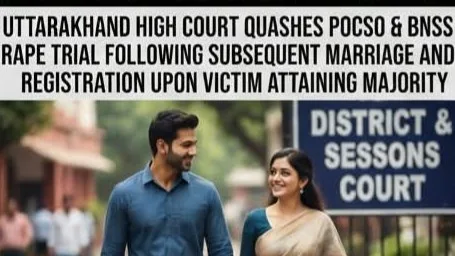
Uttarakhand High Court Quashes POCSO & BNSS Rape Trial Following Subsequent Marriage and UCC Registration Upon Victim Attaining Majority
Court / Authority
Uttarakhand High Court
Update / Judgement Date
16 Nov 2026
Date of Publication
19 Nov 2026
Case No.
C528/2514/2026 (Neutral Citation: 2026:UHC:10379)
Source
WCP News Bulletin
Author
Soumya Gupta — WCP Legal Desk
Reading Time
5 min read
View Count
Background / Synopsis :
• An FIR (Case Crime No. 02 of 2025) was registered at Police Station Thana Munsyari, District Pithoragarh, alleging that the applicant committed a wrongful act with the informant's minor daughter (Paras 4-5).
• Following investigation, a charge-sheet was filed, leading to Special Session Trial No. 37 of 2025 before the Special Sessions Judge, Pithoragarh, for offences punishable under Section 64 (mentioned as B.N.S.S. in the order) and Sections 3/4 of the POCSO Act (Paras 4-5).
• During the proceedings, the victim's statement under Section 183 of the BNSS was recorded, in which she stated that she and the applicant were in a love relationship (Para 6).
• Upon attaining the marriageable age (date of birth recorded as 18.07.2007), the victim and the applicant solemnized their marriage on 12.10.2026 according to Hindu rites and rituals, and registered the marriage under the Uniform Civil Code (UCC) (Para 7).
• The applicant filed Criminal Miscellaneous Application No. C528/2514/2026 alongside a joint compounding application (I.A. No. 1 of 2026) supported by affidavits of the applicant and the victim, seeking quashing of the entire trial proceedings (Paras 4, 8).
Issues For Consideration :
Whether the High Court should exercise its inherent jurisdiction under Section 528 of the BNSS to quash non-compoundable criminal proceedings under Section 64 and Sections 3/4 of the POCSO Act based on a voluntary compromise and subsequent lawful marriage between the applicant and the victim after she attained majority?
Submissions Of Parties :
Applicant:
• Submitted that the applicant was falsely implicated and that he and the victim were in a consensual romantic relationship, as corroborated by the victim's statement recorded under Section 183 of the BNSS (Para 6).
• Contended that the victim (born on 18.07.2007) attained marriageable age, married the applicant on 12.10.2026 as per Hindu rites, registered their marriage under the Uniform Civil Code (UCC), and is residing peacefully with him as husband and wife (Para 7).
• Relied on the joint compounding application (I.A. No. 1 of 2026) and supporting affidavits confirming that the dispute was amicably settled and that neither the complainant nor the victim wished to prosecute further (Para 8).
Respondent / State:
• Opposed the quashing application on the ground that the allegations involved serious and non-compoundable offences, particularly under the POCSO Act (Para 10).
• Did not dispute the factum of marriage between the applicant and the victim or the filing of the joint compounding application supported by their respective affidavits (Para 10).
Court's Observations & Analysis :
Re: Exercise of Inherent Jurisdiction under Section 528 BNSS to Quash Non-Compoundable Offences
• Upon interacting with the applicant and respondents via video conferencing, the Court noted the victim's categorical statement that the matter was amicably settled, that she married the applicant on 12.10.2026, and that they were living together peacefully (Paras 9, 12).
• The Court found that the dispute originated from a personal relationship and that the compromise entered into by the complainant and the victim was voluntary, genuine, and free from coercion or undue influence (Para 12).
• Acknowledging that the alleged offences were non-compoundable, the Court reiterated that under Section 528 of the BNSS (corresponding to Section 482 of the Code of Criminal Procedure, 1973), the High Court possesses wide inherent powers to quash criminal proceedings where the dispute is essentially personal or matrimonial in nature and continuation would be futile or amount to an abuse of the process of law (Paras 13-14).
• Applying the principles laid down by the Supreme Court in Gian Singh v. State of Punjab, Narinder Singh v. State of Punjab, and Parbatbhai Aahir v. State of Gujarat, the Court held that continuing the trial would serve no fruitful purpose and would adversely impact the couple's matrimonial life (Paras 14-15).
• Held: The compounding application was allowed and the proceedings in Special Session Trial No. 37 of 2025 were quashed to secure the ends of justice and prevent abuse of the process of the Court (Paras 16-18).
Notable Observations: None
Decision & Directions :
• Allowed the compounding application (I.A. No. 1 of 2026) (Para 17).
• Quashed the entire criminal proceedings of Special Session Trial No. 37 of 2025 (arising out of Case Crime No. 02 of 2025, P.S. Thana Munsyari, District Pithoragarh) pending before the Special Sessions Judge, Pithoragarh (Para 18).
• Allowed Criminal Miscellaneous Application No. C528/2514/2026 and disposed of all pending applications (Paras 19-20).
• Separate Opinions: None.
Full Judgement / Attachment
Full Judgement
Frequently asked questions about Uttarakhand High Court
- Where does the Uttarakhand High Court sit and which areas does it cover?
- The Uttarakhand High Court sits in Nainital; in 2026 the Supreme Court cleared the way for its relocation to Haldwani. It has jurisdiction over the State of Uttarakhand. It was established on 9 November 2000, when Uttarakhand was formed from Uttar Pradesh.
- Where are Uttarakhand High Court orders and cause lists published?
- The official website, highcourtofuttarakhand.gov.in, publishes cause lists, case status and judgements of the High Court at Nainital. Records are also on the eCourts High Court Services portal (hcservices.ecourts.gov.in).
- What kinds of cases does the Uttarakhand High Court hear?
- It hears writs on service, forest, environment and land matters, civil and criminal appeals from across Uttarakhand, and income-tax appeals arising from the ITAT Dehradun Circuit Bench.
- What is a Special Appeal in the Uttarakhand High Court?
- Following the Allahabad High Court practice it inherited, an intra-court appeal against certain single-judge orders is filed as a 'Special Appeal' before a Division Bench. A final judgement can be challenged by a Special Leave Petition under Article 136, ordinarily within 90 days.
- How can White Collar Professional help with a Uttarakhand High Court matter?
- Post your requirement on White Collar Professional to receive proposals from verified Advocates, Chartered Accountants and Company Secretaries, compare them, and pay securely through the platform. This page also tracks the latest Uttarakhand High Court judgements and legal updates as they are reported.