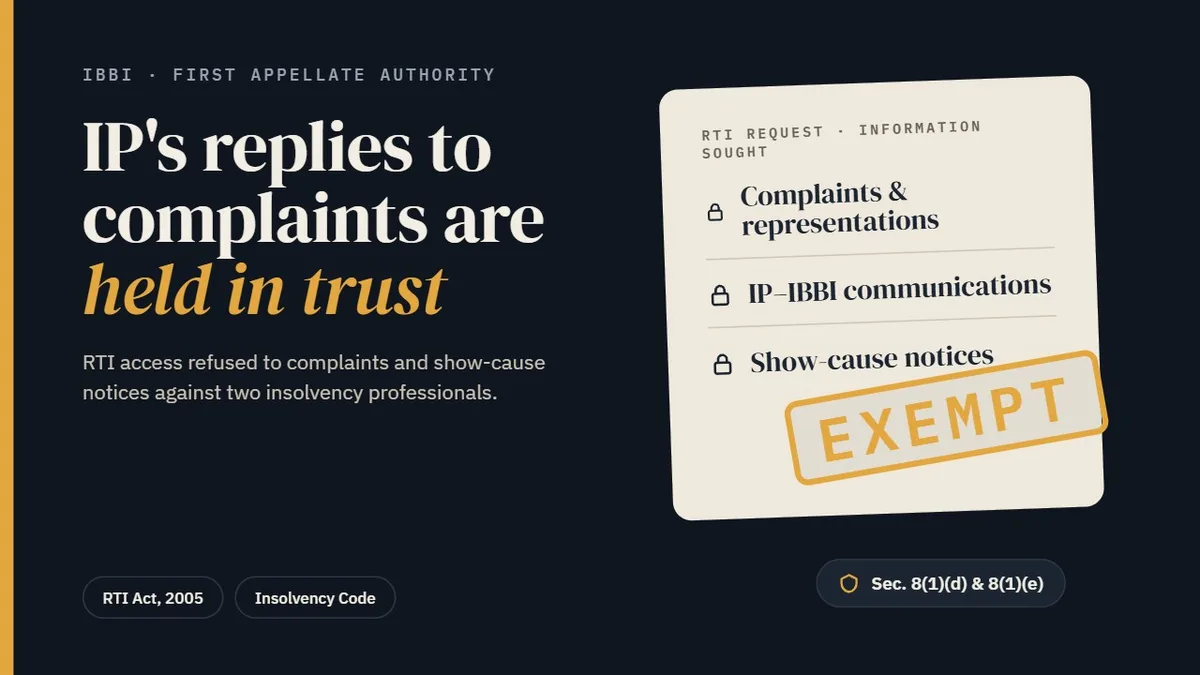
The appellant sought, under the RTI Act, records of complaints and representations received by IBBI, communications between IBBI and the insolvency professionals, and copies of…
Court / Authority
Delhi High Court
Update / Judgement Date
23 Nov 2026
Date of Publication
24 Nov 2026
Case No.
CRL.REF. 1/2026; CNR No. DLHC010085422026
Source
WCP News Bulletin
Author
Soumya Gupta — WCP Legal Desk
Reading Time
7 min read
View Count
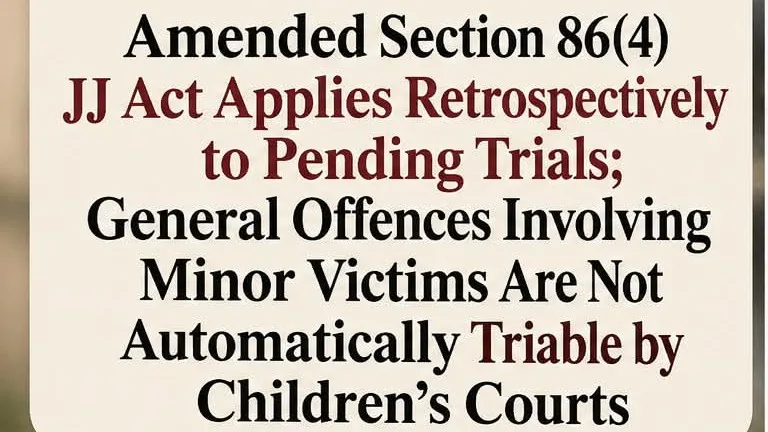
The Delhi High Court considered whether the 2021 amendment inserting Section 86(4) into the Juvenile Justice (Care and Protection of Children) Act, 2015 applied to trials already pending before Magistrates, and whether ordinary BNS/IPC offences became exclusively triable by Children’s Courts merely because a victim was a minor. The Court held that a change in trial forum is ordinarily procedural and retrospective unless a contrary legislative intention appears or the amendment curtails a vested substantive right. Since the amended provision expressly mandates that offences under the JJ Act be tried by the Children’s Court and does not curtail the accused’s right of appeal, it applies to pending trials, which must be transferred. However, Section 86(4) applies only to offences under the JJ Act; ordinary BNS/IPC offences involving a minor victim are not automatically triable exclusively by a Children’s Court under Section 25 of the CPCR Act. The reference was disposed of accordingly. (Paras 10–30)
Background / Synopsis :
● The reference arose from an order dated 24 January 2026 passed by the Additional Sessions Judge-06 (POCSO), South East District, Saket Court, in SC 741/2025, State v. Uday Kumar, arising out of FIR No. 479/2021, Police Station Lajpat Nagar.
● The referring court sought the High Court’s opinion under Section 436 of the Bharatiya Nagarik Suraksha Sanhita, 2023 (BNSS), corresponding to Section 395 of the Code of Criminal Procedure, 1973 (Cr.P.C.), on two questions concerning the amended Section 86 of the JJ Act and the jurisdiction of Children’s Courts.
● Before amendment, Section 86 classified offences under the JJ Act by punishment and assigned trial jurisdiction to a Children’s Court, a Magistrate of First Class, or any Magistrate. The Juvenile Justice Amendment Act No. 23 of 2021, effective from 1 September 2022, inserted Section 86(4), providing that offences under the JJ Act shall be triable by the Children’s Court.
● The referring court was concerned that transferring pending cases from Magistrates to Children’s Courts could alter the appellate forum for the accused and the State.
● The relief sought through the reference was an authoritative determination of the temporal operation of Section 86(4) and the forum for general offences under the BNS/IPC where a victim is a minor.
Issues For Consideration :
● Whether Section 86(4) of the JJ Act, 2015, inserted by the 2021 Amendment, operates retrospectively or prospectively.
● Whether general offences under the BNS/IPC, in which one of the victims is a minor, are offences against children under Section 2(b) read with Section 25 of the CPCR Act and must be tried by a Children’s Court.
Full Judgement / Attachment
Full Judgement
Submissions Of Parties :
Referring Court’s concern: The Additional Sessions Judge considered that transfer of pending trials from a Magistrate to a Children’s Court would change the appellate forum. The accused’s appeal would lie before the High Court rather than the Court of Sessions; the State’s appeal against acquittal would also be subject to a different forum and leave requirement. (Paras 9, 19–20)
Respondent / Union of India: The judgment records that the view ultimately taken by the High Court was in tune with the position canvassed by counsel for the Union of India and the Government of NCT of Delhi. It does not separately set out detailed submissions or individual arguments. (Para 29)
Petitioner / Amicus Curiae: Mr. Jai Sahai Endlaw was appointed as Amicus Curiae and assisted the Court. The judgment does not separately record a detailed list of submissions made on behalf of the amicus. (Paras 1, 31)
Court's Observations & Analysis :
Re: Issue 1 – Retrospective operation of Section 86(4)
● A change in the forum of trial is ordinarily procedural and is presumed to operate retrospectively unless a contrary legislative intention appears. An exception may arise where the change of forum is coupled with a change in a vested right of appeal or another substantive right. (Para 10)
● Relying on Hitendra Vishnu Thakur, the Court reiterated that statutes affecting substantive rights are generally prospective, while procedural statutes are generally retrospective; the right of appeal is substantive, whereas forum and procedure are ordinarily procedural. (Para 11)
● Neena Aneja and Mumtaz Yarud Dowla Wakf reaffirmed that amendments changing the forum ordinarily apply to pending proceedings unless the statute indicates otherwise. (Paras 12–14)
● The Court considered the exception discussed in Dhadi Sahu, but noted that Neena Aneja had doubted the proposition that a litigant acquires a vested right to a particular forum merely because proceedings have commenced. Pure changes in forum ordinarily affect pending proceedings unless a contrary intention appears. (Paras 15–16)
● Although the appellate forum changes, Section 101(5) of the JJ Act read with Section 415 BNSS / Section 374 Cr.P.C. does not curtail the accused’s right of appeal; only the forum shifts from the Court of Sessions to the High Court. (Para 19)
● The State’s appeal against acquittal would move from the Court of Sessions, where it could be filed without leave in the stated category of cases, to the High Court, where leave is required under Section 419(3) BNSS. The Court held this insufficient to disregard the clear legislative mandate in Section 86(4). (Para 20)
● The amended Section 86(4), using an overriding clause, clearly provides that offences under the JJ Act shall be triable by the Children’s Court. The Supreme Court’s reasoning in Ramesh Kumar Soni and the Kerala High Court decisions in Vaheeda and Mini Mathew supported retrospective application. (Paras 20–22)
Held: Section 86(4) applies retrospectively. Pending trials for offences under the JJ Act before Judicial Magistrates of the First Class under the unamended law must be transferred to the Children’s Court. (Para 23)
Re: Issue 2 – General offences involving a minor victim
● Section 86(4) is confined by its terms to ‘offences under this Act’, meaning offences under the JJ Act, 2015. It does not mandate transfer of ordinary BNS/IPC trials merely because a victim is a minor. (Para 25)
● Section 25 of the CPCR Act does not create an exclusive forum for all offences against children or violations of child rights. The CPCR Act does not define those expressions, and jurisdiction to try offences arises under the Cr.P.C./BNSS or the applicable special statute. (Para 26)
● The Court relied on Presiding Officer, Children’s Court and Sessions Judge, East-Nimar Khandwa v. Vinod S/o Kishanlal Gawli, which cautioned that treating every penal offence affecting a child as exclusively triable by a Children’s Court would lead to an impractical and absurd result. (Para 26)
Held: General offences under the BNS/IPC, even where one victim is a minor, are not exclusively triable by a Children’s Court under Section 25 of the CPCR Act unless another statute so provides. (Para 27)
Notable Observations: None.
Decision & Directions :
● Question 1 was answered in favour of retrospective operation: all trials for offences under the JJ Act pending before Judicial Magistrates of the First Class under the unamended Act are to be transferred to the Children’s Court by virtue of amended Section 86(4).
● Question 2 was answered in the negative: general offences under the BNS/IPC involving a minor victim are not exclusively triable by a Children’s Court established under Section 25 of the CPCR Act, unless another statute provides otherwise.
● The criminal reference was disposed of in the above terms.
● A copy of the judgment was directed to be communicated to the Reference Court for further proceedings in the matters pending before it.
● No order as to costs was stated.
● Separate Opinions: None. The judgment was authored by Navin Chawla, J., with Arun Bhardwaj, J., on the Division Bench
© 2026 White Collar Professional Technologies Pvt. Ltd. All rights reserved. CIN: U74999MH2024PTC000001
The appellant sought, under the RTI Act, records of complaints and representations received by IBBI, communications between IBBI and the insolvency professionals, and copies of…

IGNOU entrusted recruitment to 200 Junior Assistant-cum-Typist posts to NTA; after a computer-based test 25,094 candidates and a typing test 1,985 candidates , NTA declared 199…
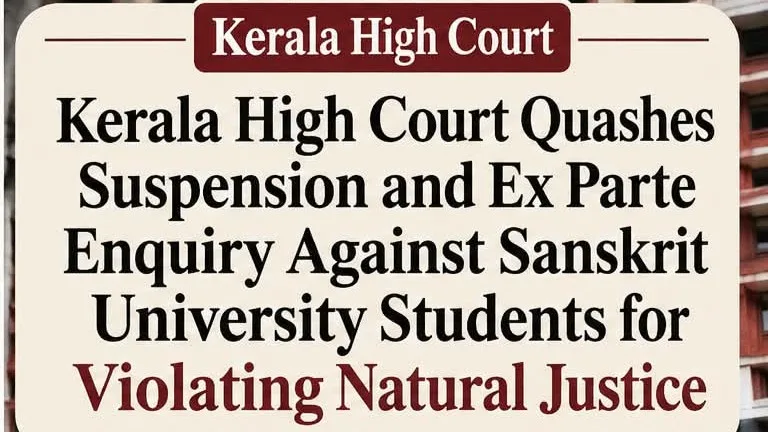
Sixteen students of Sree Sankaracharya University of Sanskrit, Kalady challenged their suspension and subsequent disciplinary punishments arising out of a campus protest during a…
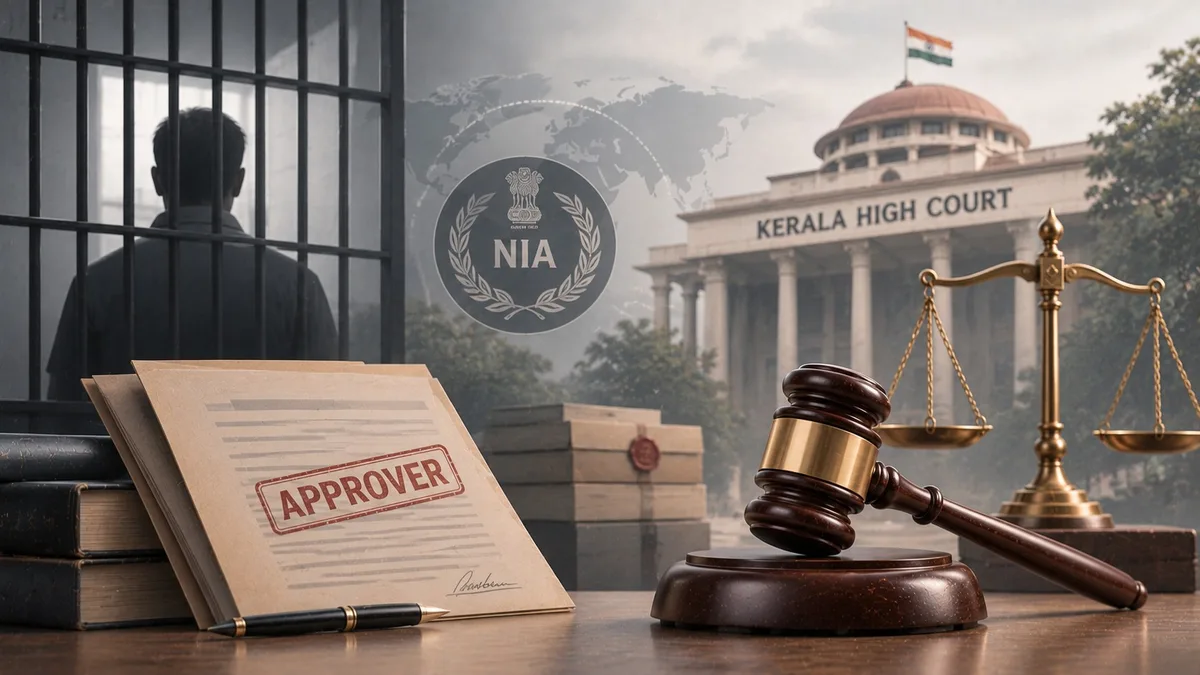
The Kerala High Court held that the custody requirement in Section 306 4 b of the Code of Criminal Procedure, 1973 CrPC applies to a pardon tendered by a Magistrate under Section…

National Testing Agency had applied an incorrect typing-speed threshold and the assessment required correction, the identified discrepancies did not establish that the…
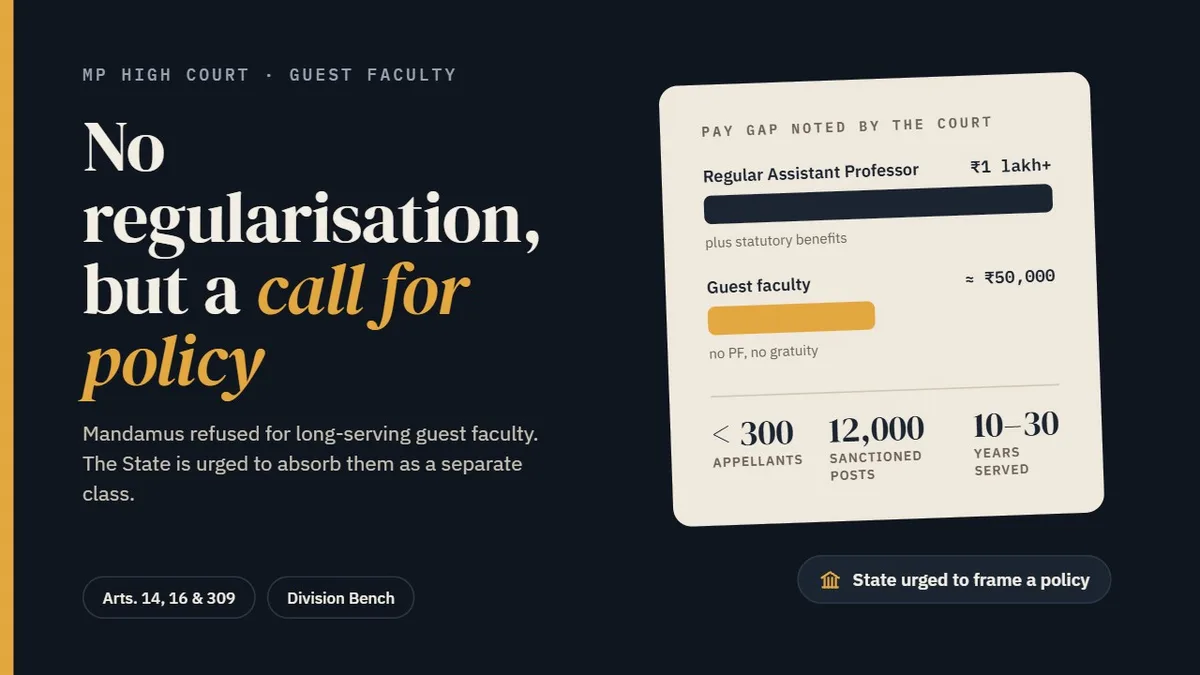
A batch of writ appeals was filed by guest faculty – Assistant Professors, Sports Officers and Librarians engaged after advertisement and selection and serving 10 to 30 years in…

Directorate of Enforcement, Mumbai Zonal Office-I | Draft Press Release | 23 November 2026 The Directorate of Enforcement's draft press release states that its Mumbai Zonal…

The Directorate of Enforcement's draft press release states that its Guwahati Zonal Office-I has provisionally attached movable and immovable properties valued at ₹70.09 lakh in a…

The National Company Law Tribunal, New Delhi Court-IV, approved a resolution plan valued at ₹30.90 crore for Shyam Indofab Private Limited on 8 September 2026. The plan, submitted…

The National Company Law Tribunal, Mumbai Bench-II, approved the resolution plan for Vivaan Multistructures Limited on 30 September 2026 under Section 31 1 of the Insolvency and…