
The Division Bench dismissed the connected writ appeals, while making a limited modification to the Single Judge’s findings concerning the Bar Council of Kerala. In light of…
Civil LawOther Legal Matters
21/11/20265 min read
Update / Judgement Date
12 Nov 2025
Source
WCP News Bulletin
Author
Sakshi Bhardwaj — WCP Legal Desk
Reading Time
3 min read
View Count
1
The Bombay High Court held that once ownership of agricultural land is conferred under Sections 32G and 32M of the Bombay Tenancy and Agricultural Lands Act, 1948, such ownership becomes exclusive and cannot be reopened through a civil suit for partition. The Court ruled that the civil court lacked jurisdiction under Sections 85 and 85-A of the Act, and the claim was also barred by limitation. Consequently, the Second Appeal filed by the appellant was allowed, and the judgments of the Trial Court and the District Court were set aside.
• The dispute pertained to agricultural lands situated in Uran, Raigad, Maharashtra (Survey Nos. 21, 22, and 29/1).
• The original tenant, Ramji Patil, died in 1949, and his wife Yenibai/Venibai was recorded as the protected tenant in 1952.
• Around 1957, Krishnabai (Appellant) was recorded as the kul (tenant), and in 1961, she acquired ownership through proceedings under Sections 32G and 32M of the Bombay Tenancy and Agricultural Lands Act, receiving a Sale Certificate in her name.
• In 2002, Savitribai (Respondent), her sister, filed a civil suit for partition, claiming the land was joint family property.
• The Trial Court decreed partition, and the District Court dismissed Krishnabai’s appeal. Hence, the present Second Appeal was filed before the High Court.
• The ownership was validly conferred upon Krishnabai in 1961 through a proper 32G and 32M process, and the Sale Certificate (Exhibit 38) conclusively established her title.
• There was no evidence that Krishnabai acted as a representative of the family or that the land was cultivated jointly.
• The respondents never challenged the 32G and 32M proceedings, the mutation entry, or the sale certificate for more than four decades, making their claim hopelessly delayed.
• The decision relied upon by the respondents, Ramakant Ganesh Naik v. Anusaya Shantaram Naik (2024 (3) Mh.L.J. 389), was found inapplicable, as in that case there was proof of joint cultivation, unlike here.
• The High Court emphasized that Sections 85 and 85-A of the Tenancy Act bar civil courts from reopening tenancy issues, which must be adjudicated exclusively by revenue authorities.
• The suit, filed in 2002, was therefore barred by limitation and beyond civil court jurisdiction.
• Ownership of the disputed land vested exclusively in the appellant, Krishnabai, in 1961 under Section 32M.
Legal Provisions Discussed:• The land ceased to be joint family property thereafter.
• The civil suit for partition was not maintainable due to statutory bar and delay.
• Second Appeal allowed — Judgments of the Trial Court and District Court set aside.
• Sections 32G & 32M, Bombay Tenancy and Agricultural Lands Act, 1948 – Conferment of ownership on tenants and issuance of Sale Certificate.
• Sections 85 & 85-A, Bombay Tenancy and Agricultural Lands Act, 1948 – Bar of Civil Court’s jurisdiction in tenancy matters.
• Article 65 & Article 110, Limitation Act, 1963 – Limitation for suits for possession and partition.
Citation: 2025:BHC-AS:48235
Case: Ajay Krishnabai Babya Navale v. Savitri Shankar Gharat (since deceased through LRs.) & Ors.
Court: High Court of Judicature at Bombay
Coram: Justice Milind N. Jadhav
Date of Decision: 12 November 2025
Case Type: Second Appeal No. 394 of 2017
© 2026 White Collar Professional Technologies Pvt. Ltd. All rights reserved. CIN: U74999MH2024PTC000001
The Division Bench dismissed the connected writ appeals, while making a limited modification to the Single Judge’s findings concerning the Bar Council of Kerala. In light of…

The High Court held that the trial court was not justified in directing the parties to undergo fresh DNA testing when the existing expert report had not been rejected for legally…

The High Court held that a subsequently communicated minimum 20% local-content requirement, including an indigenously developed EMS software condition, could not be…

The Division Bench held that the petitioner had been deprived of a reasonable opportunity to present its case before the Commissioner of Sales Tax. An adjournment request must be…

The High Court exercised its inherent jurisdiction to quash a POCSO FIR and the pending trial after obtaining independent reports verifying the parties’ marriage, family…

The Division Bench held that the writ court had exceeded the proper scope of the dispute between the supplier and KSBCL by deciding, in effect, the Revenue’s separate tax…

The High Court considered the petitioners’ request for regular bail in an Enforcement Directorate prosecution alleging money laundering under the Prevention of Money Laundering…

The High Court upheld the appellant’s conviction under Section 18 c of the NDPS Act for possession of opium but reduced the sentence of seven years’ rigorous imprisonment to the…

The High Court dismissed the State’s appeal against acquittal, holding that the trial court’s view was a reasonably possible view on the evidence and that material inconsistencies…
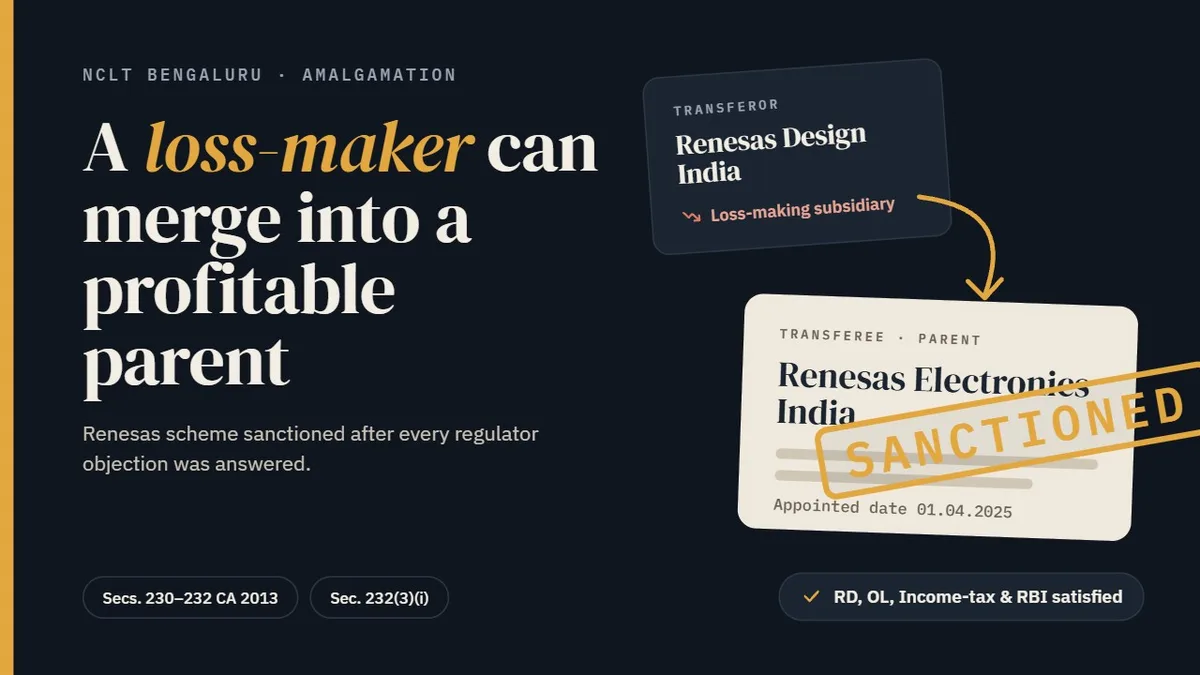
Renesas Design India Pvt. Ltd., a loss-making wholly owned subsidiary engaged in semiconductor design, and its parent Renesas Electronics India Pvt. Ltd. sought sanction of a…