
The Madhya Pradesh High Court directed that the petitioner’s bank account be unfrozen while preserving the disputed sum of ₹23,425.21 in a fixed deposit. Following earlier…
Banking
Court / Authority
Delhi High Court
Update / Judgement Date
18 Nov 2026
Date of Publication
23 Nov 2026
Case No.
W.P.(C) 11809/2022
Source
WCP News Bulletin
Author
Soumya Gupta — WCP Legal Desk
Reading Time
9 min read
View Count
Background / Synopsis :
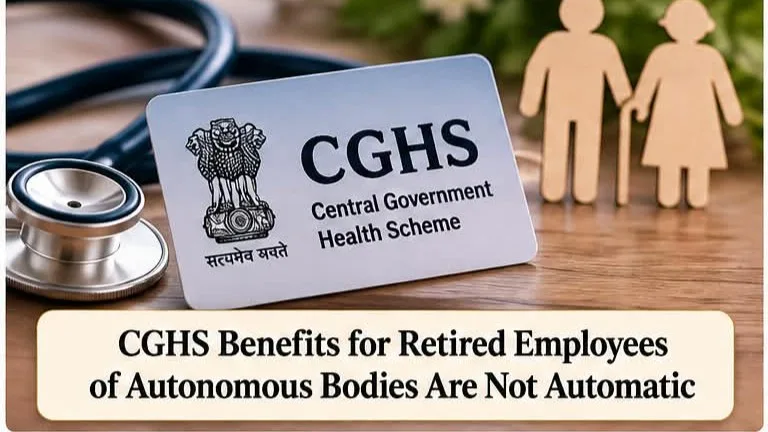
• The petitioner joined the Indian Institute of Public Administration (IIPA), Respondent No. 2, on 07.09.1981 and retired on 31.12.2019. During service, he availed CGHS facilities. (Paras 1–2)
• After retirement, CGHS benefits were not continued. By letter dated 21.05.2020, the petitioner sought continuation; IIPA replied that, as an autonomous organisation, only serving employees were eligible.
• The petitioner sought information from the Ministry of Health and Family Welfare under the Right to Information Act, 2005. In its response dated 22.06.2022, the Ministry stated that CGHS was primarily for Central Government employees and dependent family members, and that certain autonomous/statutory bodies could extend coverage subject to the OM dated 10.06.2014.
• The petitioner filed the writ petition seeking CGHS benefits for himself and similarly placed retired employees, contending that withdrawal after retirement was arbitrary and discriminatory.
• IIPA relied on an actuarial study dated 25.07.2023. Its counter-affidavit stated that there were 180 retired employees and 98 serving employees, and estimated a financial burden exceeding Rs. 20 crore over ten years if CGHS were extended to retirees. It also referred to its accumulated deficit exceeding Rs. 140 crore as at 31.03.2022. (Para 19)
• The impugned action was the non-continuation of CGHS after retirement and IIPA's decision not to forward a proposal under the OM dated 10.06.2014. The relief sought was a direction to extend CGHS facilities to the petitioner and other retired employees.
Issues For Consideration :
Full Judgement / Attachment
Full Judgement
• Whether prior CGHS coverage during service and long service with IIPA created an enforceable right to continuation of CGHS facilities after retirement.
• Whether paragraph 2 of the OM dated 10.06.2014, read with its conditions and paragraph 4, automatically entitled retired employees of an autonomous body to CGHS coverage.
• Whether the Court could direct IIPA to extend CGHS benefits or forward a proposal to the Ministry despite IIPA's asserted financial constraints.
• Whether the decisions concerning retired employees of CCRH, NMML and the School of Planning and Architecture required the same relief in the petitioner's case.
Submissions Of Parties :
Petitioner:
• He had served IIPA for over 38 years and had regularly availed CGHS during employment; discontinuation after retirement, when medical needs may be greater, was arbitrary and discriminatory.
• He relied on President, CCRH Scientists Welfare Assn. v. Union of India, 2011 SCC OnLine Del 1627, and submitted that the OM dated 10.06.2014 recognised extension of CGHS to retired employees of autonomous bodies.
• IIPA should not be permitted to defeat the benefit by refusing to forward a proposal to the Ministry, particularly when its serving employees were already covered and other autonomous bodies extended CGHS to retirees.
Respondent No. 1 and 3 (Union of India / Ministry):
• The OM dated 10.06.2014 required an autonomous/statutory body already covered for serving employees to accept the specified conditions and forward a proposal to the Ministry for consideration.
• No proposal had been received from IIPA for extending CGHS to its retired employees; consideration or further action could follow only after receipt of such a proposal.
Respondent No. 2 (IIPA):
• Government financial aid did not convert IIPA employees into Central Government servants or confer an automatic right to the same service benefits.
• The precedents relied on by the petitioner arose from materially different facts and service regulations, particularly the School of Planning and Architecture litigation.
• The OM was enabling, not mandatory. It required the autonomous body to bear medical expenses on a cost-to-cost basis, and the decision to opt in had to account for the organisation's financial position.
• The actuarial study projected a financial burden exceeding Rs. 20 crore over ten years. IIPA asserted that it lacked the resources to meet this liability and was already facing financial constraints.
Court's Observations & Analysis :
Re: Issue 1 – No enforceable post-retirement right from prior coverage
• The petitioner was a retired employee of an autonomous body, not a Central Government pensioner. Government funding or long service did not, by itself, confer parity with Central Government employees.
• The Court relied on State of Maharashtra v. Bhagwan, (2022) 4 SCC 193, for the principle that employees of autonomous bodies could not claim government service benefits as a matter of right merely because the institution received government funding or adopted government service rules.
• No service regulation or binding rule was shown that provided for continuation of CGHS after retirement. Prior receipt of the benefit during employment therefore did not create an enforceable post-retirement entitlement.
• Held: Long service and previous CGHS coverage did not establish a legal right to continuation after retirement. (Paras 10–11)
Re: Issue 2 – Construction of the OM dated 10.06.2014
• Paragraph 2 of the OM could not be read in isolation. Paragraph 3 imposed conditions, including cost-to-cost coverage, OPD facilities and medicines through CGHS Wellness Centres in Delhi/NCR, the autonomous body's responsibility for IPD/hospitalisation expenses at CGHS rates, and annual advance service charges and renewal.
• Paragraph 4 provided that bodies already covered for serving employees and desirous of extending benefits to retirees may accept the conditions and forward a proposal, with IFD approval/recommendation through the Administrative Ministry/Department, for consideration.
• The expressions 'desirous to extend' and 'may accept' reflected a structured choice for the autonomous body, taking account of the financial responsibilities involved.
• Coverage of serving employees was a necessary eligibility condition for the body to seek extension, but was not sufficient to create an automatic individual right in each retired employee.
• Held: The OM created a conditional mechanism, not an unconditional mandate to extend CGHS to all retirees of covered autonomous bodies. (Paras 13–18)
Re: Issue 3 – Financial policy and scope of judicial review
• IIPA's counter-affidavit relied on the actuarial study and its financial statements, including the projected burden of more than Rs. 20 crore over ten years and an accumulated deficit exceeding Rs. 140 crore as at 31.03.2022.
• Under the OM, the autonomous body itself had to bear the relevant medical expenses and costs. The Court held that it could not compel IIPA to assume this financial burden merely because the petitioner considered it manageable.
• The Court referred to J.K. Sawhney v. Punjab National Bank, 2010:DHC:4340-DB, and the principle that courts should be circumspect in directing formulation or implementation of policies with financial and economic implications.
• The discretion of the authorities had to be exercised fairly and without arbitrariness, but the Court could not substitute its assessment of desirability or affordability for that of the competent authorities.
• Held: No basis was shown for judicially compelling the policy choice or financial commitment sought by the petitioner. (Paras 19–20, 26)
Re: Issue 4 – Distinguishing the petitioner's precedents
• President, CCRH Scientists Welfare Assn. v. Union of India was based substantially on the earlier SPA Retired Employees' Welfare Association decision. The SPA matter involved service regulations entitling its retirees to medical facilities, and a differential treatment between employees retiring before and after 1992; the Supreme Court's order was confined to that factual setting.
• The Court noted that Union of India v. S. Srinivasa Rao, 2011:DHC:5650-DB, had observed that the CCRH decision followed SPA without noticing J.K. Sawhney, which treated CGHS coverage as a policy matter.
• The Court also relied on S.P. Mediratta & Ors. v. Union of India & Ors., 2024:DHC:2181-DB, where a Division Bench declined to direct extension of CGHS to retired employees of the Central Silk Board in view of resource constraints and the policy nature of the decision.
• The fact that some other autonomous bodies extended CGHS to retirees did not establish that their service regulations, funding structures or financial burdens were identical to IIPA's.
• Held: The earlier cases did not require the same relief on the facts and record of this petition. (Paras 21–27)
Notable Observations:
• “The coverage of serving employees under CGHS is therefore a necessary eligibility condition for the concerned autonomous body to seek extension of the facility to its retirees.” (Para 18)
• “the beneficial character of a scheme does not, by itself, confer an indefeasible or automatic right upon every retired employee of an autonomous body to claim its extension” (Para 25)
Decision & Directions :
• The Court held that no ground was made out to exercise jurisdiction under Article 226 of the Constitution of India.
• The writ petition, W.P.(C) 11809/2022, was dismissed. (Para 29)
• All pending applications were also disposed of. (Para 30)
• No separate compliance timeline, implementation direction or order as to costs was recorded in the operative paragraphs.
• Separate Opinions: None; the judgment was delivered by a Single Judge.
© 2026 White Collar Professional Technologies Pvt. Ltd. All rights reserved. CIN: U74999MH2024PTC000001
The Madhya Pradesh High Court directed that the petitioner’s bank account be unfrozen while preserving the disputed sum of ₹23,425.21 in a fixed deposit. Following earlier…

The Karnataka High Court quashed a private complaint, the Magistrate’s referral order and the resulting FIR alleging medical negligence against an eye hospital and its doctors.…

The Karnataka High Court allowed an appeal and granted anticipatory bail in a case invoking the SC/ST Prevention of Atrocities Act. The Court took note of the 13-day delay in…

The Karnataka High Court quashed criminal proceedings against two former Karnataka State Open University functionaries after holding that the Magistrate had exceeded jurisdiction…

The Orissa High Court held that a registering authority cannot refuse registration of an arbitral award in its entirety merely because one of the properties covered by the award…

The Bombay High Court granted bail to an accused charged in a dacoity case involving the MCOC Act, taking into account his limited alleged role as a lookout, the absence of…
Following an inter-corporate deposit of Rs. 1,00,00,000/- made by the complainant company to M/s. Tantia Constructions Limited, a cheque of Rs. 1,00,00,000/- issued towards…

Respondent no. 1 claimed marriage and cohabitation with the appellant, giving birth to respondent no. 2, while prior proceedings under Section 9 of the Hindu Marriage Act, 1955…

The appellant-plaintiff occupied Suit Property-I as a tenant and later sought specific performance of three Agreements to Sell dated 22.04.2017, 25.05.2017, and 30.12.2017,…
The applicant sought anticipatory bail in connection with a complaint filed before Paldi Police Station, Ahmedabad City alleging offences under Sections 316 and 318 of the…