
The Division Bench dismissed the connected writ appeals, while making a limited modification to the Single Judge’s findings concerning the Bar Council of Kerala. In light of…
Civil LawOther Legal Matters
21/11/20265 min read
Update / Judgement Date
29 Oct 2025
Source
WCP News Bulletin
Author
Sakshi Bhardwaj — WCP Legal Desk
Reading Time
3 min read
View Count
1
The Delhi High Court held that partial default in payment under a settlement in cheque dishonour cases under Section 138 of the Negotiable Instruments Act does not amount to contempt of court when the default is due to financial hardship and not wilful defiance. Observing that substantial amounts had already been paid and the respondent expressed genuine intent to comply, the Court granted time till December 2025 to clear remaining dues with interest, while clarifying that failure to comply would invite execution proceedings.
• The petitioner companies, Capital Buildcon Pvt. Ltd. and Krishna Buildtech Pvt. Ltd., filed complaints under Section 138 of the Negotiable Instruments Act, 1881 against Somesh Kumar Bishnoi for cheque dishonour of ₹5 crore and ₹2 crore, respectively.
• The accused was convicted and directed to pay compensation with interest. The Sessions Court later suspended his sentence on condition of depositing ₹5.62 crore and ₹2.25 crore.
• During proceedings under Section 482 CrPC, the parties entered a settlement on 27.12.2017 agreeing to payment of ₹5.45 crore in instalments.
• On 31.10.2018, the respondent filed an Affidavit of Undertaking, promising to pay ₹1.17 crore within 75 days, but cheques of ₹89.5 lakh and ₹15 lakh were dishonoured.
• The petitioner initiated contempt proceedings alleging wilful disobedience of the orders dated 22.10.2018 and 23.01.2019.
• The Court noted that most of the amount had already been paid and the respondent showed a bona fide intention to clear the remaining dues.
• Citing Kanwar Singh Saini v. High Court of Delhi (2012) 4 SCC 307 and Debabrata Bandhopadhyaya v. State of W.B., AIR 1969 SC 189, the Court held that wilful disobedience requires a deliberate and conscious act of defiance.
• Mere inability to pay due to financial constraints cannot be treated as contempt.
• The Court also referred to Dayawanti v. Yogesh Kumar Gosain (2017) and Lechamps (Sea) Pte. Ltd. v. Ashish Gupta (2024:DHC:631) to reiterate that contempt jurisdiction cannot be invoked for enforcing monetary undertakings unless disobedience is intentional.
• Considering the respondent’s cooperation and partial compliance, the Court deemed it appropriate to grant a final opportunity.
• The respondent was granted time till 31 December 2025 to pay the remaining dues with 12% interest, as per the earlier undertaking.
• In case of failure, the petitioner may initiate execution proceedings for recovery.
• The Court found no wilful or deliberate disobedience and accordingly disposed of the contempt petition.
• The connected CRL.M.C. Nos. 4511/2017 and 4516/2017 were directed to be listed on 17 February 2026 for further proceedings.
• Section 138, Negotiable Instruments Act, 1881 – Dishonour of cheque for insufficiency of funds.
• Section 482, Code of Criminal Procedure, 1973 – Inherent powers of High Court.
• Contempt of Courts Act, 1971 – Punishment for wilful disobedience of court orders.
Citation: 2025:DHC:80580
Case: Capital Buildcon Pvt. Ltd. v. Somesh Kumar Bishnoi
Connected Matters: CRL.M.C. 4511/2017 & CRL.M.C. 4516/2017 – Somesh Kumar Bishnoi v. Capital Buildcon Pvt. Ltd. & M/s Krishna Buildtech Pvt. Ltd.
Court: High Court of Delhi at New Delhi
Coram: Hon’ble Ms. Justice Neena Bansal Krishna
Date of Decision: 29 October 2025
Contempt Case (C) No.: 750 of 2019
© 2026 White Collar Professional Technologies Pvt. Ltd. All rights reserved. CIN: U74999MH2024PTC000001
The Division Bench dismissed the connected writ appeals, while making a limited modification to the Single Judge’s findings concerning the Bar Council of Kerala. In light of…

The High Court held that the trial court was not justified in directing the parties to undergo fresh DNA testing when the existing expert report had not been rejected for legally…

The High Court held that a subsequently communicated minimum 20% local-content requirement, including an indigenously developed EMS software condition, could not be…
The Division Bench held that the petitioner had been deprived of a reasonable opportunity to present its case before the Commissioner of Sales Tax. An adjournment request must be…

The High Court exercised its inherent jurisdiction to quash a POCSO FIR and the pending trial after obtaining independent reports verifying the parties’ marriage, family…

The Division Bench held that the writ court had exceeded the proper scope of the dispute between the supplier and KSBCL by deciding, in effect, the Revenue’s separate tax…

The High Court considered the petitioners’ request for regular bail in an Enforcement Directorate prosecution alleging money laundering under the Prevention of Money Laundering…

The High Court upheld the appellant’s conviction under Section 18 c of the NDPS Act for possession of opium but reduced the sentence of seven years’ rigorous imprisonment to the…

The High Court dismissed the State’s appeal against acquittal, holding that the trial court’s view was a reasonably possible view on the evidence and that material inconsistencies…
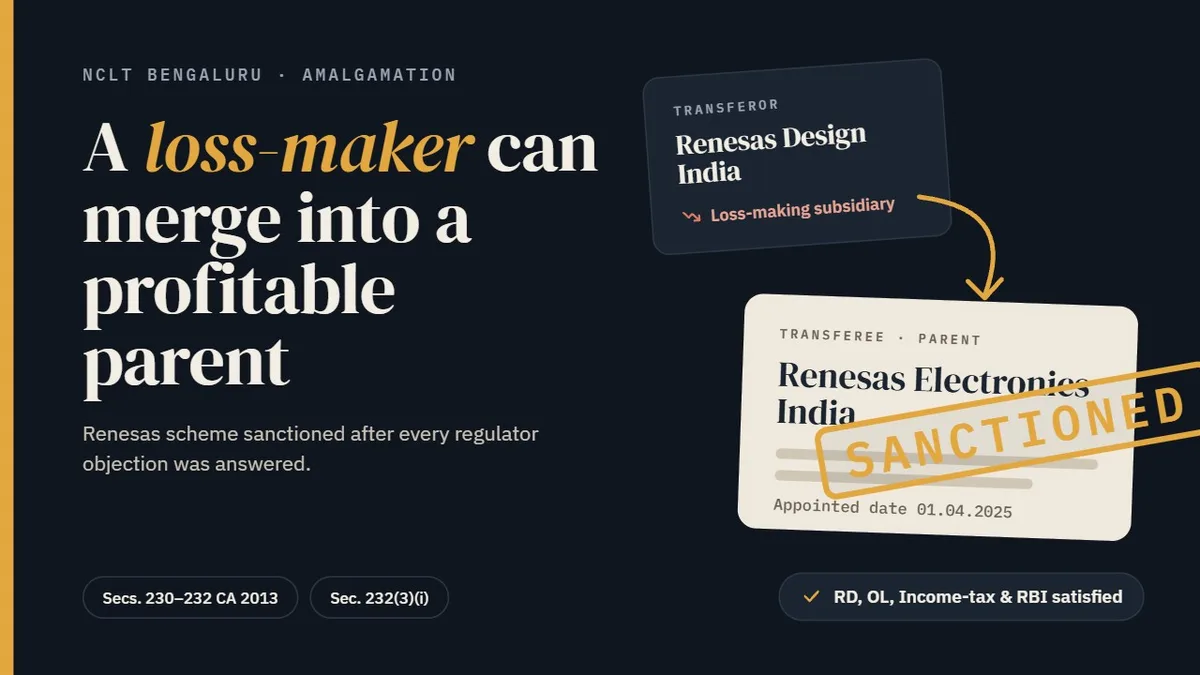
Renesas Design India Pvt. Ltd., a loss-making wholly owned subsidiary engaged in semiconductor design, and its parent Renesas Electronics India Pvt. Ltd. sought sanction of a…