
The Division Bench dismissed the connected writ appeals, while making a limited modification to the Single Judge’s findings concerning the Bar Council of Kerala. In light of…
Civil Law
Update / Judgement Date
31 Oct 2025
Source
WCP News Bulletin
Author
Sakshi Bhardwaj — WCP Legal Desk
Reading Time
4 min read
View Count
1
The Delhi High Court directed a re-examination of Shivam Pal, a candidate disqualified from the Agniveervayu Intake 01/2026 recruitment on the ground of “deranged liver function.” The Court held that mere abnormal liver function tests cannot be a ground for disqualification unless they indicate specific disqualifying liver conditions under Clause 83(b) of the Manual of Medical Examinations and Medical Boards issued by the Chief of the Air Staff. The Court ordered a fresh evaluation by a competent hepatologist/gastroenterologist at the Army Research and Referral Hospital (R&R Hospital), emphasizing adherence to the official medical fitness standards.
• The petitioner, Shivam Pal, was declared medically unfit for the Agniveervayu Intake 01/2026 due to alleged deranged liver function.
• The petitioner’s counsel, Mr. Tushar Swami, argued that the medical standards prescribed in the Manual of Medical Examinations and Medical Boards do not treat abnormal liver function tests as a standalone disqualification.
• Reliance was placed on the Delhi High Court’s earlier judgment dated 21 August 2025 in Thakur Sarthk Ajeet Singh v. Union of India (W.P.(C) 5475/2025), where similar issues were adjudicated.
• The petitioner pointed out that Clause 83(b) of the Manual specifies only certain liver conditions—such as fatty liver Grade II/III, space-occupying lesions, portal hypertension, or calcifications—as grounds for unfitness.
• The respondents, represented by Mr. Dhananjai Rana, CGSC, referred to Para 3.5.3 of the Manual, which outlines investigation procedures for liver diseases, but not specific disqualification criteria.
• The Bench clarified that Para 3.5.3 merely prescribes the procedure for evaluating candidates and does not define medical disqualification standards.
• The governing standards for assessing liver fitness are contained in Clause 83(b), which explicitly lists six disqualifying conditions.
• Therefore, a candidate cannot be rejected solely for abnormal liver function tests unless the findings correspond to one of the enumerated pathological categories.
• The Court found no evidence on record showing that the petitioner’s condition fell within these disqualifying parameters.
(i) The petitioner shall be re-examined by a Medical Board constituted by the Army Research and Referral Hospital (R&R Hospital), New Delhi.
Legal Provisions Discussed:Outcome:(ii) The Medical Superintendent of R&R Hospital shall ensure that the petitioner is examined by a qualified hepatologist/gastroenterologist.
(iii) The petitioner shall appear before the Medical Superintendent on 5 November 2025 at 10:30 AM.
(iv) The Board shall determine whether the petitioner’s medical condition falls under any of the disqualifications enumerated in Clause 83(b) of Section 4 of the Manual.
(v) If the R&R Hospital finds no disabling disqualification, the respondents shall proceed with the petitioner’s selection process accordingly.
(vi) The petitioner undertook to abide by the result of the R&R Hospital’s medical findings.
• Article 226, Constitution of India – Jurisdiction of High Courts to issue writs.
• Manual of Medical Examinations and Medical Boards, Chief of the Air Staff – Clause 83(b) (Liver conditions) and Para 3.5.3 (Liver disease procedures).
• Principles of Natural Justice – Fair opportunity for review and objective medical assessment.
The writ petition was disposed of with directions for re-examination by the Army R&R Hospital. The Court reaffirmed that abnormal liver test results alone cannot justify medical disqualification unless corroborated by clinical evidence of listed hepatic abnormalities. The decision upholds transparency and fairness in medical evaluation processes for defence recruitment.
Case: Shivam Pal v. Union of India & Ors.
Court: High Court of Delhi at New Delhi
Coram: Hon’ble Mr. Justice C. Hari Shankar and Hon’ble Mr. Justice Om Prakash Shukla
Date of Decision: 31 October 2025
Writ Petition (Civil) No.: 16249 of 2025
© 2026 White Collar Professional Technologies Pvt. Ltd. All rights reserved. CIN: U74999MH2024PTC000001
The Division Bench dismissed the connected writ appeals, while making a limited modification to the Single Judge’s findings concerning the Bar Council of Kerala. In light of…

The High Court held that the trial court was not justified in directing the parties to undergo fresh DNA testing when the existing expert report had not been rejected for legally…

The High Court held that a subsequently communicated minimum 20% local-content requirement, including an indigenously developed EMS software condition, could not be…
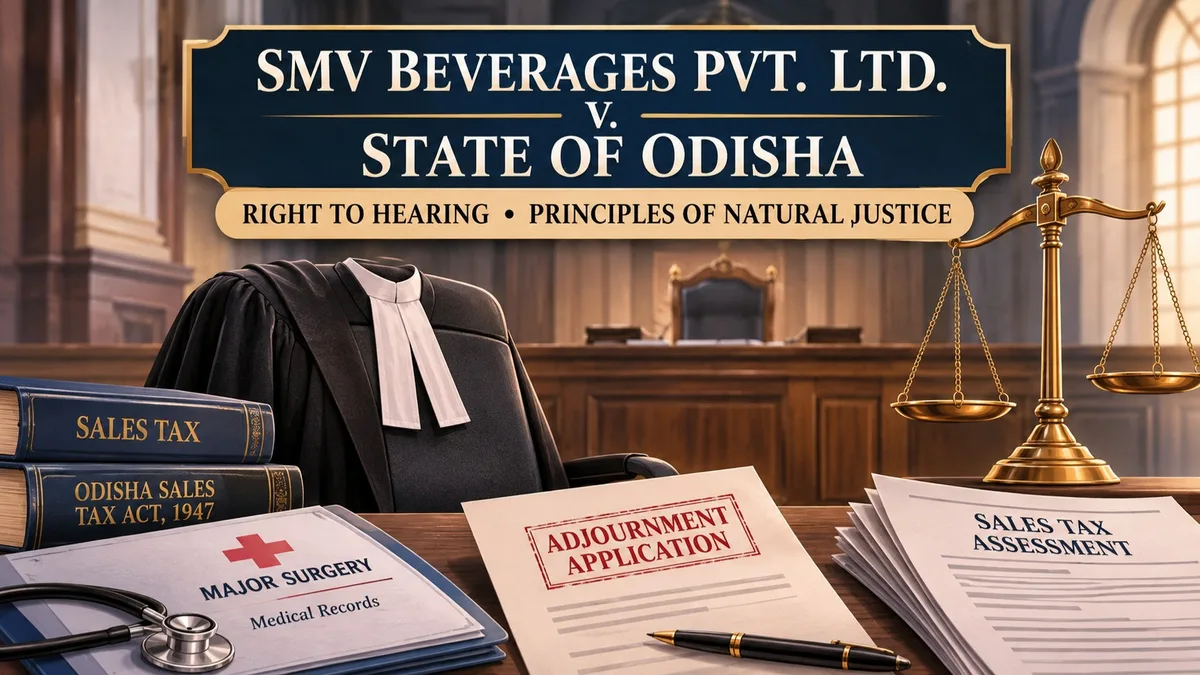
The Division Bench held that the petitioner had been deprived of a reasonable opportunity to present its case before the Commissioner of Sales Tax. An adjournment request must be…

The High Court exercised its inherent jurisdiction to quash a POCSO FIR and the pending trial after obtaining independent reports verifying the parties’ marriage, family…

The Division Bench held that the writ court had exceeded the proper scope of the dispute between the supplier and KSBCL by deciding, in effect, the Revenue’s separate tax…

The High Court considered the petitioners’ request for regular bail in an Enforcement Directorate prosecution alleging money laundering under the Prevention of Money Laundering…

The High Court upheld the appellant’s conviction under Section 18 c of the NDPS Act for possession of opium but reduced the sentence of seven years’ rigorous imprisonment to the…

The High Court dismissed the State’s appeal against acquittal, holding that the trial court’s view was a reasonably possible view on the evidence and that material inconsistencies…
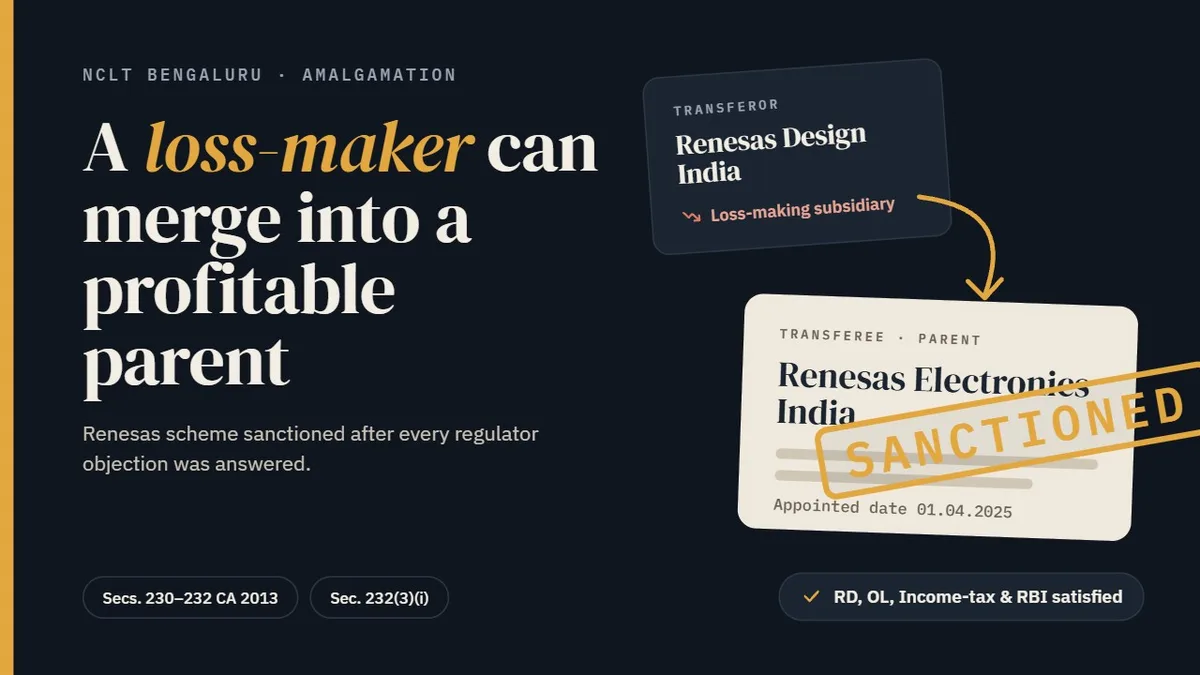
Renesas Design India Pvt. Ltd., a loss-making wholly owned subsidiary engaged in semiconductor design, and its parent Renesas Electronics India Pvt. Ltd. sought sanction of a…