
The Division Bench dismissed the connected writ appeals, while making a limited modification to the Single Judge’s findings concerning the Bar Council of Kerala. In light of…
Civil LawOther Legal Matters
21/11/20265 min read
Update / Judgement Date
02 Nov 2025
Source
WCP News Bulletin
Author
Sakshi Bhardwaj — WCP Legal Desk
Reading Time
4 min read
View Count
1

The Enforcement Directorate (ED) provisionally attached 42 properties valued at over ₹3,083 crore belonging to the Reliance Anil Ambani Group and its associated entities under Section 5(1) of the Prevention of Money Laundering Act (PMLA), 2002. The assets, spread across multiple cities including Mumbai, Delhi, Noida, Ghaziabad, Pune, Thane, Hyderabad, Chennai, and East Godavari, include the Ambani family’s Pali Hill residence and the Reliance Centre in New Delhi. The action follows an extensive probe into large-scale diversion and laundering of public funds borrowed from banks by various Reliance group companies, including Reliance Communications Ltd., Reliance Home Finance Ltd. (RHFL), Reliance Commercial Finance Ltd. (RCFL), Reliance Infrastructure Ltd., and Reliance Power Ltd.
• Between 2010–12, Reliance group companies raised thousands of crores from Indian banks, with outstanding dues of around ₹19,694 crore that later turned non-performing.
• ED’s investigation uncovered diversion of over ₹13,600 crore for evergreening loans, ₹12,600 crore routed to connected parties, and ₹1,800 crore invested in mutual funds and FDs, later liquidated and rerouted to group entities.
• Multiple banks declared Reliance Communications’ accounts as fraudulent.
• Yes Bank invested ₹2,965 crore in RHFL and ₹2,045 crore in RCFL between 2017–19, which turned non-performing by 2019.
• Public money from Reliance Nippon Mutual Fund was allegedly routed indirectly through Yes Bank to circumvent SEBI conflict-of-interest rules, channeling funds into Anil Ambani group entities.
• The investigation revealed a systematic pattern of mala fide lending, where loans were sanctioned and disbursed before approvals or due diligence.
• Several loans were disbursed ahead of sanction, with documents backdated to create a false audit trail.
• Many borrowers were shell companies or related entities, having common directors, auditors, and office addresses with Reliance group firms.
• Funds were rapidly transferred between accounts within minutes, showing clear signs of layering and circular transactions to mask diversion of public funds.
• Loans intended for specific projects (e.g., Pali Hill property) were misused for general corporate purposes, with blank security schedules and fictitious appraisals.
• A parallel investigation under FEMA revealed that ₹40 crore was siphoned off from the Jaipur–Reengus highway project through shell companies to Dubai, linked to a larger hawala network exceeding ₹600 crore.
Properties Attached:Legal Provisions Discussed:Outcome:• Pali Hill Residence, Bandra (West), Mumbai – Ambani family home.
• Reliance Centre, Maharaja Ranjeet Singh Road, New Delhi.
• Multiple properties of Reliance Infrastructure Ltd. in Mumbai, Pune, Thane, Noida, Hyderabad, East Godavari, and Goa.
• Properties of Adhar Property Consultancy Pvt. Ltd., Mohanbir Hi-Tech Build Pvt. Ltd., Gamesa Investment Management Pvt. Ltd., Vihaan43 Realty Pvt. Ltd. (formerly Kunjbihari Developers Pvt. Ltd.), and Campion Properties Ltd.
• Assets include 29 flats in Chennai’s OMR area and land parcels in Ghaziabad and East Godavari.
• Section 5(1), Prevention of Money Laundering Act, 2002 (PMLA) – Power of provisional attachment of proceeds of crime.
• Foreign Exchange Management Act, 1999 (FEMA) – For related foreign remittance and hawala investigations.
• Companies Act, 2013 (Section 143(12)) – Fraud reporting by statutory auditors.
• SEBI Regulations – Prohibition of conflict-of-interest transactions between mutual funds and group companies.
Date of Action: 31 October 2025
Issued By: Directorate of Enforcement (ED)
Law Invoked: Section 5(1), Prevention of Money Laundering Act, 2002 (PMLA)
Press Release Date: 3 November 2025
© 2026 White Collar Professional Technologies Pvt. Ltd. All rights reserved. CIN: U74999MH2024PTC000001
The Division Bench dismissed the connected writ appeals, while making a limited modification to the Single Judge’s findings concerning the Bar Council of Kerala. In light of…

The High Court held that the trial court was not justified in directing the parties to undergo fresh DNA testing when the existing expert report had not been rejected for legally…

The High Court held that a subsequently communicated minimum 20% local-content requirement, including an indigenously developed EMS software condition, could not be…

The Division Bench held that the petitioner had been deprived of a reasonable opportunity to present its case before the Commissioner of Sales Tax. An adjournment request must be…

The High Court exercised its inherent jurisdiction to quash a POCSO FIR and the pending trial after obtaining independent reports verifying the parties’ marriage, family…

The Division Bench held that the writ court had exceeded the proper scope of the dispute between the supplier and KSBCL by deciding, in effect, the Revenue’s separate tax…

The High Court considered the petitioners’ request for regular bail in an Enforcement Directorate prosecution alleging money laundering under the Prevention of Money Laundering…

The High Court upheld the appellant’s conviction under Section 18 c of the NDPS Act for possession of opium but reduced the sentence of seven years’ rigorous imprisonment to the…

The High Court dismissed the State’s appeal against acquittal, holding that the trial court’s view was a reasonably possible view on the evidence and that material inconsistencies…
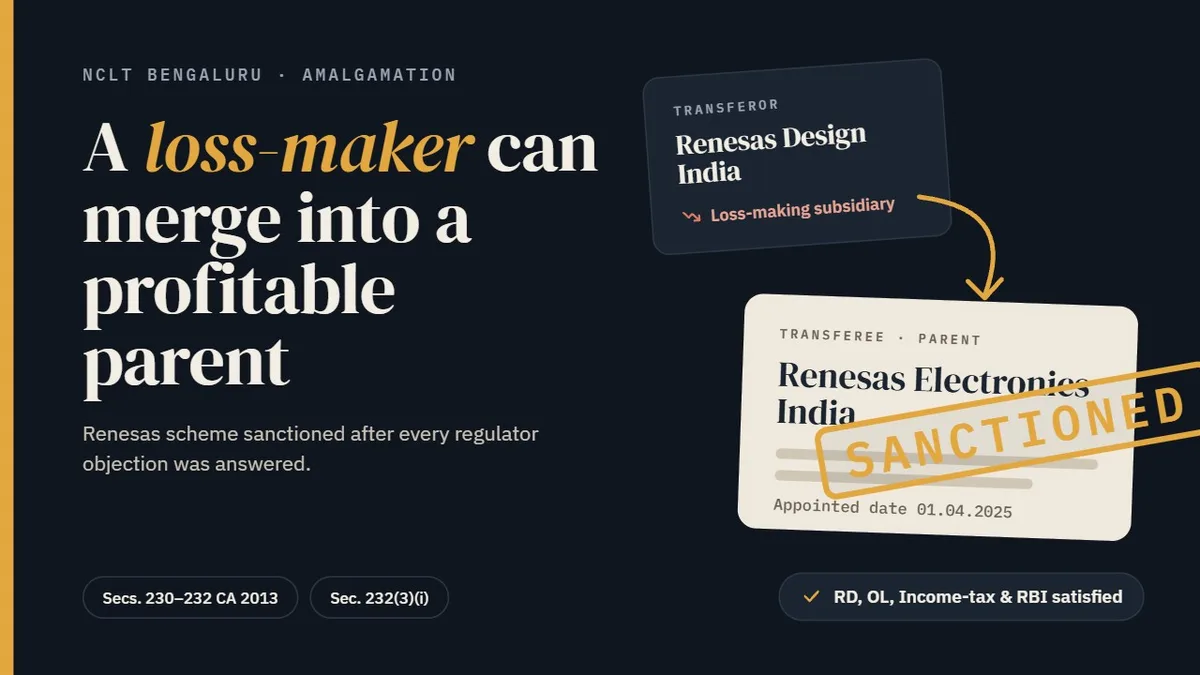
Renesas Design India Pvt. Ltd., a loss-making wholly owned subsidiary engaged in semiconductor design, and its parent Renesas Electronics India Pvt. Ltd. sought sanction of a…