
The Division Bench dismissed the connected writ appeals, while making a limited modification to the Single Judge’s findings concerning the Bar Council of Kerala. In light of…
Civil Law
Update / Judgement Date
03 Nov 2025
Source
WCP News Bulletin
Author
Sakshi Bhardwaj — WCP Legal Desk
Reading Time
3 min read
View Count
1

The Enforcement Directorate traced and provisionally attached assets and bank balances amounting to approximately ₹ 35.80 crore across more than 300 bank accounts which were found to be involved in illegal gambling and betting activities. The investigation revealed over 448 primary bank accounts opened with fraudulent documentation, which routed funds via more than 995 subsidiary accounts (1st layer) with transactions exceeding ₹ 1,000 crore, indicating a wide-scale racket. The attachment by ED under the provisions of the Prevention of Money Laundering Act, 2002 (PMLA) is aimed at frustrating further movement of illicit funds and coercing full investigative disclosure. The act of using “dummy” bank accounts for online betting and other illicit financial transactions was found to be systematic, and the ED has directed further investigation to map entities involved and identify beneficiaries.
• The investigation into Jitender Tejabhai Hiragar & Others uncovered a complex transaction chain used for high-volume banking transactions linked to online gambling and related illegal activity.
• Primary accounts (448 in number) were opened using false documentation and used to receive funds from betting and other illegal operations.
• These primary accounts transferred funds into a first layer of 995+ bank accounts; cumulatively these transactions crossed over ₹ 1,000 crore.
• The ED then located balances in 300+ bank accounts across multiple banks of roughly ₹ 35.80 crore which were attached by provisional order dated 03 November 2025.
• The case is ongoing, with ED noting further layers remain under scrutiny and investigations continue to identify the ultimate beneficial owners and flow beyond the first layer.
• The use of multiple “dummy” bank accounts to receive and transfer funds from illegal gambling and betting activities constituted proceeds of crime under PMLA.
• The value of transactions and the structure indicated money-laundering typologies (layering through many accounts) designed to obscure source and destination.
• The ED deemed it necessary to exercise its provisional attachment powers promptly to prevent dissipation of assets while investigation proceeds.
• The order underlined that even seemingly small accounts held by seemingly unconnected persons may form part of a larger funnel, and cumulative value and transaction velocity are relevant for attachment decisions.
• The ED emphasised that in digital-era financial frauds, monitoring and tracing layered transactions (including first-layer, second-layer accounts) is essential to successful enforcement and disruption of illicit financial networks.
Legal Provisions Discussed:• Section 3 and Section 4 of the Prevention of Money Laundering Act, 2002 (PMLA) – definition of “proceeds of crime”, powers of investigation, attachment of property.
• The concept of Provisional Attachment Order (PAO) under Section 5 of PMLA – enabling ED to attach property suspected to be proceeds of crime pending adjudication.
• Money-laundering typologies recognised under Indian law – opening of fraudulent bank accounts, layering of transactions, funneling of illicit funds via legal banking channels.
• Asset tracing and forensic accounting obligations in enforcement investigations – the importance of tracing multi-layer payments and ensuring no dissipation of assets.
• The interplay between banking regulations, financial-intelligence frameworks and criminal-law enforcement in preventing and disrupting illicit financial activity.
Citation: 2025:ED:PR:03.11.25
Case: Jitender Tejabhai Hiragar & Others — Attachment under the Proceeds of Crime (POC) / Provisional Attachment Order (PAO) dated 03 November 2025
Court / Agency: Director of Enforcement – Enforcement Directorate (India)
Date of Decision / Order: 03 November 2025
© 2026 White Collar Professional Technologies Pvt. Ltd. All rights reserved. CIN: U74999MH2024PTC000001
The Division Bench dismissed the connected writ appeals, while making a limited modification to the Single Judge’s findings concerning the Bar Council of Kerala. In light of…

The High Court held that the trial court was not justified in directing the parties to undergo fresh DNA testing when the existing expert report had not been rejected for legally…

The High Court held that a subsequently communicated minimum 20% local-content requirement, including an indigenously developed EMS software condition, could not be…

The Division Bench held that the petitioner had been deprived of a reasonable opportunity to present its case before the Commissioner of Sales Tax. An adjournment request must be…

The High Court exercised its inherent jurisdiction to quash a POCSO FIR and the pending trial after obtaining independent reports verifying the parties’ marriage, family…

The Division Bench held that the writ court had exceeded the proper scope of the dispute between the supplier and KSBCL by deciding, in effect, the Revenue’s separate tax…

The High Court considered the petitioners’ request for regular bail in an Enforcement Directorate prosecution alleging money laundering under the Prevention of Money Laundering…

The High Court upheld the appellant’s conviction under Section 18 c of the NDPS Act for possession of opium but reduced the sentence of seven years’ rigorous imprisonment to the…

The High Court dismissed the State’s appeal against acquittal, holding that the trial court’s view was a reasonably possible view on the evidence and that material inconsistencies…
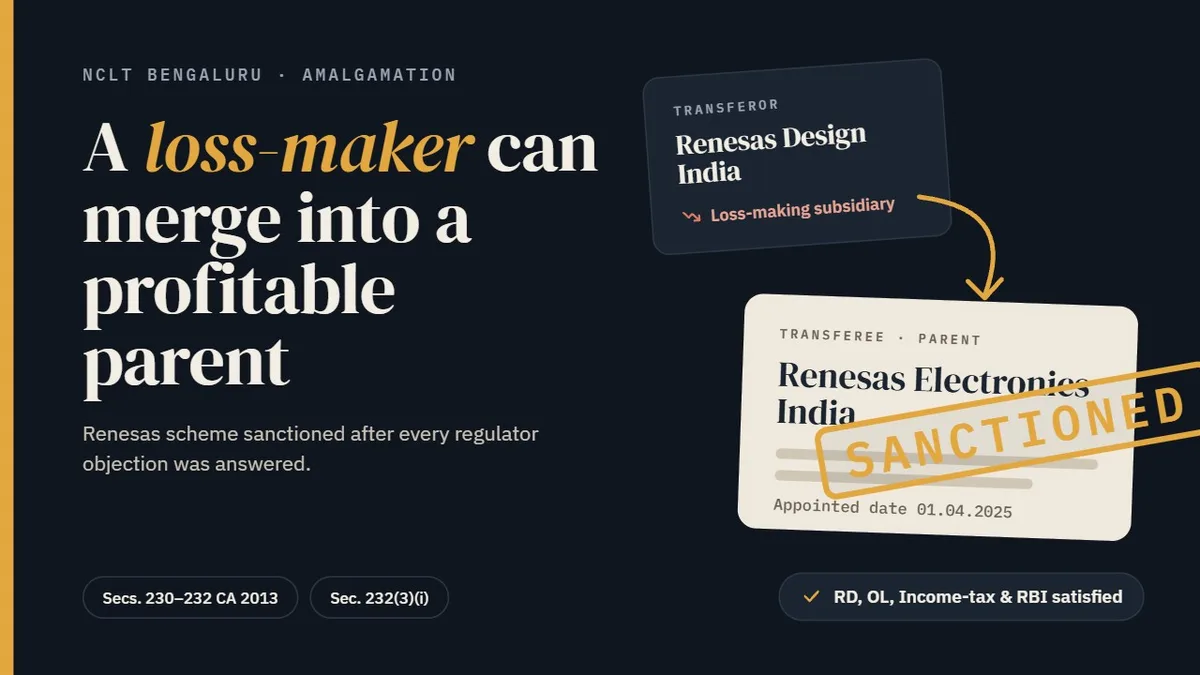
Renesas Design India Pvt. Ltd., a loss-making wholly owned subsidiary engaged in semiconductor design, and its parent Renesas Electronics India Pvt. Ltd. sought sanction of a…