
The Division Bench dismissed the connected writ appeals, while making a limited modification to the Single Judge’s findings concerning the Bar Council of Kerala. In light of…
Civil LawOther Legal Matters
21/11/20265 min read
Update / Judgement Date
27 Oct 2025
Source
WCP News Bulletin
Author
Sakshi Bhardwaj — WCP Legal Desk
Reading Time
3 min read
View Count
1
Headnote:
The Delhi Bench of the Income Tax Appellate Tribunal (ITAT) held that Customer Acquisition Cost incurred by Tata Teleservices Ltd. was revenue expenditure, not capital. The Tribunal observed that such costs — including porting charges, data entry expenses, and handset subsidies — were incurred in the regular course of business without creating any enduring asset or benefit. The disallowance made by the Assessing Officer and confirmed by the CIT(A) was deleted.
Background:
• The assessee filed a return declaring a loss of ₹324.29 crore, which was assessed at a reduced loss of ₹90.20 crore after disallowing ₹169.08 crore towards Customer Acquisition Cost (CAC).
• The Assessing Officer treated the CAC as capital expenditure, holding that it resulted in the acquisition of business rights and future economic benefits.
• The CIT(A) upheld the disallowance, relying on India Capital Markets (P) Ltd. and SKS Micro Finance Ltd., treating customer base as an intangible asset eligible for depreciation under Section 32(1)(ii).
• The assessee argued that the CAC was incurred for normal business operations, provided no enduring benefit, and had been consistently allowed as revenue expenditure in earlier and subsequent assessment years. Reliance was placed on SBI Cards & Payments (P) Ltd. (229 Taxman 356, Del HC) and Empire Jute Co. Ltd. (124 ITR 1, SC).
Tribunal’s Observations:
• The genuineness of the expenditure was not in dispute; the only issue was its classification as revenue or capital.
• The Tribunal distinguished earlier cases cited by the Revenue, noting that India Capital Markets (P) Ltd. and SKS Micro Finance Ltd. involved acquisition of customer bases through slump sale, unlike the present case where customers were acquired in the ordinary course of business.
• The AO’s approach was inconsistent — while treating handset subsidies as capital expenditure, he accepted the corresponding handset sale receipts as revenue.
• The expenditure on porting and data entry charges was of recurring nature and did not confer any enduring benefit.
• Relying on the coordinate bench’s earlier decisions in assessee’s own cases (AYs 2009–10 to 2016–17), the Tribunal held that the CAC was allowable as revenue expenditure.
Legal Provisions Discussed:
• Section 37(1), Income Tax Act, 1961 – Allowability of business expenditure.
• Section 32(1)(ii), Income Tax Act, 1961 – Depreciation on intangible assets.
• Relevant Case Laws:
– SBI Cards & Payments (P) Ltd. v. CIT (229 Taxman 356, Del HC)
– Empire Jute Co. Ltd. v. CIT (124 ITR 1, SC)
– Excel Industries Ltd. v. CIT (38 taxmann.com 100, SC)
– India Capital Markets (P) Ltd. (Mumbai ITAT)
– SKS Micro Finance Ltd. (Hyderabad ITAT)
Decision:
The ITAT allowed the appeal, holding that the Customer Acquisition Cost of ₹169.08 crore was revenue in nature and fully deductible under Section 37(1).
Citation: ITA No. 2549/Del/2024
Case: Tata Teleservices Limited v. Assistant Commissioner of Income Tax, Circle-25(1), New Delhi
Court: Income Tax Appellate Tribunal, Delhi Bench ‘C’
Coram: Shri Satbeer Singh Godara (Judicial Member) & Shri Avdhesh Kumar Mishra (Accountant Member)
Assessment Year: 2017–18
© 2026 White Collar Professional Technologies Pvt. Ltd. All rights reserved. CIN: U74999MH2024PTC000001
The Division Bench dismissed the connected writ appeals, while making a limited modification to the Single Judge’s findings concerning the Bar Council of Kerala. In light of…

The High Court held that the trial court was not justified in directing the parties to undergo fresh DNA testing when the existing expert report had not been rejected for legally…

The High Court held that a subsequently communicated minimum 20% local-content requirement, including an indigenously developed EMS software condition, could not be…

The Division Bench held that the petitioner had been deprived of a reasonable opportunity to present its case before the Commissioner of Sales Tax. An adjournment request must be…

The High Court exercised its inherent jurisdiction to quash a POCSO FIR and the pending trial after obtaining independent reports verifying the parties’ marriage, family…

The Division Bench held that the writ court had exceeded the proper scope of the dispute between the supplier and KSBCL by deciding, in effect, the Revenue’s separate tax…

The High Court considered the petitioners’ request for regular bail in an Enforcement Directorate prosecution alleging money laundering under the Prevention of Money Laundering…

The High Court upheld the appellant’s conviction under Section 18 c of the NDPS Act for possession of opium but reduced the sentence of seven years’ rigorous imprisonment to the…

The High Court dismissed the State’s appeal against acquittal, holding that the trial court’s view was a reasonably possible view on the evidence and that material inconsistencies…
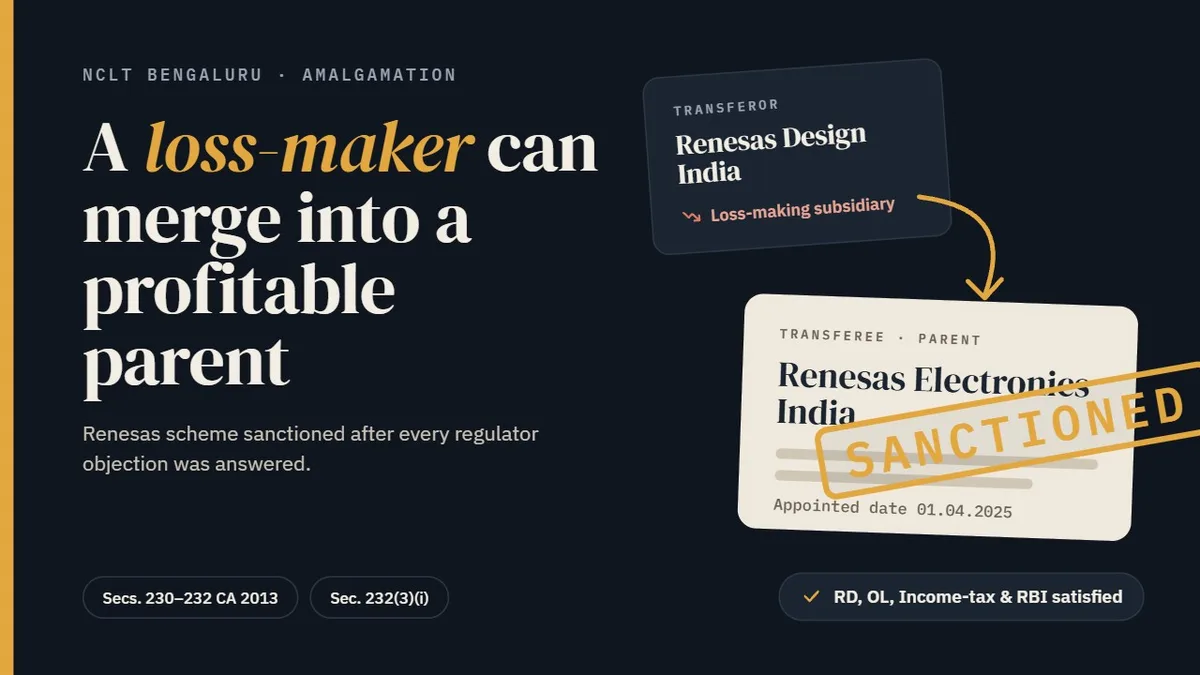
Renesas Design India Pvt. Ltd., a loss-making wholly owned subsidiary engaged in semiconductor design, and its parent Renesas Electronics India Pvt. Ltd. sought sanction of a…