Kerala High Court: Preventive Detention Set Aside for Detenu Already in Judicial Custody.
Update / Judgement Date
09 Nov 2025
Source
WCP News Bulletin
Author
Sakshi Bhardwaj — WCP Legal Desk
Reading Time
3 min read
View Count
1
Criminal LawOther Legal Matters
WCP News Bulletin
Headnote:
The Kerala High Court quashed a preventive detention order issued under Section 3(1) of the Kerala Anti-Social Activities (Prevention) Act, 2007 (KAA(P) Act) against a person already in judicial custody for the alleged “last prejudicial activity.” The Court held that for detention of such a person, the jurisdictional authority must satisfy a “triple test” established by the Supreme Court:
There is a real possibility of release on bail;
On release, the detenu would likely indulge in prejudicial activities;
Detention is essential to prevent repetition of criminal conduct.
Failure to record satisfaction on these points renders the detention order invalid.
Background:
Petitioner: Martha, mother of detenu Manoj (S/o Ayyanar).
Respondents: State of Kerala (Chief Secretary, Additional Chief Secretary (Home), District Magistrate, Deputy Commissioner of Police, Sub Inspector, Superintendent of Jail).
Detention Order: Issued 16.07.2025 under Section 3(1) KAA(P) Act, approved by government on 03.10.2025, for 6 months.
Reason for Detention: Manoj was classified as a “known rowdy” and involved in 9 prior cases; last prejudicial activity: Crime No. 112/2025, Eloor PS (Sections 303(2) r/w 3(5) of Bharatiya Nyaya Sanhita).
Manoj was already in judicial custody from 14.03.2025 for the last prejudicial activity.
Petitioner’s Argument:
Relied on Kamarunnissa v. Union of India [1991 (1) SCC 128], arguing that:
Preventive detention cannot be issued casually when the detenu is in judicial custody.
The authority must record satisfaction that there is a real possibility of bail and that the detenu, if released, would likely commit prejudicial acts.
Claimed that the impugned order (Ext.P2) did not mention the possibility of release on bail or the likelihood of re-offending.
Government’s Argument:
The learned Government Pleader contended:
All procedural formalities were complied with.
The detenu was a known rowdy, and preventive detention was necessary to deter repetition of criminal activities.
Awareness of judicial custody at the time of order does not invalidate detention.
Court’s Analysis:
A preventive detention order is a drastic measure affecting fundamental rights.
Decision:Legal Principles:
Judicial precedents (Kamarunnissa, Veeramani v. State of Tamil Nadu [1994 (2) SCC 337], Union of India v. Paul Manickam [2003 (8) SCC 342]) require that:
Detenu is actually in custody;
Authority must have reason to believe real possibility of bail exists;
Authority must have reason to believe that, if released, detenu would likely indulge in prejudicial activity, and detention is essential.
In the present case, the impugned order did not satisfy or record the necessary findings regarding possibility of release on bail and likelihood of re-offending.
Writ Petition Allowed.
Ext.P2 detention order set aside.
Superintendent of Central Jail, Kannur, directed to release Manoj immediately if detention is not required for any other case.
Registry directed to communicate the order forthwith.
Preventive detention of a person in judicial custody is permissible only if the “triple test” is satisfied.
Authorities must record reasons on the basis of reliable materials; mere awareness of custody is insufficient.
Fundamental rights implications: Preventive detention is extraordinary and cannot bypass procedural safeguards.
Outcome: Detention set aside; detenu released unless required for other legal proceedings.
Citation: 2025:KER:85089
Case:Martha v. State of Kerala & Ors.
Court: High Court of Kerala at Ernakulam
Coram: Dr. Justice A.K. Jayasankaran Nambiar & Justice Jobin Sebastian
The Division Bench dismissed the connected writ appeals, while making a limited modification to the Single Judge’s findings concerning the Bar Council of Kerala. In light of…
The High Court held that the trial court was not justified in directing the parties to undergo fresh DNA testing when the existing expert report had not been rejected for legally…
The High Court held that a subsequently communicated minimum 20% local-content requirement, including an indigenously developed EMS software condition, could not be…
The Division Bench held that the petitioner had been deprived of a reasonable opportunity to present its case before the Commissioner of Sales Tax. An adjournment request must be…
The High Court exercised its inherent jurisdiction to quash a POCSO FIR and the pending trial after obtaining independent reports verifying the parties’ marriage, family…
The Division Bench held that the writ court had exceeded the proper scope of the dispute between the supplier and KSBCL by deciding, in effect, the Revenue’s separate tax…
The High Court considered the petitioners’ request for regular bail in an Enforcement Directorate prosecution alleging money laundering under the Prevention of Money Laundering…
The High Court upheld the appellant’s conviction under Section 18 c of the NDPS Act for possession of opium but reduced the sentence of seven years’ rigorous imprisonment to the…
The High Court dismissed the State’s appeal against acquittal, holding that the trial court’s view was a reasonably possible view on the evidence and that material inconsistencies…
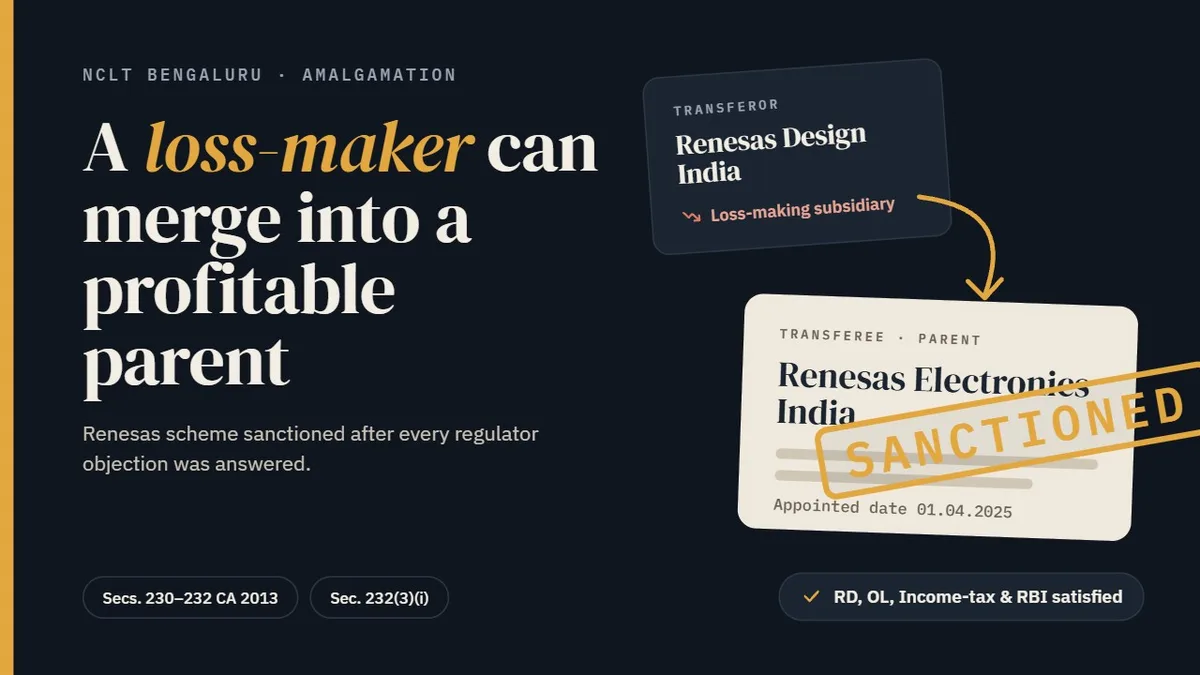
Renesas Design India Pvt. Ltd., a loss-making wholly owned subsidiary engaged in semiconductor design, and its parent Renesas Electronics India Pvt. Ltd. sought sanction of a…