
The Division Bench dismissed the connected writ appeals, while making a limited modification to the Single Judge’s findings concerning the Bar Council of Kerala. In light of…
Civil Law
Update / Judgement Date
16 Nov 2025
Source
WCP News Bulletin
Author
Sakshi Bhardwaj — WCP Legal Desk
Reading Time
4 min read
View Count
1
Headnote:
The Delhi Bench of the Income Tax Appellate Tribunal disposed of cross appeals filed by Punjab National Bank (PNB) and the Revenue concerning multiple issues, including set-off of carry-forward business losses, allowability of bad-debt deduction under Section 36(1)(vii), applicability of MAT under Section 115JB, disallowance under Section 14A, TDS credit under Section 194A relating to SARFAESI sales, and carry forward of long-term capital losses.
The Tribunal partly allowed PNB’s appeal for statistical purposes by restoring certain issues to the Assessing Officer for fresh examination. The Revenue’s appeal was dismissed in entirety, with the Tribunal affirming the CIT(A)'s findings that disallowance under Section 14A was not applicable to bank stock-in-trade investments and that TDS credit under Rule 37BA could not be denied when the income relating to SARFAESI recoveries was duly offered to tax.
Background:
PNB filed ITA No. 2712/DEL/2024 challenging denial of set-off of carry-forward business losses amounting to ₹47.15 crore for A.Y. 2018–19, along with additional grounds concerning deduction of bad debts under Section 36(1)(vii) without set-off against provisions under Section 36(1)(viia), and non-applicability of MAT u/s 115JB to banking companies.
The Revenue filed ITA No. 3039/DEL/2024 challenging deletion of:
Disallowance of ₹58.56 crore under Section 14A r/w Rule 8D,
Restriction of TDS credit under Section 194A where borrower properties were liquidated under SARFAESI,
Allowance of ₹53.11 crore as carried-forward long-term capital loss.
PNB argued that the NFAC as well as the AO failed to verify whether business losses were already allowed in earlier or later years, and further justified the claim for TDS credit on SARFAESI recoveries as interest income had been duly taxed.
The Revenue argued that Section 14A was mandatory where exempt income existed and that TDS credit could be denied if the related income was not assessed under “Capital Gains.”
Tribunal’s Observations:
Business Loss (₹47.15 crore)
The Tribunal found uncertainty regarding the factual allowance of these losses in A.Y. 2018-19 or later years. The issue was remanded to the AO for verification. If the losses were not granted earlier, the assessee must receive benefit in the present year.
Bad Debts & Section 115JB (Additional Grounds)
2712/DEL/2024 & 3039/DEL/2024 (A.Y. 2020–21)Though not raised before lower authorities, the Tribunal noted that both issues arise from the record and deserve adjudication in the interest of natural justice. Both matters were remanded to the AO for proper verification.
Section 14A Disallowance (Revenue’s Ground 1)
The Tribunal affirmed that investments held as stock-in-trade by banking companies are outside the scope of disallowance under Section 14A. The finding relied upon:
Maxopp Investment Ltd. v. CIT (SC),
South Indian Bank Ltd. v. CIT (SC),
Delhi High Court rulings in PNB’s own cases (2024).
Ground dismissed.
TDS Credit under Section 194A (Revenue’s Ground 2)
The Tribunal upheld CIT(A)’s detailed factual finding that PNB had offered relevant interest and charges from SARFAESI recoveries to tax, and therefore credit of ₹4.41 crore could not be denied merely because the income was not assessed under “Capital Gains.”
Revenue’s ground dismissed.
Long-Term Capital Loss (₹53.11 crore) (Revenue’s Ground 3)
The Tribunal held that since the AO had not specifically disallowed these losses in A.Y. 2019-20, and earlier scrutiny assessments had allowed such losses, denial was unjustified.
Ground dismissed.
Legal Provisions Discussed:
Section 36(1)(vii) & 36(1)(viia) – Deduction of bad debts and provisions for rural advances.
Section 115JB – Minimum Alternate Tax; applicability to banking companies.
Section 14A r/w Rule 8D – Disallowance of expenditure relating to exempt income.
Rule 37BA(2) – TDS credit to rightful recipient.
Section 194A – TDS on interest.
Section 143(3) – Scrutiny assessments and treatment of losses.
SARFAESI Act – Recovery mechanism for NPAs.
Case: Punjab National Bank v. Dy. Commissioner of Income Tax
Court: Income Tax Appellate Tribunal, Delhi ‘A’ Bench
Coram: Shri Satbeer Singh Godara (Judicial Member) & Shri Naveen Chandra (Accountant Member)
Date of Decision: 28 August 2025
© 2026 White Collar Professional Technologies Pvt. Ltd. All rights reserved. CIN: U74999MH2024PTC000001
The Division Bench dismissed the connected writ appeals, while making a limited modification to the Single Judge’s findings concerning the Bar Council of Kerala. In light of…

The High Court held that the trial court was not justified in directing the parties to undergo fresh DNA testing when the existing expert report had not been rejected for legally…

The High Court held that a subsequently communicated minimum 20% local-content requirement, including an indigenously developed EMS software condition, could not be…

The Division Bench held that the petitioner had been deprived of a reasonable opportunity to present its case before the Commissioner of Sales Tax. An adjournment request must be…

The High Court exercised its inherent jurisdiction to quash a POCSO FIR and the pending trial after obtaining independent reports verifying the parties’ marriage, family…

The Division Bench held that the writ court had exceeded the proper scope of the dispute between the supplier and KSBCL by deciding, in effect, the Revenue’s separate tax…

The High Court considered the petitioners’ request for regular bail in an Enforcement Directorate prosecution alleging money laundering under the Prevention of Money Laundering…

The High Court upheld the appellant’s conviction under Section 18 c of the NDPS Act for possession of opium but reduced the sentence of seven years’ rigorous imprisonment to the…

The High Court dismissed the State’s appeal against acquittal, holding that the trial court’s view was a reasonably possible view on the evidence and that material inconsistencies…
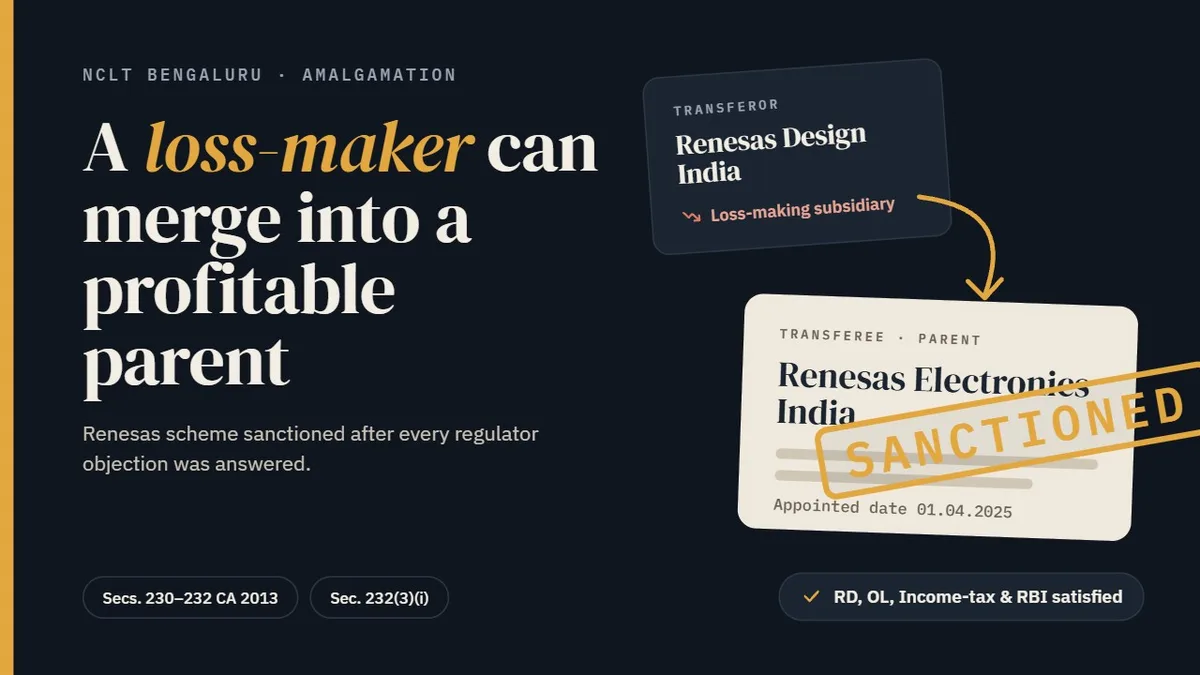
Renesas Design India Pvt. Ltd., a loss-making wholly owned subsidiary engaged in semiconductor design, and its parent Renesas Electronics India Pvt. Ltd. sought sanction of a…