Calcutta High Court Directs Dual Acceptance of Two Answers in LDA Examination and Orders Re-evaluation
Court / Authority
Calcutta High Court
Update / Judgement Date
13 Nov 2026
Date of Publication
16 Nov 2026
Case No.
APOT/136/2026
Source
WCP News Bulletin
Author
Dipanshi Bansal — WCP Legal Desk
Reading Time
7 min read
View Count
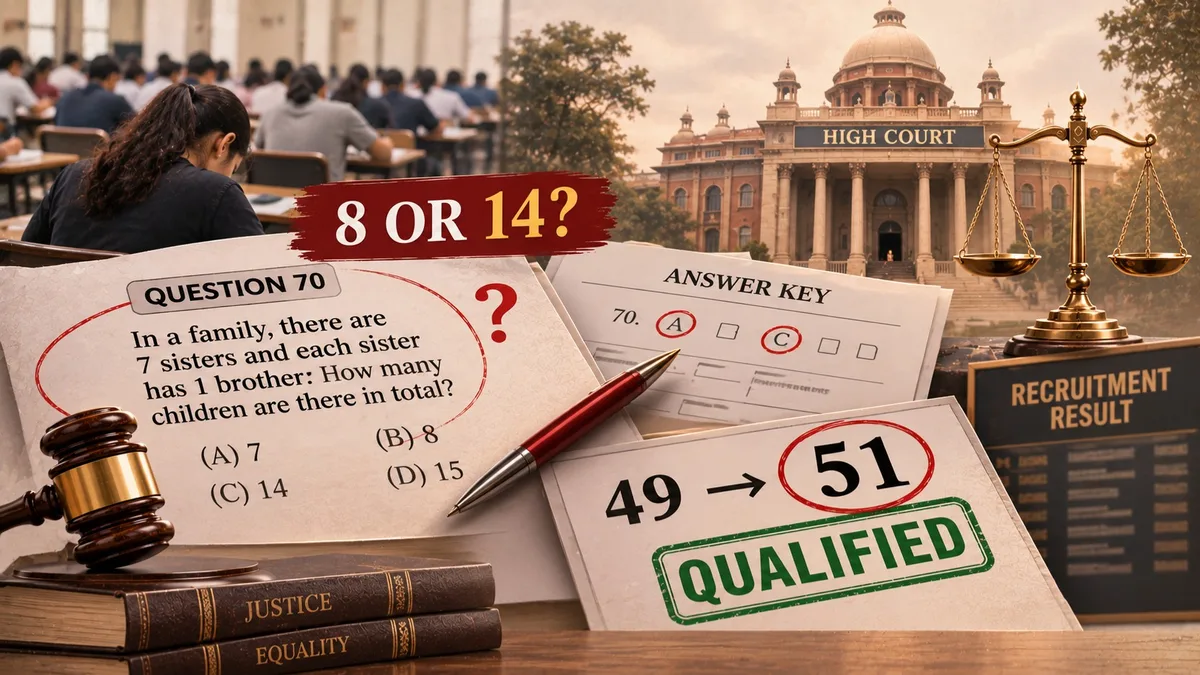
In the LDA/24 recruitment examination, candidates who selected either of the two disputed answers to Question No. 70 were directed to receive the mark and have the negative deduction removed, with results to be revised for eligibility to the next stage.
Key Proposition: Constitution of India – Article 226 – Recruitment examination – Answer key – Whether judicial review should replace expert assessment? The Court reiterated judicial restraint but resolved the appeal on the High Court’s undertaking to accept both options. (Paras 9–14)Recruitment examination – Negative marking – Re-evaluation – Whether candidates choosing either option (B) or (C) should receive the mark and have the deduction removed? Held, yes. (Paras 11–14)
Background / Synopsis :
- Shamim Akhtar challenged a Single Judge judgment dated 28 April 2026 dismissing WPO/102/2025. The appeal was APOT/136/2026 with GA/1/2026.
- The dispute in the appeal concerned Question No. 70 in the LDA/24 examination, booklet series B: “In a family, there are 7 sisters and each sister has 1 brother. How many children are there in total in this family?” The provisional answer key identified option (B), eight children, as correct. After objections, the final answer key treated option (C), fourteen children, as correct.
- The appellant argued that the answer should be eight because the seven sisters could share one brother. The recruitment authority relied on the paper setter’s opinion and the Recruitment and Promotion Committee’s decision to change the answer to fourteen.
- Separately, the appeal record noted that the State had introduced a fresh 100-point OBC reservation policy during the selection process. The Division Bench indicated that the question of applying that policy midway through an ongoing selection could be considered by the High Court on its administrative side. The appellant accepted that course, and the Bench did not decide the reservation-policy issue judicially.
Issues For Consideration :
- Whether the final answer key’s treatment of option (C), fourteen children, as the correct answer to Question No. 70 was sustainable.
- Whether the Court should substitute its own view for the expert assessment of the paper setter and the Recruitment and Promotion Committee.
- Whether the recruitment authority’s decision to accept both options (B) and (C) as correct could resolve the appellant’s grievance and affect the candidates’ eligibility for the next stage.
- Whether the fresh OBC reservation policy could be applied to a selection process already underway; the Bench left this question to the High Court’s administrative side and did not decide it on the judicial side.
Submissions Of Parties :
Appellant: The correct answer was option (B), eight children, because the seven sisters could all have the same one brother. The appellant relied on answers generated by artificial intelligence, challenged the change in the answer key, and argued that objections to the final answer key had not been considered. He sought appointment of an expert to assess the question and contended that the one-mark deduction affected his qualification for the next stage.
Respondents: The High Court’s report stated that eight objections had been received to the question after publication of the provisional key. These were forwarded to the paper setter and considered by the Recruitment and Promotion Committee, which approved option (C), fourteen children, as the correct answer. The respondents opposed judicial interference with the expert assessment.
Court's Observations & Analysis :
- Limits of judicial review of academic assessment: The Court reiterated that it could not assume the role of an academic expert and that the correctness of an examination answer ordinarily had to be left to the expert body. It noted that the objections had been considered by the paper setter and the Recruitment and Promotion Committee.
- The Court’s own reading of the question: The Division Bench observed that the question tested common sense and that the seven sisters could share one biological brother. It therefore considered option (B), eight children, to be the correct answer on that reasoning. It explained that fourteen would assume that each sister had a different brother, rather than one brother common to all seven sisters. (Para 10)
- Resolution accepted by the High Court: Despite the above observation, the Bench recorded the High Court’s statement that both options (B) and (C) would be treated as correct. The High Court explained that 291 Lower Division Assistant posts were vacant and there was an urgent need to complete recruitment. The Court therefore did not need to conclusively resolve the disputed answer for the purpose of granting relief. (Para 11)
- Effect on the appellant: The appellant had suffered a one-mark deduction for choosing option (C) under negative marking and had a score of 49. Under the agreed resolution, he would receive the mark for a correct answer and the negative deduction would be removed, taking his score to 51 out of 100 and qualifying him for the next stage. (Para 12)\
- Reservation policy: The Bench had earlier raised the concern that a new 100-point OBC reservation policy had been introduced after the selection process had completed its first phase. In view of the submissions made on behalf of the High Court and the appellant’s acceptance, it left that issue to be considered on the administrative side and did not decide it judicially. (Paras 2–4)
Decision & Directions :
- The appeal was disposed of by recording that candidates who had selected either option (B) or option (C) for Question No. 70 in booklet series B would be treated as having answered correctly.
- The results of all candidates who selected either option were directed to be reconsidered and republished by adding the one mark allocated to the question and removing the one-mark negative deduction.
- Candidates who qualified after the revised evaluation would become eligible to participate in the next stage, namely the written test.
- The impugned Single Judge order was held to lose its efficacy in consequence of the agreed resolution.
- The issue concerning application of the fresh OBC reservation policy was left for consideration by the High Court on its administrative side; no judicial ruling was made on its legality or applicability.
- All pending interim applications were disposed of.
Legal Provisions Discussed :
- Constitution of India – Article 226: Writ jurisdiction invoked to challenge the recruitment authority’s answer-key decision and the Single Judge’s dismissal of the petition.
- Recruitment process – LDA/24 examination: The judgment concerned evaluation of Question No. 70 in booklet series B and the effect of negative marking.
- Reservation policy: A fresh 100-point OBC reservation policy was referred to, but the Court expressly left its application to the administrative side and did not decide the legal issue.
Case Details :
- Case / Party Name: Shamim Akhtar v. The Registrar General and Others
- Case Number(s): APOT/136/2026; IA No. GA/1/2026; impugned order in WPO/102/2025
- Coram / Judges: Ravindra Vithalrao Ghuge, Chief Justice, and Om Narayan Rai, J. – Division Bench
- Judgment Authored By: Per Court
- Date of Decision: 13 November 2026
- Nature of Proceedings: Intra-court appeal arising from a writ petition concerning recruitment examination evaluation
- Letters Patent / Appeals: APOT/136/2026 challenging the Single Judge judgment dated 28 April 2026 in WPO/102/2025
- Counsel Appearances: For appellant: S. E. Huda, Nabeela Akbar, Saima Amin, Anwesha Guha Ray and Sk. Aptabuddin. For respondents 1 and 2: Jaydip Kar, Senior Advocate; Debashis Banerjee and Rakesh Jana. For the State: Ajit Kumar Mishra, AGP; N. G. Khaitan and Raj Mohan Chattoraj.
Disclaimer: This summary is an editorial aid and does not form part of the judgment. Refer to the original judgment before citing.
Full Judgement / Attachment
Full Judgement
Frequently asked questions about Calcutta High Court
- Where does the Calcutta High Court sit and which areas does it cover?
- The Calcutta High Court sits in Kolkata, with circuit benches at Port Blair and Jalpaiguri. It has jurisdiction over West Bengal and the Andaman and Nicobar Islands. Established on 1 July 1862, it is the oldest High Court in India.
- How do I check Calcutta High Court case status on the Original and Appellate Sides?
- The official website, calcuttahighcourt.gov.in, keeps separate cause lists for the Original Side, the Appellate Side and the circuit benches at Port Blair and Jalpaiguri. Case status and orders are also available on the eCourts High Court Services portal (hcservices.ecourts.gov.in).
- What does the Calcutta High Court's Original Side hear?
- As one of the three chartered High Courts, it exercises ordinary original civil jurisdiction over high-value suits arising within Kolkata, including commercial suits and arbitration matters. Its Appellate Side hears writs, appeals from district courts and tax appeals from the ITAT Kolkata Bench.
- How are Calcutta High Court single-judge orders appealed?
- Orders of a single judge on the Original Side are challenged before a Division Bench through an intra-court appeal under the Letters Patent (often listed as an APO). Appellate Side writ orders go by intra-court appeal as well. Final judgements can be challenged by a Special Leave Petition under Article 136, ordinarily within 90 days.
- How can White Collar Professional help with a Calcutta High Court matter?
- Post your requirement on White Collar Professional to receive proposals from verified Advocates, Chartered Accountants and Company Secretaries, compare them, and pay securely through the platform. This page also tracks the latest Calcutta High Court judgements and legal updates as they are reported.