Calcutta High Court Restores Unused Period of Temporary Liquor Licences After Unreasoned Election Suspension
Court / Authority
Calcutta High Court
Update / Judgement Date
13 Nov 2026
Date of Publication
16 Nov 2026
Case No.
MAT 812 of 2024 with CAN 1 of 2024 and CAN 2 of 2026; MAT 847 of 2022
Source
WCP News Bulletin
Author
Dipanshi Bansal — WCP Legal Desk
Reading Time
12 min read
View Count
1
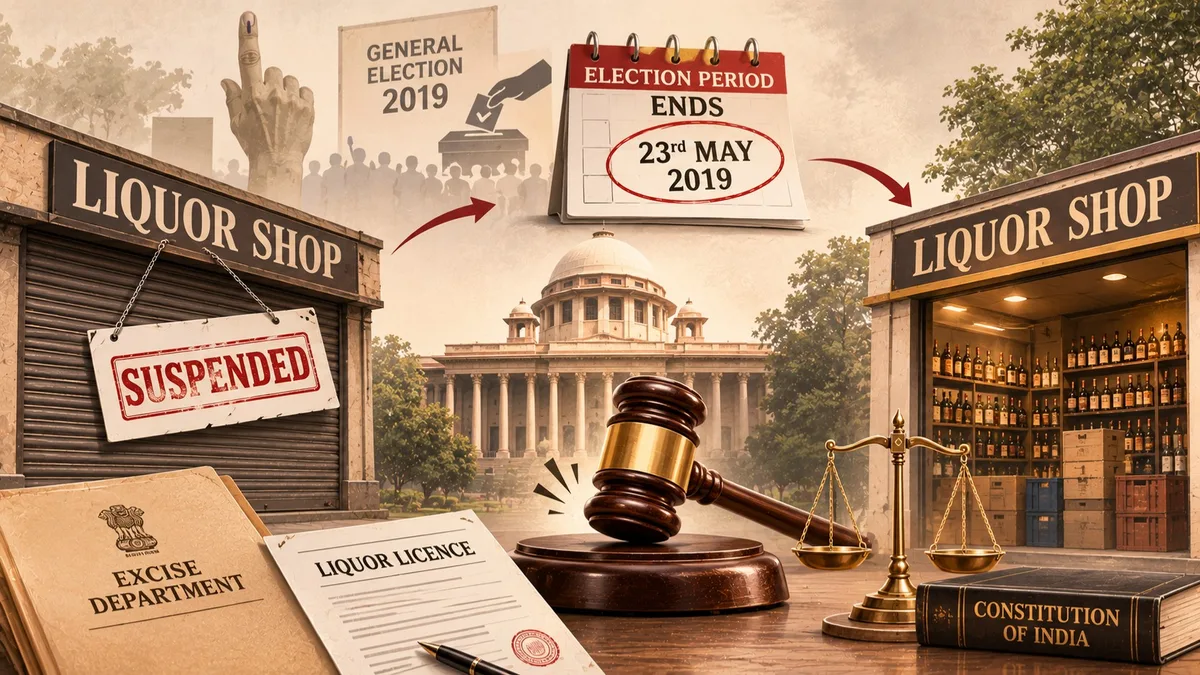
Although no fundamental right exists to carry on the liquor trade, the State cannot keep temporary licences suspended beyond the election period without disclosing cogent reasons and then rely on expiry of the licence period to deny licensees the balance period lost through the State’s own action.
Key Proposition: Bengal Excise Act, 1909 – Sections 26 and 42 – Suspension of temporary liquor licences – Whether prolonged suspension after the election, without disclosed reasons, was sustainable? Held, no. (Paras 32–34)Bengal Excise Act, 1909 – Section 37 – Six-month temporary licence – Whether the State could rely on expiry by efflux of time after preventing operation during the licence period? Held, not in the circumstances of these cases. (Paras 33–36)Constitution of India – Article 14 – Legitimate expectation and non-arbitrariness – Whether State action affecting existing licensees required fair and reasoned consideration? Held, yes. (Paras 32–35)
Background / Synopsis :
- Three connected intra-court appeals were decided by a common judgment: MAT 812 of 2024 (Barun Malakar & Others), MAT 847 of 2022 (Raju Ghosh), and MAT 418 of 2023 (Goutam Mondal and Another). The first two appeals concerned temporary liquor licences issued under Rule 4(q) of the West Bengal Excise Rules, 2003; the third concerned a related category of foreign-liquor “Off” shop licences under Rule 4(v).
- By notification dated 3 October 2018, Rule 4(q) introduced a category permitting sale of liquor other than tari and pachwai. The appellants received temporary licences for six months. On 2 March 2019, the Excise Commissioner ordered suspension of the operation of the shops until further orders, citing the 2019 General Election and Election Commission instructions.
- The general election concluded on 23 May 2019, but the suspension continued. By order dated 22 August 2019, the Excise Commissioner rescinded the suspension while indicating that continuation of the temporary licences would be considered by the Excise Directorate. The appellants were not allowed to operate for the unexpired portion of the licence period.
- In the MAT 418/2023 appeal, the appellants also challenged Notification No. 2067-F.T. dated 27 December 2019, which omitted the relevant Rule 4(v) licence category. They argued that the State had acted without properly invoking Sections 30, 31 and 37A of the Bengal Excise Act, 1909, and had unfairly affected licences already granted.
- The appeals challenged the legality and duration of the suspension, the refusal to restore the remaining licence period, the omission of the licence category, alleged unequal treatment compared with other liquor licensees, and the failure to consider representations. The State maintained that liquor trade was a regulated privilege, not a fundamental right, and that temporary licences could not automatically be renewed or extended.
Issues For Consideration :
- Whether the suspension of the temporary licences during the 2019 General Election, and its continuation after the election, was supported by the Bengal Excise Act, 1909 and the applicable election-closure rules.
- Whether the State was required to disclose cogent reasons for keeping the licences suspended for an extended period after the election had concluded.
- Whether the appellants could be denied the unexpired portion of their six-month licences on the ground that the licences had expired by efflux of time, when the State’s suspension had prevented them from operating.
- Whether the State could omit the relevant licence category through Notification Nos. 2067-F.T. and 2068-F.T. dated 27 December 2019, and what effect that omission had on licences already granted.
- Whether the appellants had a fundamental right or other enforceable entitlement to continue the liquor business, and whether the State’s action was arbitrary or unfair.
- Whether the appellants could apply for licences under Rule 9(1)-F and whether their pending representations required time-bound consideration.
Submissions Of Parties :
Appellants: The licences had been granted for a fixed six-month period after compliance with the prescribed requirements and payment of fees. No breach or default was alleged against them. The suspension was imposed for the election but continued after the election had ended, without reasons and without being tied to any statutory ground. Once rescinded, the licences should have been restored for their unexpired period. They also relied on investment made in infrastructure and stock, legitimate expectation, and differential treatment of their licence category.
Appellants further argued that the Excise Commissioner lacked authority to suspend licences granted by the Collector, and that the State could not retrospectively or indirectly deprive them of the benefit of licences already granted. In MAT 418/2023, they challenged the omission of Rule 4(v), relied on Sections 30, 31 and 37A of the Bengal Excise Act, and invoked Articles 14, 19(1)(g) and 21 of the Constitution.
State: The State submitted that trade in intoxicating liquor is res extra commercium and that no citizen has an absolute fundamental right under Article 19(1)(g) to obtain, renew or continue a liquor licence. It relied on the statutory power to suspend or cancel licences, the power to close shops for public peace, and the six-month limit in Section 37. It argued that temporary licences expired by efflux of time, that there was no automatic right of renewal, and that promissory estoppel could not prevent exercise of statutory or legislative power.
Court's Observations & Analysis :
- Nature of the right: The Division Bench accepted that there is no fundamental right to carry on the liquor trade. However, it held that a privilege or legal right conferred through a licence cannot be curtailed arbitrarily or without a cogent and legally sustainable reason. State action remains subject to fairness, reasonableness and constitutional safeguards.
- Authority and reasons for suspension: The licences had been granted by the Collector. Section 42 of the Bengal Excise Act, 1909 contemplated suspension or cancellation by the authority that granted the licence. The impugned suspension order of 2 March 2019 was issued by the Excise Commissioner without identifying the statutory provision under which he acted. The Court also noted that the order dated 22 August 2019 did not explain why suspension had continued long after the general election ended.
- Indefinite continuation after election: The temporary licences were granted for six months but were suspended shortly after commencement and remained suspended beyond the election period. The State did not establish any default by the licensees or disclose an acceptable reason for prolonging the suspension. The Court held that the State could not simply rely on expiry by efflux of time where its own action had prevented the licensees from using the licensed period.
- Reasons cannot be supplied later: The Court rejected the suggestion that reasons such as public health could be supplied by the Court in support of the State’s action when those reasons were not reflected in the orders themselves. A decision affecting the licensees had to stand on the reasons actually disclosed by the authority.
- Investment and legitimate expectation: The Court took account of the appellants’ investment in premises, infrastructure and liquor stock, and the expectation that licences granted for a defined period would not be rendered unusable without justification. It did not recognise a general fundamental right to renewal; rather, it required fair consideration of the licensees’ position and lawful reasons for the State’s action.
- Withdrawal of licence category: Although the Rule 4(q) category had been withdrawn with effect from 27 December 2019, the Court found that the State could not rely on the withdrawal and the passage of time to defeat the balance period which the licensees had been prevented from enjoying. The Court’s relief was confined to the peculiar circumstances and the appellants in these connected appeals.
- Re: Applications and representations: The Court granted liberty to apply under Rule 9(1)-F of the 2003 Rules and directed the authorities to decide such applications and pending representations within three months. The relevant notifications were directed to remain in abeyance only to the extent and for the limited period necessary to give effect to the relief.
Decision & Directions :
- The three appeals were disposed of in favour of the appellants. The State was directed to allow the appellants to operate their shops for the balance portion of the original six-month licence period, so that they could clear the stock accumulated in their respective shops.
- The appellants were permitted to resume business from 15 December 2026 and continue until completion of the balance portion of the six-month term.
- The appellants were granted liberty to submit appropriate applications under Rule 9(1)-F of the West Bengal Excise (Selection of New Sites and Grant of Licence for Retail Sale of Liquor and Certain Other Intoxicants) Rules, 2003. The State authorities were directed to decide such applications in accordance with law within three months from the date of application.
- All pending representations, particularly those submitted by Goutam Mondal and others, were directed to be decided in accordance with law within three months from the date of the judgment.
- Notification Nos. 2067-F.T. and 2068-F.T., both dated 27 December 2019, were directed to remain in abeyance only until the balance period of the temporary licences ended, and only in relation to the appellants in the three appeals.
- No order as to costs; connected applications were also disposed of.
Legal Provisions Discussed :
- Bengal Excise Act, 1909 – Section 26: Power concerning closure of shops selling intoxicants for preservation of public peace.
- Bengal Excise Act, 1909 – Section 37: Relevant provision concerning grant of retail licences for a period not exceeding six months.
- Bengal Excise Act, 1909 – Section 42: Power to suspend or cancel a licence, permit or pass; the Court considered the authority competent to exercise that power.
- West Bengal Excise Rules, 2003 – Rule 4(q): Category of temporary licence introduced by notification dated 3 October 2018.
- West Bengal Excise Rules, 2003 – Rule 4(v): Licence category relevant to the third connected appeal and omitted by the notification dated 27 December 2019.
- West Bengal Excise Rules, 2003 – Rule 9(1)-F: Provision under which the appellants were permitted to make fresh applications.
- West Bengal Excise (Closure of Retail Licensed Premises on Special Occasion, viz. Election) Rules, 1998: Rules relied upon in relation to election-related closure of licensed premises.
- Constitution of India – Articles 14, 19(1)(g) and 21: Equality, freedom of trade and life/liberty provisions invoked in the challenge; the Court recognised that liquor trade is not a fundamental right but State action must remain non-arbitrary.
- Doctrine: Legitimate expectation – a relevant consideration in assessing arbitrariness and fairness, not an independent right to renewal.
Precedents Cited :
- Sudhamoy Mondal v. Collector of Bankura and Others, 92 C.W.N. 138 – Relied on by the appellants regarding the investment and infrastructure undertaken by temporary liquor licensees.
- State of Jharkhand and Others v. Brahmputra Metallics Limited, Ranchi and Another, (2023) 10 SCC 634 – Relied on for the role of legitimate expectation as an aspect of non-arbitrariness under Article 14.
- State of Madhya Pradesh and Others v. Nandlal Jaiswal and Others, (1986) 4 SCC 566 – Cited by the appellants and the State in relation to State regulation of liquor trade and the limits of rights in that field.
- State of Kerala v. Kandath Distilleries, (2013) 6 SCC 573 – Relied on by the State on the regulatory character of liquor licensing.
- Khoday Distilleries Ltd. v. State of Karnataka, (1995) 1 SCC 574 – Relied on by the State for the principle that there is no fundamental right to trade in intoxicating liquor.
- Excise Commissioner, U.P., Allahabad v. Ram Kumar, (1976) 3 SCC 540 – Cited by the State in support of its position on liquor licensing powers.
- State of Kerala v. Six Holiday Resorts Private Ltd., (2010) 5 SCC 186 – Cited by the State on the limits of claims arising from liquor licences.
- State of Gujarat v. Dipak Babaria, (2014) 3 SCC 502 – Cited by the State in relation to exercise of statutory power.
- Kerala Bar Hotels Association v. State of Kerala, (2015) 16 SCC 421 – Relied on by the State regarding regulation of liquor trade.
Case Details :
- Case / Party Name: Barun Malakar & Others v. State of West Bengal & Others; Raju Ghosh v. State of West Bengal & Others; Goutam Mondal and Another v. State of West Bengal and Others
- Case Number(s): MAT 812 of 2024 with CAN 1 of 2024 and CAN 2 of 2026; MAT 847 of 2022; MAT 418 of 2023. The judgment’s paragraph 39 refers to MAT 418 of 2025, although the cause title and opening paragraphs identify MAT 418 of 2023.
- Coram / Judges: Arijit Banerjee, J. and Apurba Sinha Ray, J. – Division Bench
- Judgment Authored By: Apurba Sinha Ray, J.; Arijit Banerjee, J. agreed
- Date of Decision: 13 November 2026
- Nature of Proceedings: Three connected intra-court appeals arising from writ proceedings concerning temporary excise licences
- Letters Patent / Appeals: MAT 812/2024, MAT 847/2022 and MAT 418/2023; connected CAN applications
- Counsel Appearances: For appellants in MAT 812/2024 and MAT 847/2022: Aninda Kumar Mitra, Senior Advocate; Arindam Banerjee, Arpita Saha, Ashis Kumar Mukherjee and Saurabh Prasad. For the State: Surojit Nath Mitra, Advocate General; Amit Chakraborty, Shiv Shankar Banerjee, Falguni Bandopadhyay and Soma Chakraborty. Separate appearances for MAT 418/2023 are not separately identified in the cause-title appearance block.
Disclaimer: This summary is an editorial aid and does not form part of the judgment. Refer to the original judgment before citing.
Full Judgement / Attachment
Full Judgement
Frequently asked questions about Calcutta High Court
- Where does the Calcutta High Court sit and which areas does it cover?
- The Calcutta High Court sits in Kolkata, with circuit benches at Port Blair and Jalpaiguri. It has jurisdiction over West Bengal and the Andaman and Nicobar Islands. Established on 1 July 1862, it is the oldest High Court in India.
- How do I check Calcutta High Court case status on the Original and Appellate Sides?
- The official website, calcuttahighcourt.gov.in, keeps separate cause lists for the Original Side, the Appellate Side and the circuit benches at Port Blair and Jalpaiguri. Case status and orders are also available on the eCourts High Court Services portal (hcservices.ecourts.gov.in).
- What does the Calcutta High Court's Original Side hear?
- As one of the three chartered High Courts, it exercises ordinary original civil jurisdiction over high-value suits arising within Kolkata, including commercial suits and arbitration matters. Its Appellate Side hears writs, appeals from district courts and tax appeals from the ITAT Kolkata Bench.
- How are Calcutta High Court single-judge orders appealed?
- Orders of a single judge on the Original Side are challenged before a Division Bench through an intra-court appeal under the Letters Patent (often listed as an APO). Appellate Side writ orders go by intra-court appeal as well. Final judgements can be challenged by a Special Leave Petition under Article 136, ordinarily within 90 days.
- How can White Collar Professional help with a Calcutta High Court matter?
- Post your requirement on White Collar Professional to receive proposals from verified Advocates, Chartered Accountants and Company Secretaries, compare them, and pay securely through the platform. This page also tracks the latest Calcutta High Court judgements and legal updates as they are reported.