ED Attaches ₹100.44 Crore Assets In Illegal Coal Mining And Hawala Laundering Case Linked To ECL Areas
Court / Authority
Indirect Taxes and Customs (CBIC)
Update / Judgement Date
12 Jul 2026
Source
WCP News Bulletin
Author
Manas Yadav — WCP Legal Desk
Reading Time
2 min read
View Count
1
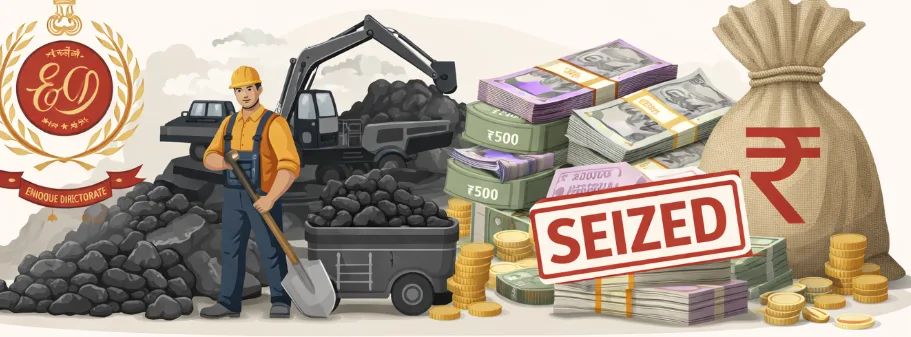
The Directorate of Enforcement (ED) has provisionally attached assets worth ₹100.44 crore under the Prevention of Money Laundering Act, 2002, in connection with a large-scale illegal coal mining and pilferage racket operating in the leasehold areas of Eastern Coalfields Limited (ECL). The investigation centres on a syndicate allegedly led by Anup Majee alias Lala, which was engaged in systematic illegal excavation and distribution of coal across West Bengal, allegedly with the assistance of elements within the local administration.
According to the ED, the syndicate devised an elaborate mechanism using fake transport challans, popularly known as the “Lala pad,” issued in the names of non-existent firms to facilitate movement of illegally mined coal. Transporters were provided currency notes of ₹10 or ₹20 and instructed to photograph the note alongside the vehicle’s number plate carrying coal, which images were circulated via WhatsApp to officials along the route to avoid interception.
The probe further revealed the use of underground hawala networks to transfer proceeds of crime in cash, authenticated through pre-shared currency note serial numbers, enabling large sums to be moved without banking trails. Seized registers, digital data, accounting software records and WhatsApp communications indicate that the syndicate generated proceeds of crime of approximately ₹2,742 crore. The attached assets include immovable properties, fixed deposits and mutual fund investments held in the names of beneficiary companies, notably Shakambhari Ispat and Power Limited and Gagan Ferrotech Limited. With this attachment, the total assets seized in the case now stand at ₹322.71 crore. The ED stated that further investigation is underway to trace additional proceeds of crime and identify all beneficiaries involved in the laundering network.
Full Judgement / Attachment
Full Judgement
Frequently asked questions about Indirect Taxes and Customs (CBIC)
- What is the CBIC?
- The Central Board of Indirect Taxes and Customs (CBIC), in the Department of Revenue, Ministry of Finance, administers customs, central excise and the Central GST and IGST. It issues notifications, circulars and instructions that field formations follow.
- How do importers and exporters file customs documents?
- Bills of entry and shipping bills are filed electronically through ICEGATE, the CBIC's customs e-commerce gateway. Most bills of entry are assessed under the Faceless Assessment system.
- How do I appeal against a customs order?
- A first appeal lies to the Commissioner (Customs Appeals) within 60 days, with a pre-deposit of 7.5 per cent of the duty in dispute. A further appeal lies to the Customs, Excise and Service Tax Appellate Tribunal (CESTAT) within three months, with a pre-deposit of 10 per cent.
- Where are CBIC notifications published?
- Notifications and circulars on customs, GST and central excise are published on the CBIC website (cbic.gov.in) and in the Gazette of India, under separate series for tariff and non-tariff notifications.
- How can White Collar Professional help with a customs or CBIC matter?
- Post your requirement on White Collar Professional to receive proposals from verified Chartered Accountants, customs brokers and Advocates, compare them, and pay securely through the platform. This page also tracks the latest customs or CBIC CBIC and customs updates as they are reported.