No Invoice, No Value, No Tax: Gujarat High Court Quashes Rs. 43.43 Crore IGST Demand on Amul for Not Cross-Charging Head Office Services, Holds Revenue-Neutral Omission Is Not Suppression Under Section 74
Court / Authority
Gujarat High Court
Update / Judgement Date
16 Oct 2026
Date of Publication
27 Oct 2026
Case No.
7085 of 2025
Source
WCP News Bulletin
Author
Arshee Saifi — WCP Legal Desk
Reading Time
8 min read
View Count
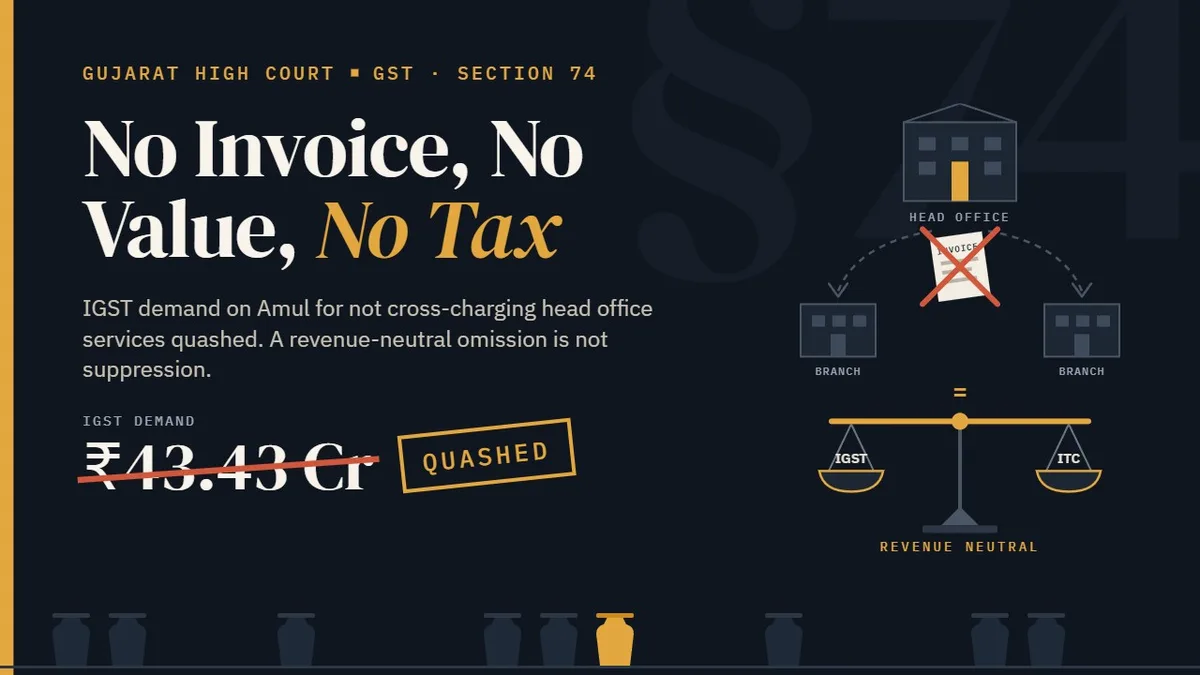
Key Proposition: Where a head office has issued no tax invoice to a distinct-person branch eligible for input tax credit, the value of its internally generated services is deemed 'Nil' under the second proviso to Rule 28 of the CGST Rules as clarified by CBIC, so no GST arises; and a revenue-neutral failure to cross-charge, with all expenses recorded in the books, cannot by itself establish fraud or suppression to invoke Section 74.
Background / Synopsis :
The petitioner is the apex marketing federation of Gujarat's milk co-operatives ('Amul'), with its Head Office at Anand, an ISD registration for the HO, a common registration for branches and depots in Gujarat, and separate registrations for branches outside Gujarat (Paras 3–6, 34–35).
The HO incurs corporate expenses – advertisement and publicity, IT infrastructure, IBM and SAP maintenance, audit, legal and litigation costs – used by itself and its branches (Paras 7, 36).
From July 2017 to March 2019 it did not allocate these expenses to branches by cross-charging; from 1 April 2019 it began doing so (Paras 8, 27).
A show-cause-cum-demand notice dated 31 August 2022 invoked Section 74 and demanded GST on common expenditure and HO salaries in proportion to branch turnover (Paras 10–13).
During adjudication CBIC issued Circulars dated 17 July 2023 and 26 June 2024 on HO-to-branch services (Paras 15–16).
By Order-in-Original dated 1 January 2025 the Additional Commissioner, CGST, Ahmedabad South confirmed IGST of Rs. 43,43,12,441 with interest and penalty under Section 74 (Para 17).
Issues For Consideration :
- Whether the Head Office and branches are 'distinct persons' so that HO services to branches are taxable supplies.
- How such services are to be valued where the HO issued no tax invoice to the branches, in light of Rule 28 and the CBIC Circulars.
- Whether the extended period under Section 74 could be invoked for the failure to cross-charge.
Submissions Of Parties :
- Petitioner (Federation):
The issue is covered by Metal One Corporation India Pvt. Ltd. v. Union of India (Del HC), which quashed similar demands applying the Circulars (Para 18).
Cross-charging is an internal accounting practice, not a statutory mandate; proceedings were wrongly initiated against the Ahmedabad branch, and the Gujarat branches have no separate registration (Paras 19–23).
With no invoice issued, the value is deemed 'Nil' under the Circulars and Rule 28 (Para 24).
All expenses and salaries are recorded in the books; there was no fraud, wilful misstatement or suppression, so Section 74 is without jurisdiction (Para 25).
- Respondents (Revenue):
The petitioner deliberately avoided cross-charging to evade GST, and accepted the legal position by cross-charging from 1 April 2019 (Paras 26–27).
Metal One is inapplicable; the Circulars apply only where the recipient branch is eligible for full ITC, as the adjudicating authority explained (Para 29).
Branches outside Gujarat hold separate registrations; valuation was done under Rules 28, 30 and 31; the HO retained the entire ITC instead of passing it to branches (Paras 30–31).
The petitioner never disclosed that it was not paying IGST on cross-charges, justifying Section 74 (Para 32).
Court's Observations & Analysis :
- Re: Issue (i): Distinct persons and cross-charging
Under Section 25(4) and (5), each registration is a distinct person; Entry 2 of Schedule I makes supplies between distinct persons in the course of business taxable even without consideration, and Rule 28 governs their valuation (Paras 41–42).
The CGST Act does not define 'cross-charge', but the scheme of these provisions establishes it as the invoicing of HO-to-branch supplies (Para 42).
Held: Branches with separate registrations are distinct persons whose shared services are supplies; HO and branches under a single registration are outside cross-charging. (Para 42)
- Re: Issue (ii): Valuation where no invoice was issued
Circular 199/11/2023 clarifies that where the recipient branch is eligible for full ITC, the invoice value is deemed open market value, and if no invoice is issued the value may be deemed 'Nil'; Circular 210/4/2024 reiterates this (Paras 44–45).
Metal One held that where no invoices were generated, the value must be treated as 'Nil' and proceedings would be futile (Para 46).
It is undisputed that no invoices were issued; the adjudicating authority referred to the Circulars only cursorily and brushed them aside on an unrelated ground (Para 47).
The authorities cannot determine value on a proportionate turnover basis merely because the petitioner did not cross-charge; HO services are input services whose tax would in any case be available as ITC to the branches (Paras 48–49).
Held: The value of the services is 'Nil' and no tax liability arises; the order suffers from non-application of mind. (Paras 47–48)
- Re: Issue (iii): Invocation of Section 74
The only basis recorded was that the facts emerged from a DGGI investigation; nothing in the notice or the order satisfies the ingredients of fraud, wilful misstatement or suppression (Para 50).
Tata Steel (SC) requires the foundational facts of fraud or suppression to be evident from the notice itself; mechanical recital of statutory words does not show application of mind (Paras 50–51).
Even with cross-charging, the tax would have been paid from HO ITC and credited back to the branches – a revenue-neutral position; the expenditure was fully recorded in the books (Para 52).
Held: The essential ingredients of Section 74 were not established. (Para 53)
Notable Observations:
"The mere exhuming of information by DGGI, without forming any opinion establishing the core vices on such information cannot attract the rigors of Section 74 of the CGST Act." (Para 51)
"The situation would, therefore, have been revenue-neutral." (Para 52)
Decision & Directions :
Writ petition allowed; Order-in-Original No. 74/CGST/(Ahmedabad South)/ADC/PBM/24-25 dated 1 January 2025 quashed and set aside. Rule made absolute. (Para 54)
Legal Provisions Discussed & Precedents Cited :
- Central Goods and Services Tax Act, 2017 – Sections 7, 16(1), 25(4), 25(5), 31, 74; Schedule I, Entry 2.
- Central Goods and Services Tax Rules, 2017 – Rule 28 (second proviso), Rules 30 and 31.
- CBIC Circular No. 199/11/2023-GST dated 17.07.2023 and Circular No. 210/4/2024-GST dated 26.06.2024.
- Doctrines applied: revenue neutrality; requirement of foundational facts for extended limitation.
- Metal One Corporation India Pvt. Ltd. v. Union of India, 2024 (10) TMI 1534 (Delhi HC) – Followed.
- Tata Steel Ltd. v. Union of India, 2026 (189) taxmann.com 520 (SC) – Followed.
Case Details :
- Case / Party Name: M/s Gujarat Co-operative Milk Marketing Federation Ltd. v. Union of India & Ors.
- Case Number(s): R/Special Civil Application No. 7085 of 2025 (CNR GJHC240329302025)
- Coram / Judges: A.S. Supehia and Vaibhavi D. Nanavati, JJ. – Division Bench
- Counsel Appearances: For the Petitioner: Mr. Amal Paresh Dave and Mr. Paresh M. Dave, Advocates. For Respondents 1 to 3: Ms. Hetvi H. Sancheti, Senior Standing Counsel.
Disclaimer: This summary is an editorial aid and does not form part of the judgment. Refer to the original judgment before citing.
Full Judgement / Attachment
Full Judgement
Frequently asked questions about Gujarat High Court
- Where does the Gujarat High Court sit and which areas does it cover?
- The Gujarat High Court sits at Sola, Ahmedabad. It has jurisdiction over the State of Gujarat. It was established on 1 May 1960, when Gujarat was formed from the former Bombay State.
- Can I watch Gujarat High Court hearings live?
- Yes. The Gujarat High Court was the first High Court in India to live-stream its court proceedings, on its official YouTube channel. Case status, cause lists and judgements are on its website, gujarathighcourt.nic.in, and on the eCourts High Court Services portal (hcservices.ecourts.gov.in).
- What kinds of cases does the Gujarat High Court hear?
- It hears writs, civil and criminal appeals for Gujarat, along with a large volume of tax litigation, including income-tax appeals from the ITAT Ahmedabad, Rajkot and Surat Benches and GST and customs matters linked to the state's ports and industrial hubs.
- How is a single-judge order appealed in the Gujarat High Court?
- Certain single-judge orders, mainly in writ matters, can be challenged before a Division Bench by a Letters Patent Appeal under Clause 15 of the Letters Patent. A final judgement can be challenged by a Special Leave Petition under Article 136, ordinarily within 90 days.
- How can White Collar Professional help with a Gujarat High Court matter?
- Post your requirement on White Collar Professional to receive proposals from verified Advocates, Chartered Accountants and Company Secretaries, compare them, and pay securely through the platform. This page also tracks the latest Gujarat High Court judgements and legal updates as they are reported.