Preventive Detention Quashed: Mere Criminal Cases Do Not Establish a Threat to Public Order
Court / Authority
Gujarat High Court
Update / Judgement Date
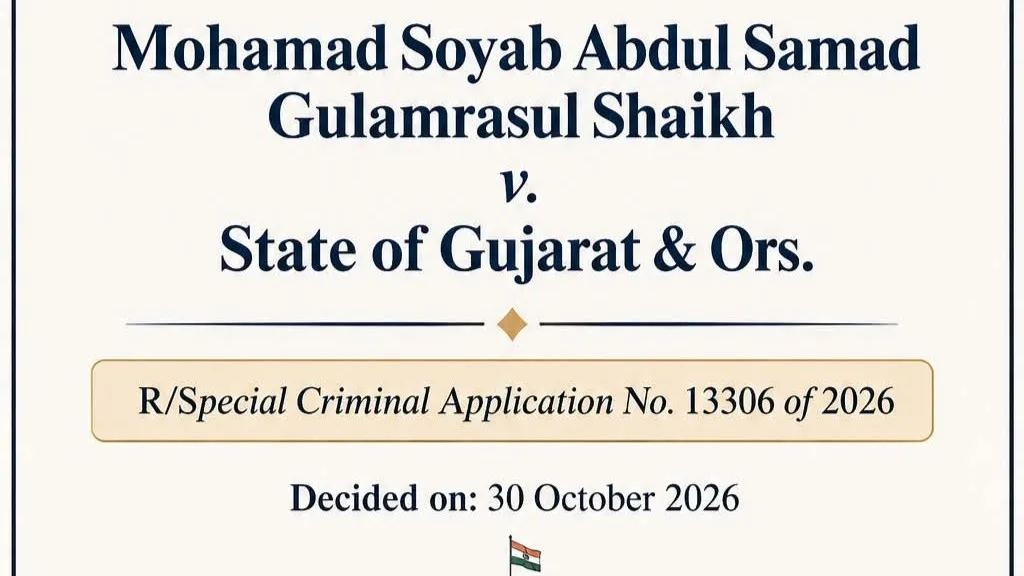
30 Oct 2026
Date of Publication
02 Nov 2026
Case No.
R/Special Criminal Application No. 13306 of 2026
Source
WCP News Bulletin
Author
Soumya Gupta — WCP Legal Desk
Reading Time
5 min read
View Count
3
● The petitioner was preventively detained under an order dated 24 August 2026 (also recorded in the judgment as 30 August 2026) by the Police Commissioner, Ahmedabad, as a “dangerous person” under Section 2(c) of the Gujarat Prevention of Anti-social Activities Act, 1985.
● The grounds of detention referred to four criminal cases registered at Kagdapith Police Station for offences under Sections 303(2), 317(2) and 54 of the Bharatiya Nyaya Sanhita, 2023, on 20 October 2025, 2 November 2025, 2 March 2026 and 10 May 2026. The petitioner had been granted bail in all four cases.
● The petitioner challenged the legality and validity of the detention order, contending that the allegations related only to law and order and did not affect public order.
● The detention order was executed and the petitioner was in jail when the High Court considered the petition.
Issues For Consideration :
● Whether the four criminal cases relied upon by the Detaining Authority were sufficient to establish that the petitioner’s activities adversely affected, or were likely to adversely affect, the maintenance of public order under the 1985 Act.
● Whether the Detaining Authority’s subjective satisfaction and the resulting preventive detention order were legally sustainable.
Submissions Of Parties :
Petitioner:
● The grounds of detention had no nexus with public order and concerned, at most, law and order.
● Registration of the alleged offences did not show an adverse effect on the maintenance of public order as contemplated by Section 3(4) of the 1985 Act.
Respondent / State:
● The petitioner was a habitual offender whose activities affected society at large.
● Considering the petitioner’s antecedents and past activities, the Detaining Authority had passed the order to prevent conduct prejudicial to the maintenance of public order in Ahmedabad.
Court's Observations & Analysis :
Re: Whether the material established a threat to public order
● The Court considered the four criminal cases relied upon in the grounds of detention and noted that the petitioner had been granted bail in all of them.
● The Court held that the Detaining Authority had wrongly reached subjective satisfaction that the petitioner’s activities were prejudicial to the maintenance of public order. The offences had no demonstrated bearing on public order.
● Relying on Piyush Kantilal Mehta v. Commissioner of Police, Ahmedabad, the Court reiterated the distinction between law and order and public order, referring to the Supreme Court’s discussion in Pushkar Mukherjee v. State of Bengal.
● Every breach of law may affect order, but it does not necessarily affect public order. The relevant distinction is whether the conduct affects the community or public at large, rather than primarily injuring specific individuals or causing a local disturbance.
● The Court found that the material did not establish that the petitioner’s alleged activities had adversely affected, or were likely to adversely affect, public order. The subjective satisfaction of the Detaining Authority was therefore not legal, valid or in accordance with law.
Notable Observations:
● “The contravention of any law always affects order but before it can be said to affect public order, it must affect the community or the public at large.” (Para 8; quotation reproduced in the judgment from the precedent discussed)
● “A mere disturbance of law and order leading to disorder is thus not necessarily sufficient for action under the Preventive Detention Act...” (Para 8; quotation reproduced in the judgment from the precedent discussed)
Decision & Directions :
● The petition was allowed.
● The impugned detention order dated 24 August 2026 (also recorded as 30 August 2026) passed by the respondent authority was quashed.
● The Court directed that the detenue be set at liberty forthwith, if he was not required in any other case.
● Rule was made absolute. Direct service was permitted.
● Separate Opinions: None.
Legal Provisions Discussed & Precedents Cited :
● Gujarat Prevention of Anti-social Activities Act, 1985 – Section 2(c): Defined “dangerous person”, the category under which the petitioner was detained.
● Gujarat Prevention of Anti-social Activities Act, 1985 – Section 3(4): Referred to in assessing whether the alleged activities adversely affected or were likely to adversely affect the maintenance of public order.
● Bharatiya Nyaya Sanhita, 2023 – Sections 303(2), 317(2) and 54: Provisions under which the four criminal cases referred to in the grounds of detention were registered. No old–new equivalent was discussed in the judgment.
● Piyush Kantilal Mehta v. Commissioner of Police, Ahmedabad, 1989 Supp (1) SCC 322 – Relied on for the distinction between law and order and public order and the limits on preventive detention based on criminal allegations.
● Pushkar Mukherjee v. State of Bengal, 1969 (1) SCC 10 – Referred to through Piyush Kantilal Mehta for the principle that an individual disturbance does not necessarily amount to a disturbance of public order
Full Judgement / Attachment
Full Judgement
Frequently asked questions about Gujarat High Court
- Where does the Gujarat High Court sit and which areas does it cover?
- The Gujarat High Court sits at Sola, Ahmedabad. It has jurisdiction over the State of Gujarat. It was established on 1 May 1960, when Gujarat was formed from the former Bombay State.
- Can I watch Gujarat High Court hearings live?
- Yes. The Gujarat High Court was the first High Court in India to live-stream its court proceedings, on its official YouTube channel. Case status, cause lists and judgements are on its website, gujarathighcourt.nic.in, and on the eCourts High Court Services portal (hcservices.ecourts.gov.in).
- What kinds of cases does the Gujarat High Court hear?
- It hears writs, civil and criminal appeals for Gujarat, along with a large volume of tax litigation, including income-tax appeals from the ITAT Ahmedabad, Rajkot and Surat Benches and GST and customs matters linked to the state's ports and industrial hubs.
- How is a single-judge order appealed in the Gujarat High Court?
- Certain single-judge orders, mainly in writ matters, can be challenged before a Division Bench by a Letters Patent Appeal under Clause 15 of the Letters Patent. A final judgement can be challenged by a Special Leave Petition under Article 136, ordinarily within 90 days.
- How can White Collar Professional help with a Gujarat High Court matter?
- Post your requirement on White Collar Professional to receive proposals from verified Advocates, Chartered Accountants and Company Secretaries, compare them, and pay securely through the platform. This page also tracks the latest Gujarat High Court judgements and legal updates as they are reported.