IRDAI Sets Up Life and Non-Life Working Groups to Build Risk Based Capital on Ind AS Accounts, Seeks Draft RBC Regulations Within One Month
Court / Authority
Insurance (IRDAI)
Update / Judgement Date
10 Nov 2026
Date of Publication
12 Nov 2026
Source
WCP News Bulletin
Author
Arshee Saifi — WCP Legal Desk
Reading Time
6 min read
View Count
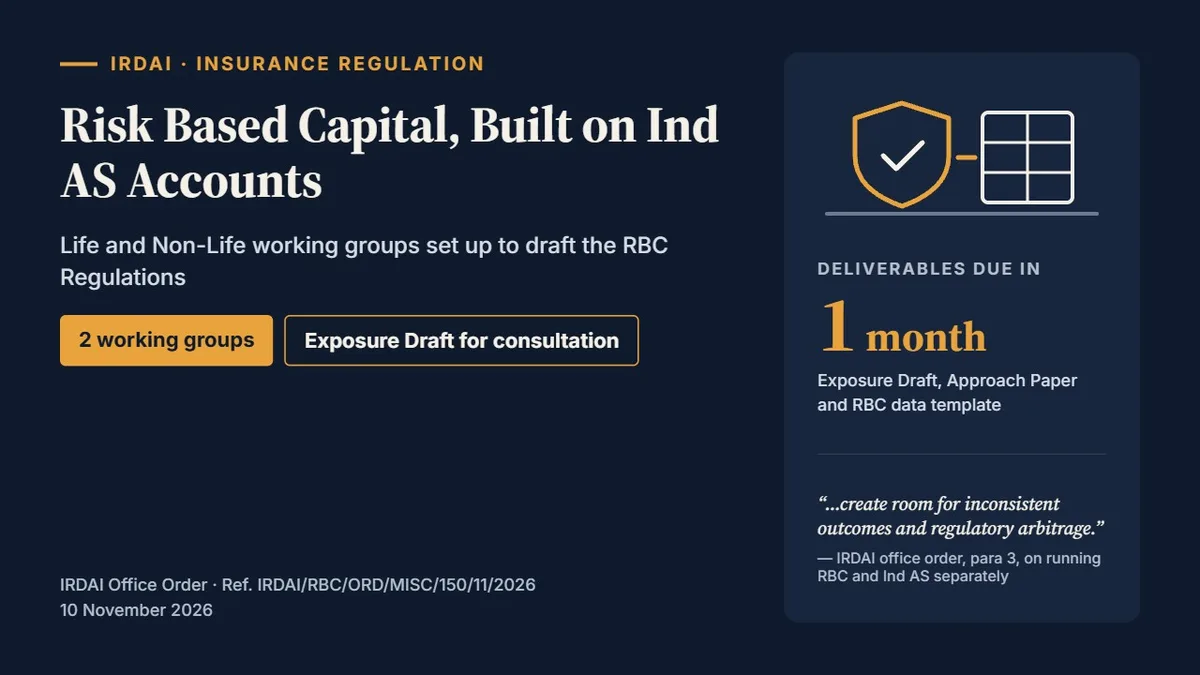
Key Proposition: IRDAI proposes that insurers' Ind AS financial statements form the starting point and basis for the Risk Based Capital framework, with clearly defined adjustments only where RBC's prudential objectives require them, and has tasked two industry working groups with drafting the RBC Regulations on that converged basis within one month.
A. Background :
IRDAI is in the process of transitioning the Indian insurance sector from the existing factor-based solvency regime to an RBC framework. (Para 1)
The IRDAI (Actuarial, Finance and Investment Functions of Insurers) (Amendment) Regulations, 2026, notified on 30.03.2026, require financial statements to be prepared under applicable Ind AS. (Para 2)
Running the two frameworks on unconnected bases would impose duplicative cost on insurers and create room for inconsistent outcomes and regulatory arbitrage. (Para 3)
B. Purpose of the Order :
To give effect to an approach in which Ind AS financial statements form the starting point and basis for RBC, and to develop the regulatory instruments needed for it. (Paras 4–5)
C. Key Provisions of the Order :
- Objectives (Para 14):
A coherent convergence in which a single set of data, models and assumptions serves both Ind AS and RBC as far as possible; the resulting framework must be transparent, comparable, resistant to arbitrage, proportionate and implementable on a realistic transition path.
Preparation of the Exposure Draft of the RBC Regulations and an associated Approach Paper.
- Guiding principles (Para 15):
Convergence must neither dilute RBC's prudential purpose (policyholder protection at a defined confidence level) nor distort Ind AS objectives (faithful representation).
The groups should examine narrowing the choices Ind AS allows insurers, based on data and outcomes, without curtailing reasoned flexibility.
A standard industry approach should be adopted; where divergence is possible, governance and monitoring of the divergence should be defined.
Every recommendation must be backed by analysis, data and quantified impact, including sensitivity testing.
- Terms of reference – Exposure Draft (Para 16(a)):
Valuation of assets and liabilities starting from Ind AS carrying values, with an exhaustive list of permitted and mandatory adjustments; Available Capital and its tiers; Required Capital, risk modules, calibration and diversification.
Treatment of key Ind AS components such as debt securities and ECL, contract boundary, discounting, Contractual Service Margin, risk adjustment, loss component, acquisition cash flows and reinsurance held.
Solvency ratio, supervisory intervention levels and ladder of action under Section 64VA; governance and Board responsibilities; reporting and disclosure; transitional provisions; and consequential amendments.
- Terms of reference – Approach Paper and other work (Para 16(b)–(g)):
Approach Paper on alternatives and consequences, covering sensitivity testing, acceptable ranges, materiality, construction of the risk-free yield curve, flooring of negative liabilities or CSM, alignment of risk margin with Ind AS risk adjustment, and the illiquidity premium.
Draft data-submission template, including an Ind AS-to-RBC reconciliation; recommendations on actuarial valuation under Sections 13 and 49 of the Insurance Act, 1938; recalibration and stress factors; and treatment of foreign business.
- Working arrangements (Paras 6–13):
Ms. Jamuna Choudhary (Life) and Mr. Parmeshwar Shelke (Non-Life), both DGMs (RBC), IRDAI, are Member Conveners.
Quorum is at least 50% of each group's members (separately for joint sittings); meetings may be physical, virtual or hybrid, and video participation counts towards quorum.
Valuation Actuaries or Deputy CFOs may attend in place of or in addition to Appointed Actuaries or CFOs; the groups may co-opt experts; all deliberations, data and drafts are strictly confidential.
Notable Observations: “Running the two frameworks on separate, unconnected bases would impose duplicative cost on insurers, introduce reconciliation complexity, and create room for inconsistent outcomes and regulatory arbitrage.” (Para 3)
D. Deliverables & Timeline :
1. Two Working Groups constituted – Life (Annexure 1) and Non-Life (Annexure 2). (Para 5)
2. Deliverables: Exposure Draft of the RBC Regulations suitable for public consultation, an Approach Paper and a draft RBC data template, with related recommendations. (Paras 14, 16)
3. All work to be completed and deliverables submitted within one month from the date of the order (10.11.2026). (Para 17)
Issued with the approval of the Competent Authority; signed by C. Srinivasa Kumar, CGM (Actuarial & RBC). (Para 18)
E. Statutory Provisions & Instruments Referred :
- Insurance Act, 1938 – Section 64VA (solvency margin and supervisory action); Sections 13 and 49 (actuarial valuation).
- IRDAI (Actuarial, Finance and Investment Functions of Insurers) (Amendment) Regulations, 2026 – notified 30.03.2026.
- Indian Accounting Standards (Ind AS) – components named include ECL, contract boundary, Contractual Service Margin, risk adjustment for non-financial risk and insurance acquisition cash flows.
F. Order Details :
- Issuing Authority: Insurance Regulatory and Development Authority of India (IRDAI), Hyderabad – C. Srinivasa Kumar, Chief General Manager (Actuarial & RBC)
- Reference No.: IRDAI/RBC/ORD/MISC/150/11/2026 dated 10 November 2026 (bilingual, Hindi and English)
- Working Group – Life (13): Aditya Birla Life, Bajaj Life, Bandhan Life, HDFC Life, ICICI Prudential, Kotak Life, LIC of India, Munich Re, SBI Life, TATA AIA, Institute of Actuaries of India, and IRDAI (Ind AS and RBC departments)
- Working Group – Non-Life (12): Bajaj General, ICICI Lombard, IndusInd General, Kiwi General, New India, Niva Bupa, SBI General, Swiss Re, TATA AIG, Institute of Actuaries of India, and IRDAI (Ind AS and RBC departments)
Disclaimer: This summary is an editorial aid and does not form part of the office order. Refer to the original IRDAI order before relying on it.
Full Judgement / Attachment
Full Judgement
Frequently asked questions about Insurance (IRDAI)
- What is IRDAI?
- The Insurance Regulatory and Development Authority of India, constituted under the IRDA Act, 1999, regulates and promotes the insurance sector. It licenses insurers and intermediaries, frames regulations and protects policyholders' interests.
- My insurance claim was rejected. What should I do first?
- Raise a written complaint with the insurer's grievance cell. If the insurer does not respond within the prescribed time or you are not satisfied, escalate through IRDAI's Bima Bharosa grievance portal or approach the Insurance Ombudsman.
- When can I approach the Insurance Ombudsman?
- You can approach the Insurance Ombudsman after the insurer rejects your written complaint, does not reply within one month, or gives a reply you do not accept. The complaint must be filed within one year. There is no fee, and the Ombudsman can award up to ₹50 lakh.
- What disputes can the Insurance Ombudsman hear?
- The Ombudsman hears complaints about full or partial claim rejections, delays in settlement, disputes over premium, misrepresentation of policy terms and policy servicing. It cannot hear a dispute that is already pending before a court, consumer commission or arbitrator.
- How can White Collar Professional help with a insurance matter?
- Post your requirement on White Collar Professional to receive proposals from verified Advocates and insurance advisers, compare them, and pay securely through the platform. This page also tracks the latest insurance IRDAI and insurance updates as they are reported.