CONFED Employees Entitled to Salary Arrears on Parity with Similarly Situated Staff
Court / Authority
J&K and Ladakh High Court
Update / Judgement Date
25 Nov 2026
Date of Publication
28 Nov 2026
Case No.
LPA No. 01 of 2026
Source
WCP News Bulletin
Author
Dipanshi Bansal — WCP Legal Desk
Reading Time
5 min read
View Count
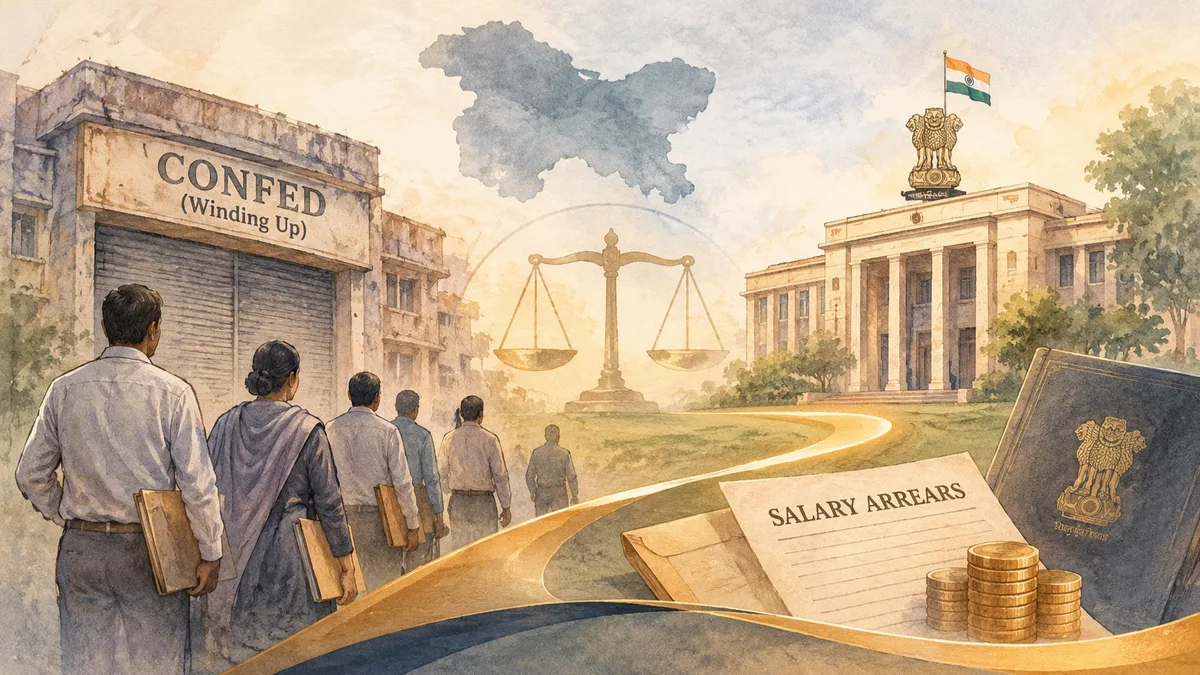
The Division Bench dismissed the Government’s appeal and upheld the direction to release salary arrears to former CONFED employees up to their absorption in the Cooperative Department. It held that the Government could not deny them benefits already granted to identically situated employees after accepting their parity in earlier proceedings, while requiring verification and adjustment to prevent double payment.
Key Proposition: The State cannot deny employees the benefit of a final judgment granted to identically situated employees where it had itself accepted their parity; the principle of no work, no pay cannot be invoked to make employees bear the consequences of delay in implementing the Government’s own absorption decision.
- Constitution of India – Article 14 – Equal treatment – Whether similarly situated former CONFED employees could be denied arrears already granted to comparable employees? – No.
- Code of Civil Procedure, 1908 – Section 152 – Correction/clarification – Whether verification of the actual unpaid period enlarged the substantive relief? – No.
Background / Synopsis :
- CONFED was ordered to be wound up pursuant to Cabinet Decision dated 15 July 1999. Employees who did not opt for the Golden Handshake Scheme sought adjustment in Government service and were absorbed in the Cooperative Department by Government Order dated 26 October 2007.
- Five other employees had obtained relief in SWP No. 812 of 2008, allowed on 22 April 2011; the decision was affirmed in appeal and the Supreme Court challenge failed.
- The respondents’ SWP No. 1387 of 2008 was disposed of on 30 September 2016 in terms of the earlier judgment, after the Government accepted that the employees were similarly situated. That order attained finality.
- Despite this, the Government rejected their claim on 27 February 2019. The respondents challenged the rejection in WP(C) No. 683 of 2023, allowed on 2 August 2024. A further order dated 28 May 2025 directed verification of the actual unpaid period.
- The Government filed the present intra-court appeal.
Issues For Consideration :
- Whether employees whose writ petition had been disposed of in terms of an earlier judgment could be denied the benefits granted to the employees in that earlier case.
- Whether the principle of no work, no pay and delay/laches defeated the claim.
- Whether the subsequent direction dated 28 May 2025 exceeded the scope of Section 152 CPC.
Submissions Of Parties :
Parties’ submissions:
- Appellants/UT: The respondents had not worked for the Government during the claimed period; CONFED was autonomous and no employer-employee relationship with the Government existed before absorption. The subsequent order allegedly exceeded Section 152 CPC and the claim was delayed.
- Respondents: Their case was covered by the earlier judgment; the Government had accepted that they were similarly situated. The later order only required computation of the actual unpaid period.
Court's Observations & Analysis :
Re: Parity and finality of earlier adjudication
- The respondents and employees in SWP No. 812 of 2008 were employees of the same institution and were absorbed under the same Government order.
- The respondents’ own writ petition had been disposed of in terms of the earlier judgment after the Government accepted that the cases were identical. The 2016 order was not challenged and had attained finality.
- The Supreme Court had upheld directions for arrears in the earlier employees’ case; the Government could not adopt different standards for employees on the same footing.
- Held: Denial of the same benefits would offend Article 14.
Re: No work, no pay and delay
- The respondents’ absence from Government service resulted from the Government’s winding-up and adjustment process. They could not be made to suffer for delay in implementing the Government’s own decision.
- They had approached the Court in 2008 and pursued proceedings thereafter; the claim was not stale.
- Held: The defences were rejected.
Re: Section 152 CPC
- The later order did not enlarge the substantive relief; it directed verification of the actual period of non-payment.
- The Government was required to inspect service records and salary registers, adjust amounts already paid and avoid double payment.
- Held: The clarification was sustainable, subject to no double recovery.
Decision & Directions :
- The appeal was dismissed and the judgment dated 2 August 2024 and subsequent order dated 28 May 2025 were upheld, subject to clarification.
- The Government must verify service records, salary registers and other material to ascertain the actual period for which each respondent remained unpaid.
- Amounts already paid for the corresponding period must be adjusted; admissible arrears are payable up to 26 October 2007, the date of absorption.
- No separate costs direction was recorded.
Legal Provisions Discussed & Precedents Cited :
- Constitution of India – Article 14: equality and protection against discriminatory treatment.
- Code of Civil Procedure, 1908 – Section 152: correction of clerical or arithmetical errors; considered in relation to the subsequent verification order.
- SWP No. 812 of 2008, judgment dated 22 April 2011 – Applied as the controlling parity judgment; affirmed in LPA No. 202 of 2011 and the Supreme Court challenge failed.
- Civil Appeal No. 239 of 2022 – Referred to as upholding directions for computation and release of arrears in the connected employees’ case.
Case Details :
- Case / Party Name: UT of Jammu and Kashmir and others v. Showkat Ali Wani and others LPA No. 01 of 2026Z
- Case Number(s): LPA No. 01 of 2026; impugned WP(C) No. 683 of 2023 and CM No. 5105 of 2024
- Coram / Judges: Sanjeev Kumar, J., and Mohd Yousuf Wani, J. – Division Bench
- Counsel Appearances: M. Younis, assisting counsel to Ab. Rashid Malik, Senior AAG, for appellants; Shakeel Sarwar for respondents.
Disclaimer: This summary is an editorial aid and does not form part of the judgment. Refer to the original judgment before citing.
Full Judgement / Attachment
Full Judgement
Frequently asked questions about J&K and Ladakh High Court
- Where does the High Court of Jammu and Kashmir and Ladakh sit and which areas does it cover?
- The High Court of Jammu and Kashmir and Ladakh functions from two wings, at Srinagar and Jammu; in August 2026 the Union Cabinet approved a further bench in Ladakh. It has jurisdiction over the Union Territories of Jammu and Kashmir and Ladakh. First established in 1928, it took its present name in 2021 as the common High Court for both Union Territories.
- How do I check cases at the Srinagar and Jammu wings?
- The official website, jkhighcourt.nic.in, publishes separate cause lists and orders for the Srinagar and Jammu wings. Case status is also available on the eCourts High Court Services portal (hcservices.ecourts.gov.in). Matters from Ladakh are currently listed at one of the two existing wings.
- What kinds of cases does the J&K and Ladakh High Court hear?
- It hears writ petitions, including habeas corpus petitions against preventive detention, service and land matters, and civil and criminal appeals from both Union Territories. It also hears tax appeals on substantial questions of law.
- How is a J&K High Court single-judge judgement appealed?
- Certain single-judge judgements can be challenged before a Division Bench by a Letters Patent Appeal (LPA). A final judgement can be taken to the Supreme Court by a Special Leave Petition under Article 136, ordinarily within 90 days.
- How can White Collar Professional help with a J&K High Court matter?
- Post your requirement on White Collar Professional to receive proposals from verified Advocates, Chartered Accountants and Company Secretaries, compare them, and pay securely through the platform. This page also tracks the latest J&K High Court judgements and legal updates as they are reported.