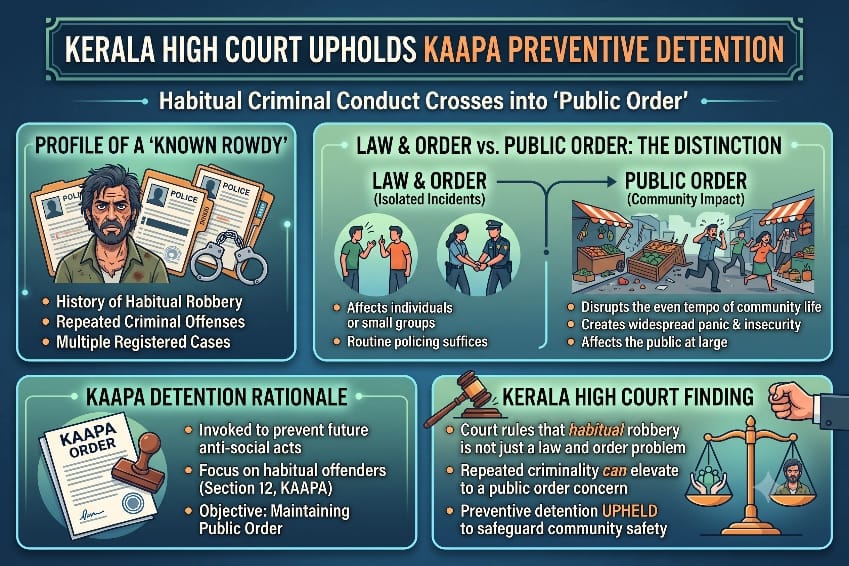
Habitual Robbery and Repeated Criminal Conduct Cross Into 'Public Order': Kerala High Court Upholds KAAPA Preventive Detention of 'Known Rowdy'
Court / Authority
Kerala High Court
Update / Judgement Date
06 Sept 2026
Source
WCP News Bulletin
Author
Team — WCP Legal Desk
Reading Time
4 min read
View Count
1
Thasmitha Abukutty v. State of Kerala and Others | High Court of Kerala at Ernakulam | 2nd September, 2026
A writ petition by the wife of a preventive detenu challenging a detention order under Section 3(1) of the Kerala Anti-Social Activities (Prevention) Act, 2007, confirmed and later reduced from one year to six months. The petitioner raised multiple grounds including non-application of mind, misreading of an earlier quashing judgment, non-consideration of representations, delay snapping the live-link, and mischaracterisation of the offences as mere 'law and order' issues rather than 'public order' concerns. The Division Bench headed by the Chief Justice held that the detenu's repeated involvement in robbery, causing hurt, criminal intimidation and related offences satisfied the statutory definition of 'known rowdy' and created a sense of public insecurity amounting to a threat to public order, that the Government's subsequent reduction of the detention period was a valid exercise of its independent statutory revocation power and did not evidence non-application of mind, and dismissed the writ petition.
Background
- An order of detention dated 25.11.2025 was passed against the detenu under Section 3(1) of the Kerala Anti-Social Activities (Prevention) Act, 2007 (KAA(P)A), based on his involvement in five criminal cases including robbery, criminal intimidation, causing disappearance of evidence, cheating by personation, and offences under the Bharatiya Nyaya Sanhita.
- An earlier detention order against the same detenu in 2024 had been quashed by the High Court in W.P.(Crl.) No.757 of 2024; shortly after release, the detenu was implicated in a fresh crime (No.992/2025, Ponnani Police Station) that formed the basis of the present proceedings.
- The detention was confirmed by the Government under Section 10(4) of the KAA(P)A for one year, and later reduced to six months by a subsequent order.
- The petitioner-wife challenged the detention on grounds including non-application of mind, misreading of the earlier quashing judgment, failure to consider the adequacy of existing bail conditions, non-exploration of ordinary preventive remedies such as Section 107 Cr.P.C., delay snapping the live-link between the last prejudicial activity and the detention order, non-consideration of representations under Article 22(5), and that the offences relied upon pertained only to 'law and order' and not 'public order'.
- The State opposed the petition, submitting that the detenu was a habitual offender with a Rowdy History Sheet opened since 2015, that ordinary preventive measures had proved ineffective, and that all statutory safeguards under the KAA(P)A had been complied with.
Court's Observations
- The materials disclosed the detenu's repeated involvement in offences of robbery, causing hurt in committing robbery, criminal intimidation, cheating by personation, and attempt to commit culpable homicide, satisfying the definition of 'known rowdy' under Section 2(p)(iii) read with Section 2(t) of the KAA(P)A.
- The repeated and non-isolated nature of such offences was held capable of disturbing 'the even tempo of life of the community', as per Angoori Devi, thereby crossing from mere 'law and order' into 'public order' within the meaning of Section 2(a) of the Act.
- The subsequent reduction of the detention period from one year to six months by the Government, in exercise of its independent statutory power under Section 13(1) of the KAA(P)A, did not by itself indicate non-application of mind in the original confirmation order.
- Non-filing of a bail application by the detenu in the last prejudicial case, coupled with his history of repeatedly violating bail conditions, entitled the Detaining Authority to reasonably apprehend future release and resumption of criminal activity.
- The proposal, having been revived and processed within a reasonable time after rejection on a technical ground, did not disclose an unexplained delay sufficient to snap the live-link between the last prejudicial activity and the detention order.
- None of the procedural or substantive grounds urged by the petitioner were found to vitiate the subjective satisfaction of the Detaining Authority; the writ petition was accordingly dismissed.
Legal Provisions Discussed
- Sections 2(a), 2(p), 2(t), 3(1), 10(4) and 13(1), Kerala Anti-Social Activities (Prevention) Act, 2007.
- Article 22(5), Constitution of India; Article 226, Constitution of India.
- Radhika B. v. State of Kerala, 2015 SCC OnLine Ker 39505.
Case Details :
Court Name: High Court of Kerala at Ernakulam
Case Number: WP(Crl.) No. 805 of 2026
Case / Party Name: Thasmitha Abukutty v. State of Kerala and Others
Coram / Judges: Hon'ble The Chief Justice Mr. Soumen Sen and Hon'ble Mr. Justice Syam Kumar V.M.
Date of Decision: 2nd September, 2026
Letters Patent / Appeals (if any): Writ Petition (Criminal) under Article 226 challenging preventive detention
Full Judgement / Attachment
Full Judgement
Frequently asked questions about Kerala High Court
- Where does the Kerala High Court sit and which areas does it cover?
- The Kerala High Court sits at Ernakulam, Kochi. It has jurisdiction over the State of Kerala and the Union Territory of Lakshadweep. It was established on 1 November 1956, when the State of Kerala was formed.
- How do I check Kerala High Court case status and judgements?
- The official website, highcourt.kerala.gov.in, provides case status, cause lists, e-filing and judgements. The court has moved most filing and records to digital form. Orders are also on the eCourts High Court Services portal (hcservices.ecourts.gov.in).
- What kinds of cases does the Kerala High Court hear?
- It hears writs, civil and criminal appeals from Kerala and Lakshadweep, and income-tax appeals arising from the ITAT Cochin Bench on substantial questions of law.
- What is a Writ Appeal in the Kerala High Court?
- Under Section 5 of the Kerala High Court Act, 1958, a judgement of a single judge in certain matters, including writ petitions, can be appealed to a Division Bench. A final judgement can be challenged by a Special Leave Petition under Article 136, ordinarily within 90 days.
- How can White Collar Professional help with a Kerala High Court matter?
- Post your requirement on White Collar Professional to receive proposals from verified Advocates, Chartered Accountants and Company Secretaries, compare them, and pay securely through the platform. This page also tracks the latest Kerala High Court judgements and legal updates as they are reported.