Unexplained Delay in Deciding Detenu's Representation Proves Fatal: Kerala High Court Orders Release Under PITNDPS Act
Court / Authority
Kerala High Court
Update / Judgement Date
06 Sept 2026
Source
WCP News Bulletin
Author
Team — WCP Legal Desk
Reading Time
4 min read
View Count
1
Fathimath Thasneem V.K. v. Union of India and Others | High Court of Kerala at Ernakulam | 3rd September, 2026
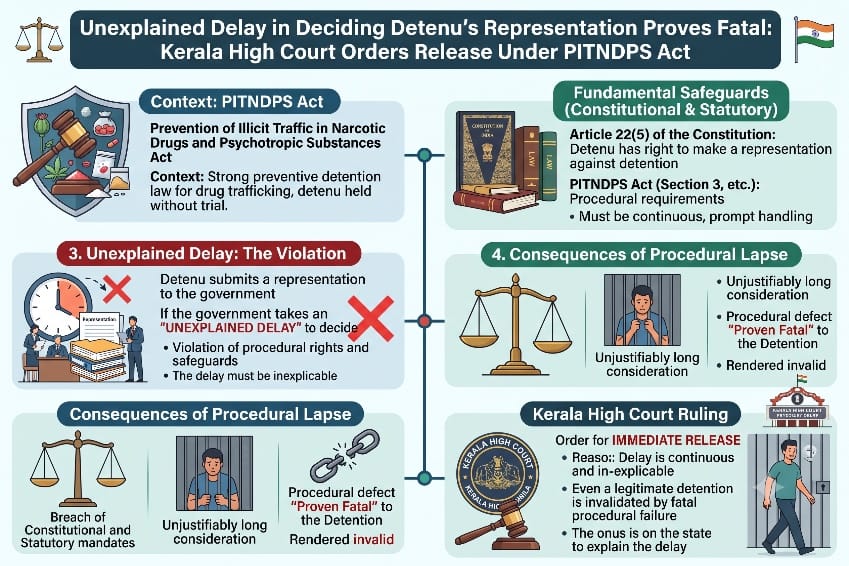
A habeas corpus writ petition by the wife of a detenu challenging preventive detention under Section 3(1) of the Prevention of Illicit Traffic in Narcotic Drugs and Psychotropic Substances Act, 1988 (PITNDPS Act), raising grounds of delay in passing the detention order, non-supply of translated documents, identity of signatory on both orders, and delay by the Union of India in deciding the detenu's representation. Applying the Constitution Bench harmonisation of Pankaj Kumar Chakrabarty and K.M. Abdulla Kunhi as clarified in Pramod Singla, the Division Bench held that while the 43-day delay in passing the detention order and the identical signatory on both orders did not vitiate the detention, the complete absence of any explanation for the delay in the Central Government's consideration of the detenu's representation infringed the constitutional safeguard under Article 22(5), rendering the detention void, and directed the detenu's immediate release.
Background
- The detenu was detained by order dated 25.03.2026 under Section 3(1) of the PITNDPS Act on the basis of three NDPS cases, the last involving seizure of Hashish oil and Methamphetamine on 29.11.2025, and the detention was confirmed for one year by order dated 22.05.2026 under Section 9(f) read with Section 11 of the Act.
- The detenu was arrested on 29.11.2025, granted bail on 13.02.2026, and the detention order was passed 43 days after his release on bail; the case was referred to and considered by the Advisory Board, which recommended confirmation.
- The petitioner-wife challenged the detention on grounds of unexplained delay of 43 days between bail and the detention order, non-supply of translated documents in the detenu's known language, the same officer signing both the detention and confirmation orders, and an unexplained delay of over 60 days by the Central Government in deciding the detenu's representation dated 18.04.2026 (decided only around 08.06.2026).
- The Union of India and the State opposed the petition, contending that all procedural formalities and statutory timelines under the PITNDPS Act had been complied with.
Court's Observations
- The 43-day delay between release on bail and the detention order was adequately explained by the time required to collect, collate, and authenticate records from three different police stations, and did not snap the live-link between the last prejudicial activity and the detention order.
- Where the statute itself contemplates the same authority passing both the initial detention order and, after the Advisory Board's report, the confirmation order, identity of the signatory does not by itself cause prejudice or vitiate the detention.
- The detenu's own representation, submitted after understanding the documents served on him, undercut the contention that illegible or non-translated documents impaired his right to make an effective representation.
- Applying the harmonisation of the Constitution Bench rulings in Pankaj Kumar Chakrabarty v. State of West Bengal and K.M. Abdulla Kunhi v. Union of India, as clarified by the Supreme Court in Pramod Singla, the detaining authority (specially empowered officer) need not await the Advisory Board's decision before deciding a representation, but the Government must ordinarily await it, save where the representation is addressed to it independently.
- No explanation was forthcoming from the Union of India for the more than 60-day delay in considering the detenu's representation dated 18.04.2026, which adversely affected the constitutional safeguard under Article 22(5) of the Constitution and rendered the continued detention void on this sole ground.
- The writ petition was allowed; the detention and confirmation orders were quashed and the Superintendent of Central Jail directed to release the detenu forthwith, unless required in connection with any other case.
Legal Provisions Discussed
- Sections 3(1), 9(b), 9(f) and 11, Prevention of Illicit Traffic in Narcotic Drugs and Psychotropic Substances Act, 1988 (PITNDPS Act).
- Article 22(5), Constitution of India; Article 226, Constitution of India.
- Pankaj Kumar Chakrabarty v. State of West Bengal, (1969) 3 SCC 400; K.M. Abdulla Kunhi and B.L. Abdul Khader v. Union of India, (1991) 1 SCC 476.
- Pramod Singla v. Union of India, 2023 SCC OnLine SC 374; Ankit Ashok Jalan v. Union of India, (2020) 16 SCC 127.
Case Details :
Court Name: High Court of Kerala at Ernakulam
Case Number: WP(Crl.) No. 905 of 2026
Case / Party Name: Fathimath Thasneem V.K. v. Union of India and Others
Coram / Judges: Hon'ble Mr. Justice Anil K. Narendran and Hon'ble Mr. Justice Muralee Krishna S.
Date of Decision: 3rd September, 2026
Letters Patent / Appeals (if any): Writ Petition (Criminal)/Habeas Corpus under Article 226 challenging preventive detention
Full Judgement / Attachment
Full Judgement
Frequently asked questions about Kerala High Court
- Where does the Kerala High Court sit and which areas does it cover?
- The Kerala High Court sits at Ernakulam, Kochi. It has jurisdiction over the State of Kerala and the Union Territory of Lakshadweep. It was established on 1 November 1956, when the State of Kerala was formed.
- How do I check Kerala High Court case status and judgements?
- The official website, highcourt.kerala.gov.in, provides case status, cause lists, e-filing and judgements. The court has moved most filing and records to digital form. Orders are also on the eCourts High Court Services portal (hcservices.ecourts.gov.in).
- What kinds of cases does the Kerala High Court hear?
- It hears writs, civil and criminal appeals from Kerala and Lakshadweep, and income-tax appeals arising from the ITAT Cochin Bench on substantial questions of law.
- What is a Writ Appeal in the Kerala High Court?
- Under Section 5 of the Kerala High Court Act, 1958, a judgement of a single judge in certain matters, including writ petitions, can be appealed to a Division Bench. A final judgement can be challenged by a Special Leave Petition under Article 136, ordinarily within 90 days.
- How can White Collar Professional help with a Kerala High Court matter?
- Post your requirement on White Collar Professional to receive proposals from verified Advocates, Chartered Accountants and Company Secretaries, compare them, and pay securely through the platform. This page also tracks the latest Kerala High Court judgements and legal updates as they are reported.