Cyber-Fraud Bank Freeze Must Be Proportionate: Disputed Amount to Be Secured, Account Released
Court / Authority
Madhya Pradesh High Court
Update / Judgement Date
27 Oct 2026
Date of Publication
28 Oct 2026
Case No.
Writ Petition No. 32781 of 2026
Source
WCP News Bulletin
Author
Dipanshi Bansal — WCP Legal Desk
Reading Time
5 min read
View Count

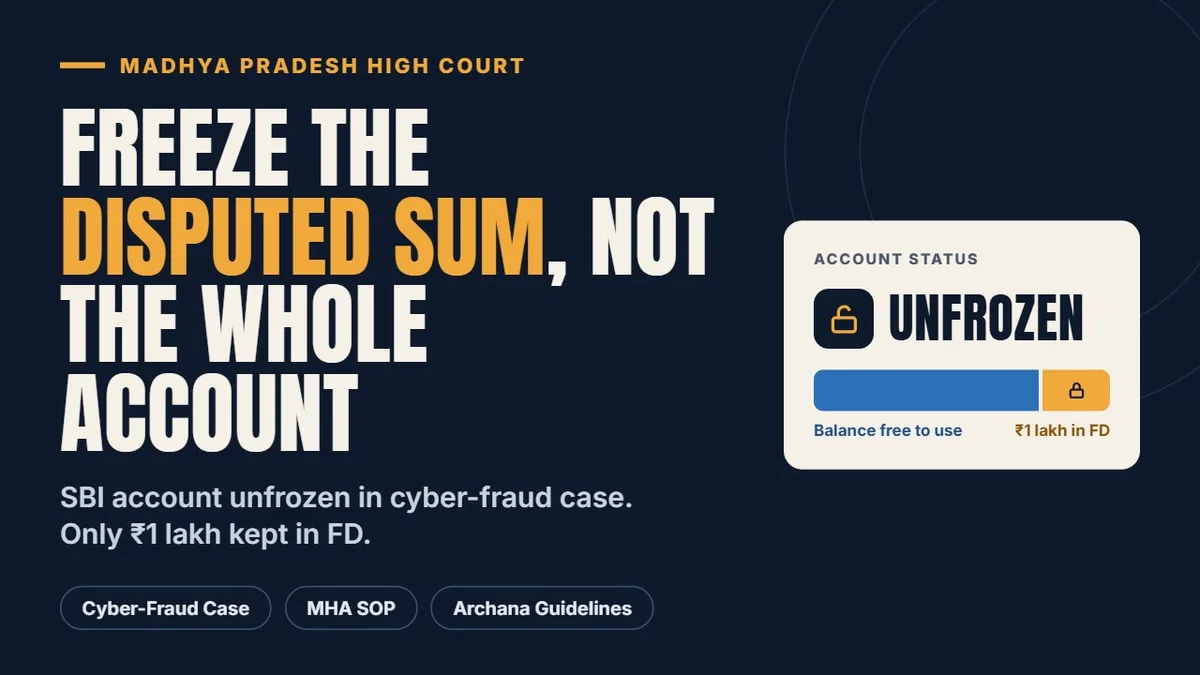
The petitioners sought release of bank accounts frozen following cyber-crime complaints. Applying earlier High Court decisions and the Government’s Standard Operating Procedure dated 10 April 2026, the Court reiterated that a freeze must be proportionate: ordinarily, only the disputed amount should be secured by lien or partial debit freeze, while a full-account freeze requires exceptional circumstances and recorded reasons. In this case, the disputed sum was Rs. 50,000. The Court directed that this amount be kept in a fixed deposit pending an order of the competent Judicial Magistrate within three months, failing which withdrawal could be permitted after intimation to the police; the account was to be unfrozen and operated. (Paras 5–7)
Key Proposition: A bank account freeze imposed in connection with a cyber-fraud complaint must be proportionate to the suspected proceeds of crime; ordinarily, only the disputed amount should be secured, and continuation of a full-account freeze requires recorded reasons.
- Criminal procedure – Bank account freeze in cyber-fraud investigation – Proportionality – Whether an entire account may routinely be frozen when a specific disputed amount can be secured – Held, no.
- Government SOP dated 10 April 2026 – Cyber-fraud grievance redressal – Whether the disputed amount may be secured in a fixed deposit while the remaining account is released – Held, yes, subject to the directions made. (Paras 5–6)
- Code of Criminal Procedure, 1973 – Section 102, and applicable successor law – Seizure/freezing of property during investigation – Police expected to proceed before the competent Judicial Magistrate within the specified period. (Para 6)
Background / Synopsis :
- The petitioners sought unfreezing of their respective bank accounts, which had been frozen on requests from cyber-crime agencies in connection with alleged suspicious transactions.
- The petitioners relied on the High Court’s earlier decision in Malcolm Murayis and on a subsequent decision applying the Government’s Standard Operating Procedure dated 10 April 2026.
- The earlier directions required the disputed amount to be placed in fixed deposits and contemplated judicial orders within three months; if the police did not proceed within that period, withdrawal of the secured sum could be permitted after notice to the investigating agency.
- The Court held that the earlier decisions and guidelines applied to the present case, with the disputed amount identified as Rs. 50,000.
Issues For Consideration :
- Whether the petitioners’ bank accounts should remain fully frozen because of cyber-crime complaints.
- Whether the disputed amount could instead be secured separately while permitting ordinary operation of the accounts.
- What time-bound safeguards should apply to the disputed amount pending action by the investigating agency and competent Judicial Magistrate.
Submissions Of Parties :
Petitioners:
- They sought directions requiring the banks and investigating authorities to unfreeze the accounts and permit lawful operation.
- They submitted that the issue was covered by the High Court’s prior decisions on accounts frozen following cyber-fraud complaints.
Respondents:
- The State was represented by the Government Advocate. The order principally applied the existing decisions and SOP framework; it does not record a detailed, separate counter-submission on the merits of the requested relief.
Court's Observations & Analysis :
Re: Application of prior decisions and the SOP
- The Court held that the earlier decisions in Malcolm Murayis and Archana applied, with necessary modifications, to the petitioners’ case.
- The prior framework required investigation agencies to identify and secure the disputed amount rather than mechanically immobilise all funds, and to act under the applicable legal procedure.
Re: Securing the disputed sum
- The Court directed that Rs. 50,000, being the disputed amount identified in the petition, be placed in a fixed deposit.
- The fixed deposit could be liquidated only after an order of the competent Judicial Magistrate within three months. If the police failed to proceed in accordance with the applicable provisions within that period, the amount could also be withdrawn by the petitioners after intimation to the police agency.
Re: Release of the bank account
- The Court directed that the bank account be unfrozen and that the petitioners be permitted to operate it.
- The order leaves room for the bank to act lawfully if another complaint is received concerning a different transaction, while requiring the SOP to be kept in view. Held: petition disposed of with the specified safeguards. (Paras 5–7)
Notable Observations: The Court adopted the earlier guideline that “freezing of a bank account is an extraordinary measure” and should not be imposed mechanically. (Guideline reproduced in the judgment from the earlier decision.)
Decision & Directions :
- The bank account was directed to be unfrozen and the petitioners permitted to operate it.
- The disputed amount of Rs. 50,000 must be kept in a fixed deposit.
- The fixed deposit may be liquidated only after orders are passed by the competent Judicial Magistrate within three months. If the investigating agency does not proceed in accordance with law within that period, the amount may be withdrawn by the petitioners after informing the police agency.
- The bank may respond to any other complaint concerning a separate transaction in accordance with law and the Government SOP dated 10 April 2026.
- The writ petition was disposed of.
Legal Provisions Discussed & Precedents Cited :
- Constitution of India – Article 226: jurisdiction invoked to seek relief against account freezing.
- Code of Criminal Procedure, 1973 – Section 102: provision referred to in the earlier order concerning police seizure/freezing of property during investigation; the judgment also refers to the applicable law under which the police may proceed.
- Bharatiya Nagarik Suraksha Sanhita, 2023 (BNSS): referred to in the operative directions as potentially applicable successor criminal procedure legislation; the judgment does not identify a specific BNSS section in the final direction.
- Government Standard Operating Procedure dated 10 April 2026: time-bound grievance redressal and bank-account-freeze procedure.
- Malcolm Murayis & Ors. v. State Bank of India & Ors., W.P. No. 1100 of 2024, order dated 26 April 2024 – relied upon for release of accounts subject to securing disputed amounts.
- Archana – referred to as a co-ordinate Bench decision explaining the SOP and proportionality requirements; full case particulars are not stated in the present order.
Full Judgement / Attachment
Full Judgement
Frequently asked questions about Madhya Pradesh High Court
- Where does the Madhya Pradesh High Court sit and which areas does it cover?
- The Madhya Pradesh High Court has its principal seat at Jabalpur, with benches at Indore and Gwalior. It has jurisdiction over the State of Madhya Pradesh. It took its present form in 1956, when the State of Madhya Pradesh was reorganised.
- How do I check MP High Court cases at Jabalpur, Indore or Gwalior?
- The official website, mphc.gov.in, publishes bench-wise cause lists, case status and orders for the principal seat at Jabalpur and the Indore and Gwalior benches. Records are also on the eCourts High Court Services portal (hcservices.ecourts.gov.in).
- What kinds of cases does the MP High Court hear?
- It hears writs, civil and criminal appeals from across Madhya Pradesh, and income-tax appeals arising from the ITAT Jabalpur and Indore Benches. Cases are listed at the bench that has territorial jurisdiction over the district where they arise.
- What is a Writ Appeal in the MP High Court?
- Under the Madhya Pradesh Uchcha Nyayalaya (Khand Nyaya Peeth Ko Appeal) Adhiniyam, 2005, certain single-judge writ orders can be appealed to a Division Bench as a Writ Appeal. A final judgement can be taken to the Supreme Court by a Special Leave Petition under Article 136, ordinarily within 90 days.
- How can White Collar Professional help with a MP High Court matter?
- Post your requirement on White Collar Professional to receive proposals from verified Advocates, Chartered Accountants and Company Secretaries, compare them, and pay securely through the platform. This page also tracks the latest MP High Court judgements and legal updates as they are reported.