Equal Punishment for Unequal Guilt Violates Article 14: MP High Court Quashes Disciplinary Penalty for Failing Parity Test Among Co-Delinquents
Court / Authority
Madhya Pradesh High Court
Update / Judgement Date
06 Sept 2026
Source
WCP News Bulletin
Author
Team — WCP Legal Desk
Reading Time
4 min read
View Count
1
Brahm Kishore Dixit v. The State of Madhya Pradesh and Others | High Court of Madhya Pradesh, Gwalior | 1st September, 2026
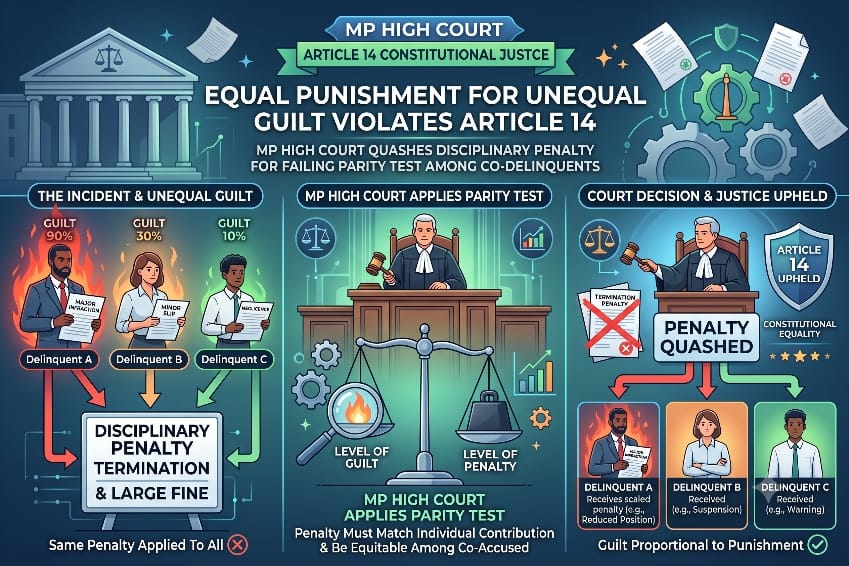
A writ petition under Article 226 by a police Assistant Sub-Inspector challenging a disciplinary penalty of withholding one annual increment with cumulative effect, imposed for merely failing to report a co-delinquent's illegal act, while the co-delinquent Sub-Inspector against whom serious bribery and misconduct charges were proved received the identical punishment. The Court held that the Disciplinary Authority failed to assign reasons for departing from the Enquiry Officer's findings as required by Rule 15(2) of the M.P. Civil Services (CCA) Rules, 1966, and that awarding identical punishment to persons with materially different degrees of culpability violates the principle of parity under Article 14. Applying Rajendra Yadav v. State of M.P. and B.C. Chaturvedi v. Union of India, the punishment order, appellate order, and mercy-petition order were quashed and the matter remitted for a fresh, reasoned decision proportionate to the petitioner's lesser role.
Background
- The petitioner, an Assistant Sub-Inspector, was placed under suspension along with two other officials following a newspaper complaint, and was charge-sheeted for cooperating with Sub-Inspector Kripa Shankar Awasthi's illegal act, failing to report it to superiors, and violating Para 64(4) of the Police Regulations.
- After a departmental enquiry, the Enquiry Officer found the serious allegations of bribery and misconduct proved only against the co-delinquent Sub-Inspector; against the petitioner, only the charge of failing to inform superior officers was found proved.
- Despite this distinction, the Disciplinary Authority imposed the identical punishment of withholding one annual increment with cumulative effect on both officers, without recording reasons for disagreeing with the Enquiry Officer's findings or following the procedure under Rule 15(2) of the M.P. Civil Services (Classification, Control and Appeal) Rules, 1966.
- The petitioner's departmental appeal and subsequent mercy petition were both dismissed by non-speaking orders that did not address this disparity in treatment.
- The petitioner challenged the punishment order, the appellate order, and the mercy-petition order as disproportionate, procedurally infirm, and discriminatory.
Court's Observations
- The Enquiry Officer's report clearly distinguished the gravity of misconduct between the petitioner and the co-delinquent Sub-Inspector, yet the Disciplinary Authority imposed the same punishment without assigning any proper reason for the departure.
- Relying on Rajendra Yadav v. State of Madhya Pradesh, (2013) 3 SCC 73, the Court held that the principle of equality applies between co-delinquents, and a person with a lesser role cannot receive the same or harsher punishment than one whose misconduct was more serious.
- Reliance was also placed on Administrator, UT of Dadra and Nagar Haveli v. Gulabhia M. Lad, (2010) 5 SCC 775 and Lucknow Kshetriya Gramin Bank v. Rajendra Singh, (2013) 12 SCC 372, holding that parity in punishment presupposes similarity of role, responsibility, and conduct.
- The Disciplinary Authority's failure to follow the procedure under Rule 15(2) of the M.P. Civil Services (CCA) Rules, 1966 while disagreeing with the Enquiry Officer's findings, without affording the petitioner a fresh opportunity, rendered the punishment procedurally infirm.
- Citing B.C. Chaturvedi v. Union of India, (1995) 6 SCC 749, the Court reiterated that judicial review of disciplinary punishment is confined to fairness, natural justice, and proportionality, and does not extend to re-appreciating evidence; however, interference is warranted where the punishment shocks the conscience of the Court.
- The punishment orders were quashed and the matter remitted to the Disciplinary Authority to pass a fresh, reasoned order within two months, ensuring that any punishment imposed on the petitioner is necessarily lesser than that imposed on the more culpable co-delinquent.
Legal Provisions Discussed
- Article 226, Constitution of India; Article 14, Constitution of India.
- Rule 15(2), Madhya Pradesh Civil Services (Classification, Control and Appeal) Rules, 1966; Para 64(4), Police Regulations.
- Rajendra Yadav v. State of Madhya Pradesh, (2013) 3 SCC 73.
- B.C. Chaturvedi v. Union of India, (1995) 6 SCC 749.
- Administrator, UT of Dadra and Nagar Haveli v. Gulabhia M. Lad, (2010) 5 SCC 775; Lucknow Kshetriya Gramin Bank v. Rajendra Singh, (2013) 12 SCC 372.
Case Details :
Court Name: High Court of Madhya Pradesh, Gwalior
Case Number: Writ Petition No. 23677 of 2021
Case / Party Name: Brahm Kishore Dixit v. The State of Madhya Pradesh and Others
Coram / Judges: Hon'ble Shri Justice Anand Singh Bahrawat
Date of Decision: 1st September, 2026
Letters Patent / Appeals (if any): Writ Petition under Article 226 of the Constitution of India
Full Judgement / Attachment
Full Judgement
Frequently asked questions about Madhya Pradesh High Court
- Where does the Madhya Pradesh High Court sit and which areas does it cover?
- The Madhya Pradesh High Court has its principal seat at Jabalpur, with benches at Indore and Gwalior. It has jurisdiction over the State of Madhya Pradesh. It took its present form in 1956, when the State of Madhya Pradesh was reorganised.
- How do I check MP High Court cases at Jabalpur, Indore or Gwalior?
- The official website, mphc.gov.in, publishes bench-wise cause lists, case status and orders for the principal seat at Jabalpur and the Indore and Gwalior benches. Records are also on the eCourts High Court Services portal (hcservices.ecourts.gov.in).
- What kinds of cases does the MP High Court hear?
- It hears writs, civil and criminal appeals from across Madhya Pradesh, and income-tax appeals arising from the ITAT Jabalpur and Indore Benches. Cases are listed at the bench that has territorial jurisdiction over the district where they arise.
- What is a Writ Appeal in the MP High Court?
- Under the Madhya Pradesh Uchcha Nyayalaya (Khand Nyaya Peeth Ko Appeal) Adhiniyam, 2005, certain single-judge writ orders can be appealed to a Division Bench as a Writ Appeal. A final judgement can be taken to the Supreme Court by a Special Leave Petition under Article 136, ordinarily within 90 days.
- How can White Collar Professional help with a MP High Court matter?
- Post your requirement on White Collar Professional to receive proposals from verified Advocates, Chartered Accountants and Company Secretaries, compare them, and pay securely through the platform. This page also tracks the latest MP High Court judgements and legal updates as they are reported.