Freeze the Disputed Sum, Not the Whole Account: Madhya Pradesh High Court Orders SBI Account Unfrozen in Cyber-Fraud Case, Keeps Only Rs. 1 Lakh in FD Under MHA SOP and Archana Guidelines
Court / Authority
Madhya Pradesh High Court
Update / Judgement Date
27 Oct 2026
Case No.
W.P. 42327/2026
Source
WCP News Bulletin
Author
Arshee Saifi — WCP Legal Desk
Reading Time
7 min read
View Count
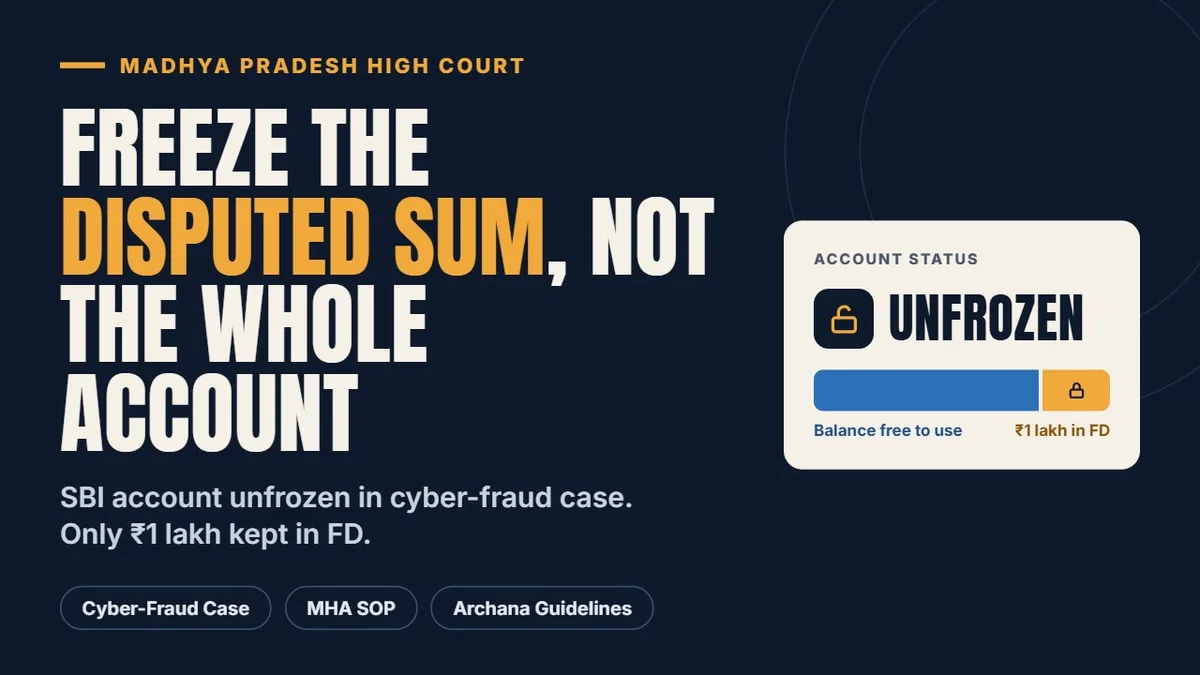
Key Proposition: Where a bank account is frozen on a cyber-crime complaint, only the disputed amount should be secured – here by keeping it in fixed deposit pending the competent Magistrate's order within three months – and the rest of the account must be unfrozen, consistently with the MHA SOP dated 10.04.2026 and the guidelines in Archana v. State of Madhya Pradesh.
Background / Synopsis :
- The petitioner's account No. 10612497593 with the State Bank of India was put on hold following a cyber complaint (Para 1).
- She sought removal of the hold/freeze, a direction against coercive action on account of the cyber complaint, and consequential benefits (Para 1).
- Her counsel submitted that the case was squarely covered by Malcolm Murayis v. SBI (W.P. No. 1100 of 2024, decided 26.04.2024) (Para 2).
- The disputed amount mentioned in the petition was Rs. 1,00,000 (Para 6).
Issues For Consideration :
- Whether the petitioner's bank account, frozen on a cyber-crime complaint, should be unfrozen, and on what conditions.
- Whether Malcolm Murayis and the guidelines in Archana v. State of MP, based on the MHA SOP dated 10.04.2026, govern the case.
Submissions Of Parties :
- Petitioner:
The case is squarely covered by Malcolm Murayis v. SBI (Para 2).
After Malcolm Murayis, the Government framed an SOP for banks, and the Jabalpur Bench dealt with the issue in Archana v. State of MP by order dated 27.07.2026 (Para 4).
- Respondents:
Only counsel for the petitioner is recorded as appearing; no submissions of the respondents are recorded in the order.
Court's Observations & Analysis :
- Re: Issue (i) and (ii): The governing precedents
In Malcolm Murayis, accounts of crypto traders were frozen at the request of cyber cells of various States that did not respond to the Court's notices; the Court directed banks to keep only the disputed amounts in fixed deposit, to be released unless the Magistrate passed orders within three months under Section 102 CrPC (Para 3, quoting paras 3–9 of that order).
In Archana (paras 11–18, reproduced), the Jabalpur Bench noted the MHA SOP dated 10.04.2026 and balanced the account holder's rights under Articles 19(1)(g) and 300-A against the duty to preserve proceeds of crime, applying the test of proportionality (Para 4).
Archana held that the bank is the first point of contact under the SOP and cannot simply send the customer to the police or the court, and framed guidelines to apply until statutory rules or executive instructions are made (Para 4).
Held: Malcolm Murayis and Archana apply mutatis mutandis. (Para 5)
- Re: Relief in the present case
The disputed amount of Rs. 1,00,000 is to be kept in FD; if another complaint about a different entry reaches the bank, it may act in accordance with law keeping the SOP in mind (Para 6).
Held: Account to be unfrozen and operated; FD amount subject to the three-month Magistrate condition. (Para 6)
Notable Observations:
"Freezing of an entire account containing legitimate funds merely because a negligible amount is suspected requires careful scrutiny and must satisfy the test of proportionality." (Archana, para 13, quoted in Para 4)
"…freezing of a bank account is an extraordinary measure and cannot be resorted to mechanically or as a matter of routine." (Archana, para 16, quoted in Para 4)
Decision & Directions :
Writ petition disposed of. (Para 7)
Disputed amount of Rs. 1,00,000 to be kept in FD, to be liquidated only after orders of the competent Judicial Magistrate within three months; failing such orders, the petitioner may withdraw it under intimation to the police agency. (Para 6)
If the bank receives any other complaint about a different entry, it may act in accordance with law keeping in mind the SOP as discussed in Archana. (Para 6)
The petitioner's account shall be unfrozen and she shall be permitted to operate it. (Para 6)
Key guidelines from Archana applied in this order (Para 4):
1. The Investigating Agency should, as far as practicable, identify the disputed amount and direct only a lien or debit freeze to that extent; freezing the entire account is for exceptional cases, with reasons recorded in writing.
2. The Investigating Officer must inform the concerned Magistrate of the seizure or freezing forthwith, meaning as soon as reasonably possible.
3. The bank must inform the account holder of the freeze, the authority behind it and the grievance mechanism, and must keep electronic records of the instruction (date, authority, NCRP number, FIR, amount).
4. The account holder may lodge a grievance at the branch with KYC, an explanation and supporting documents; the bank must conduct CDD/EDD and upload it on the CFCFRMS portal within seven days.
5. The Investigating Officer must decide the grievance by a reasoned decision within fifteen days, preferably verifying by electronic means; release instructions must be complied with by the bank, preferably within 48 hours.
6. Grievances undecided beyond fifteen days stand escalated to the District Grievance Redressal Officer, who must decide within fifteen days.
7. If a grievance remains unresolved for 90 days and no lawful direction to continue the hold is received, the bank shall release the hold after giving the agency fifteen days' notice.
8. A writ petition for de-freezing ordinarily may be entertained after the 90-day period, save in exceptional circumstances.
The SOP timelines are outer limits, not the ordinary period for action. (Archana, para 17, quoted in Para 4)
Separate Opinions: None.
Legal Provisions Discussed & Precedents Cited :
- Constitution of India – Articles 19(1)(g), 226, 300-A.
- Code of Criminal Procedure, 1973 – Section 102 (seizure; intimation to Magistrate); Bharatiya Nagarik Suraksha Sanhita, 2023 – corresponding provisions referred to generally.
- Ministry of Home Affairs Standard Operating Procedure dated 10.04.2026 – Grievance Redressal Mechanism for accounts put on hold through NCRP-CFCFRMS.
- Doctrines applied: proportionality; judicial oversight of seizure.
Case Details :
- Case / Party Name: Pushpa Devi Verma v. State Bank of India & Anr.
- Case Number(s): Writ Petition No. 42327 of 2026 [Neutral Citation: 2026:MPHC-IND:29920] (CNR MPHC020407472026)
- Coram / Judges: Sandeep N. Bhatt, J. – Single Judge
- Counsel Appearances: For the Petitioner: Shri Anirudh Patwa, Advocate. No appearance for the respondents is recorded.
Disclaimer: This summary is an editorial aid and does not form part of the judgment. Refer to the original judgment before citing.
Full Judgement / Attachment
Full Judgement
Frequently asked questions about Madhya Pradesh High Court
- Where does the Madhya Pradesh High Court sit and which areas does it cover?
- The Madhya Pradesh High Court has its principal seat at Jabalpur, with benches at Indore and Gwalior. It has jurisdiction over the State of Madhya Pradesh. It took its present form in 1956, when the State of Madhya Pradesh was reorganised.
- How do I check MP High Court cases at Jabalpur, Indore or Gwalior?
- The official website, mphc.gov.in, publishes bench-wise cause lists, case status and orders for the principal seat at Jabalpur and the Indore and Gwalior benches. Records are also on the eCourts High Court Services portal (hcservices.ecourts.gov.in).
- What kinds of cases does the MP High Court hear?
- It hears writs, civil and criminal appeals from across Madhya Pradesh, and income-tax appeals arising from the ITAT Jabalpur and Indore Benches. Cases are listed at the bench that has territorial jurisdiction over the district where they arise.
- What is a Writ Appeal in the MP High Court?
- Under the Madhya Pradesh Uchcha Nyayalaya (Khand Nyaya Peeth Ko Appeal) Adhiniyam, 2005, certain single-judge writ orders can be appealed to a Division Bench as a Writ Appeal. A final judgement can be taken to the Supreme Court by a Special Leave Petition under Article 136, ordinarily within 90 days.
- How can White Collar Professional help with a MP High Court matter?
- Post your requirement on White Collar Professional to receive proposals from verified Advocates, Chartered Accountants and Company Secretaries, compare them, and pay securely through the platform. This page also tracks the latest MP High Court judgements and legal updates as they are reported.