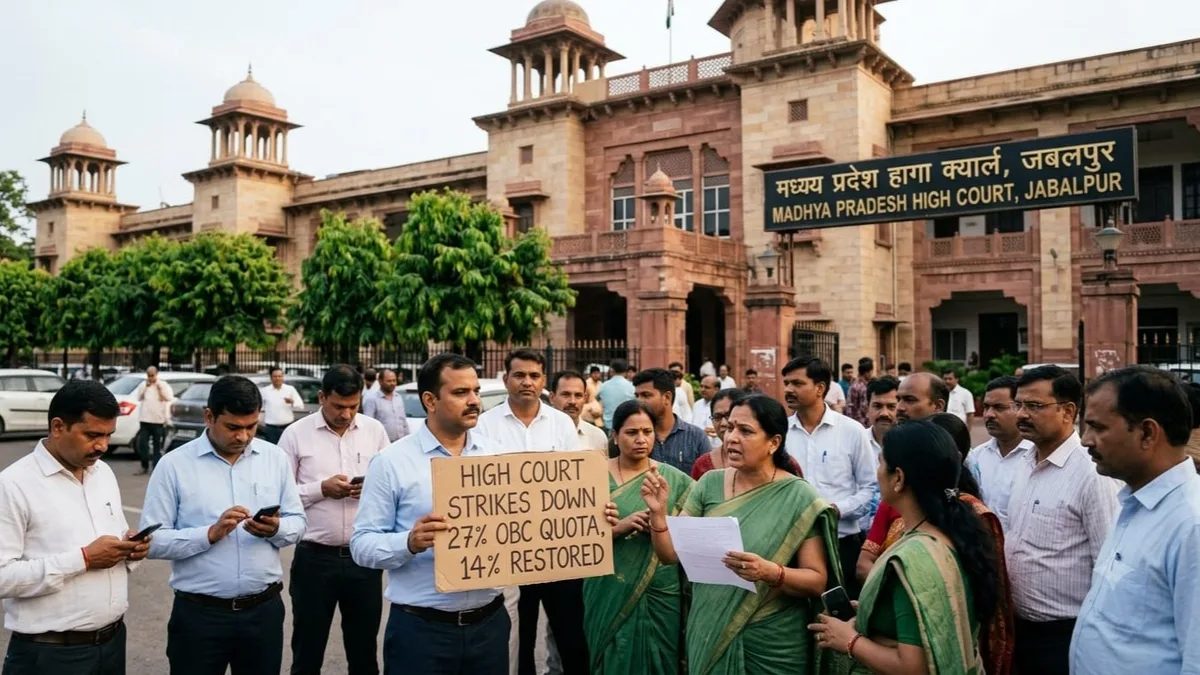
High Court Reaffirms Mandatory Quantitative Data and NCBC Consultation Rules for Legislative Reservation Amendments
Court / Authority
Madhya Pradesh High Court
Update / Judgement Date
15 Oct 2026
Date of Publication
16 Oct 2026
Source
WCP News Bulletin
Author
Pranjal Jha — WCP Legal Desk
Reading Time
3 min read
Key Proposition: A legislative act expanding reservation quotas without conducting contemporaneous survey or consulting constitutional commissions is constitutionally invalid for procedural non-compliance.
- Constitutional Law – Article 338B – Mandatory Consultation with NCBC – Omission by State Legislature – Held, renders amendment void. (Para 135)
- Jurisprudence – Quantitative Data Requirement – Assessment of Inadequacy of Representation – Reliance on stale commission report – Held, insufficient.
Background / Synopsis :
- Petitioners challenged the legislative process adopted in enacting M.P. Act 14 of 2019 without consulting NCBC.
- State produced 1983 Mahajan Commission report to justify the 27% OBC quota increase.
- Petitioners contended that 102nd Constitutional Amendment made NCBC consultation mandatory prior to statutory changes.
Issues For Consideration :
- Whether Article 338B(9) imposes a mandatory obligation on State Governments to consult NCBC before altering reservation percentages.
- Whether historical commission reports satisfy the requirement of contemporaneous quantifiable data.
Submissions Of Parties :
Petitioner / Appellant:
- Article 338B(9) mandates consultation on all major policy matters affecting socially and educationally backward classes.
- Decades-old reports cannot reflect contemporary social or economic backwardness or state service representation.
Respondent / State:
- State Legislature's authority to legislate under List II Entry 41 is independent and not subservient to advisory commissions.
Court's Observations & Analysis :
Re: Issue (i): Mandatory NCBC Consultation
- Article 338B(9) was inserted by 102nd Constitutional Amendment to ensure structured empirical evaluation.
- Failure to consult NCBC deprives the legislature of necessary expert evaluation on backwardness.
- Held: Omission of NCBC consultation renders the statutory quota enhancement procedurally fatal. (Para 135)
Re: Issue (ii): Contemporaneous Quantifiable Data
- Quantifiable data must reflect current, contemporaneous representation in state cadre services.
- 1983 Mahajan Commission data cannot justify a legislative increase in 2019.
- Held: Historical data cannot substitute for contemporaneous empirical inquiry. (Para 140)
Notable Observations: "Procedural safeguards in constitutional amendments are not empty formalities; they are conditions precedent to exercising legislative power that affects fundamental rights." (Para 128)
Decision & Directions :
- Challenge sustained on doctrinal grounds of procedural non-compliance with Article 338B and absence of empirical data.
- State granted liberty to conduct fresh survey and consult NCBC in accordance with law.
Legal Provisions Discussed & Precedents Cited :
- Constitution of India – Article 338B(9) – Mandatory consultation on major policy matters
- Constitution of India – 102nd Constitutional Amendment Act, 2018
- Pattali Makkal Katchi v. A. Mayilerumperumal, (2023) 7 SCC 481 – Followed
- M. Nagaraj v. Union of India, (2006) 8 SCC 212 – Relied on
Case Details :
Case / Party Name: Pankaj Kumar & Ors. v. State of Madhya Pradesh & Ors.
Case Number(s): Writ Petition No. 28853 of 2021
Coram / Judges: Division Bench – Hon'ble Sanjeev Sachdeva, Acting Chief Justice & Hon'ble Vinay Saraf, J.
Counsel Appearances: Senior Advocates for Petitioners; Senior Standing Counsel for Union of India & State of M.P.
Full Judgement / Attachment
Full Judgement
Frequently asked questions about Madhya Pradesh High Court
- Where does the Madhya Pradesh High Court sit and which areas does it cover?
- The Madhya Pradesh High Court has its principal seat at Jabalpur, with benches at Indore and Gwalior. It has jurisdiction over the State of Madhya Pradesh. It took its present form in 1956, when the State of Madhya Pradesh was reorganised.
- How do I check MP High Court cases at Jabalpur, Indore or Gwalior?
- The official website, mphc.gov.in, publishes bench-wise cause lists, case status and orders for the principal seat at Jabalpur and the Indore and Gwalior benches. Records are also on the eCourts High Court Services portal (hcservices.ecourts.gov.in).
- What kinds of cases does the MP High Court hear?
- It hears writs, civil and criminal appeals from across Madhya Pradesh, and income-tax appeals arising from the ITAT Jabalpur and Indore Benches. Cases are listed at the bench that has territorial jurisdiction over the district where they arise.
- What is a Writ Appeal in the MP High Court?
- Under the Madhya Pradesh Uchcha Nyayalaya (Khand Nyaya Peeth Ko Appeal) Adhiniyam, 2005, certain single-judge writ orders can be appealed to a Division Bench as a Writ Appeal. A final judgement can be taken to the Supreme Court by a Special Leave Petition under Article 136, ordinarily within 90 days.
- How can White Collar Professional help with a MP High Court matter?
- Post your requirement on White Collar Professional to receive proposals from verified Advocates, Chartered Accountants and Company Secretaries, compare them, and pay securely through the platform. This page also tracks the latest MP High Court judgements and legal updates as they are reported.