Indore Elevated Corridor Project Upheld, with High-Level Technical Oversight Ordered
Court / Authority
Madhya Pradesh High Court
Update / Judgement Date
26 Oct 2026
Date of Publication
29 Oct 2026
Case No.
Writ Petition No. 3905 of 2026
Source
WCP News Bulletin
Author
Dipanshi Bansal — WCP Legal Desk
Reading Time
6 min read
View Count
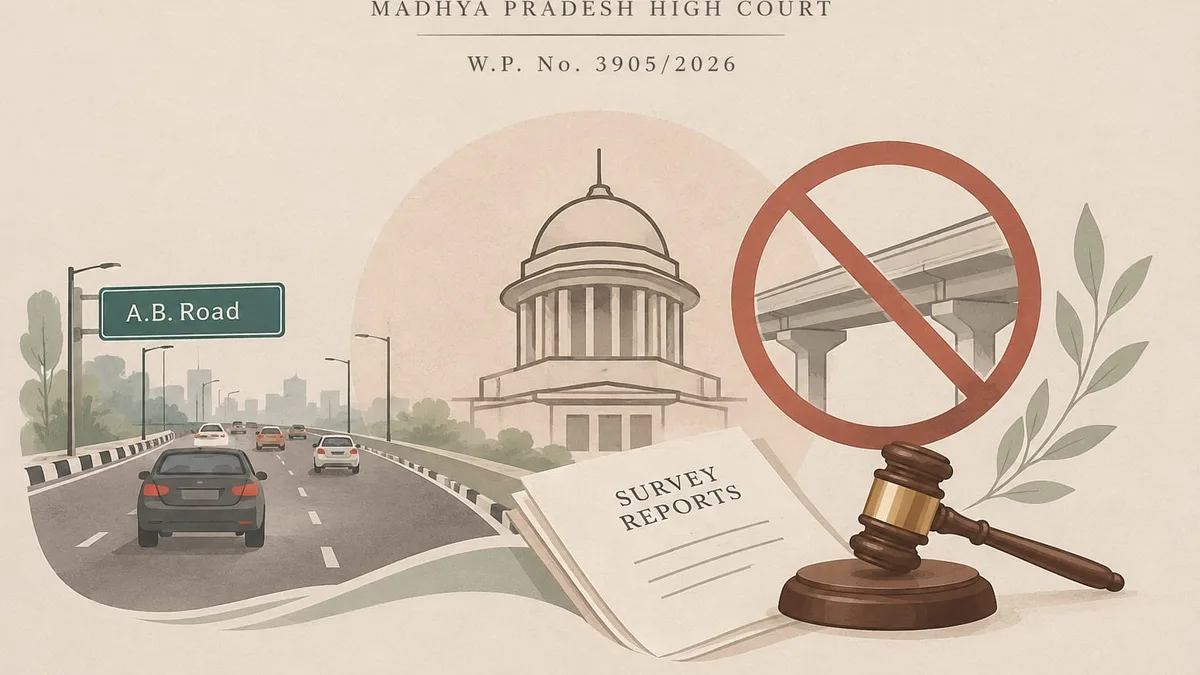
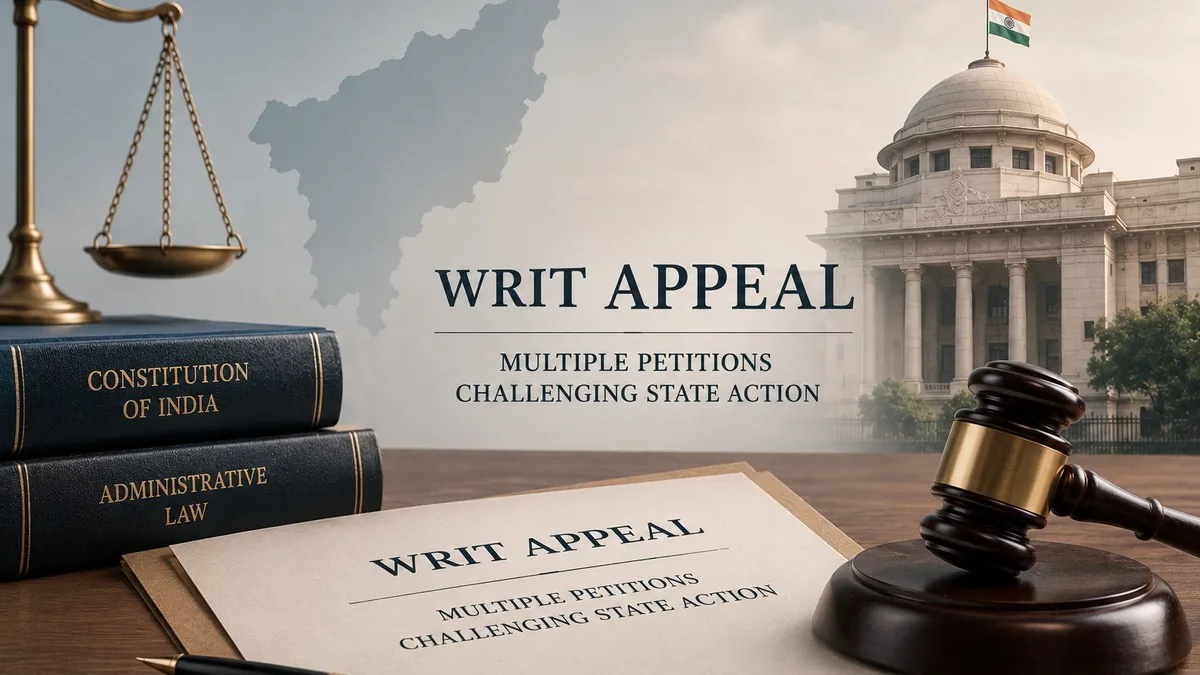
The Madhya Pradesh High Court dismissed a public interest petition challenging the proposed 6.5-kilometre elevated corridor between L.I.G. Square and Navlakha Square in Indore. The Court recognised that the petitioner’s technical concerns were not wholly unfounded, but considered that separate flyovers at each intersection could create bottlenecks and provide no additional road space. Treating the choice of infrastructure as a policy decision absent established mala fides, illegality or arbitrariness, the Court declined to halt the project, directed disclosure of its total cost and expected completion timeline, and constituted a high-level technical committee to oversee construction. (Paras 33–44)
Key Proposition: Courts ordinarily will not interfere with a government infrastructure-policy choice absent established mala fides, illegality or arbitrariness, while appropriate directions may be issued for transparency and technical oversight.
- Public interest litigation – Urban infrastructure – Elevated corridor – Whether the project should be halted in favour of separate intersection flyovers – Held, petition dismissed after weighing competing technical claims. (Paras 33–42)
- Judicial review – Policy decision – Public expenditure – Whether the Court should substitute its technical view for the State’s project choice – Held, interference not warranted absent mala fides, illegality or arbitrariness. (Para 38)
- Urban traffic planning – Technical oversight and transparency – Whether safeguards should be ordered – Held, total project cost and completion timeline to be placed in the public domain and a high-level committee constituted. (Paras 38–41)
Background / Synopsis :
- The petitioner, a chartered engineer and social worker, filed a public interest petition challenging the proposed 6.5-kilometre elevated corridor from L.I.G. Square to Navlakha Square, Indore.
- The petitioner argued that surveys and feasibility studies showed limited utility for the corridor and favoured flyovers or grade separators at individual intersections. He sought a judicial committee and an order restraining construction.
- The State and supporting intervenor argued that the corridor would add four lanes above the existing six, provide additional capacity and address traffic growth. They disputed the petitioner’s interpretation of the technical material.
- The Court noted that the Acropolis traffic study was conducted when the BRTS was operational, and considered that traffic and population growth supported the need for additional road capacity.
Issues For Consideration :
- Whether the proposed elevated corridor should be halted because of alleged deficiencies in the comparative traffic analysis and the availability of alternative flyover proposals.
- Whether the Court should interfere with the State’s infrastructure policy decision on the record presented.
- Whether transparency and technical monitoring directions were appropriate despite dismissal of the petition.
Submissions Of Parties :
Petitioner / Appellant:
- The petitioner contended that the corridor had limited utility and that government-commissioned studies favoured flyovers and grade separators at nine intersections.
- He challenged the scientific basis of the project, the handling of technical reports, the absence of a final disclosed project cost and the claimed benefits of the corridor.
- He submitted that traffic turning at nearby intersections would reduce the utility of a linear corridor and sought a high-level committee and suspension of construction pending technical review.
Respondent / State:
- The State and supporting intervenor submitted that the project had been planned to decongest A.B. Road and provide additional traffic capacity in a growing city.
- They argued that separate flyovers could create repeated ramps, merging conflicts and bottlenecks, while a continuous elevated corridor would add four lanes and reduce pressure on existing roads.
- The respondents maintained that infrastructure selection was a policy matter informed by technical evaluation and should not be displaced by competing opinions.
Court's Observations & Analysis :
Re: Competing technical proposals
- The Court acknowledged that the petitioner’s concerns about the proposed corridor were not wholly unjustified.
- It considered that separate overbridges at each entry and exit point might provide only short-term benefits, add no extra road space at ground level and cause traffic to reconverge at bottlenecks.
- The Court accepted that a continuous elevated corridor would provide four additional lanes beyond the six existing lanes and that population and vehicle growth supported adding capacity.
- Held: The petitioner’s objections did not justify discarding the entire project. (Paras 33–37)
Re: Judicial review of policy and project cost
- The Court treated the choice of an elevated corridor as a State policy decision concerning the city’s traffic problems.
- Relying on BALCO Employees’ Union v. Union of India, Narmada Bachao Andolan v. Union of India and Tata Cellular v. Union of India, it stated that intervention was not warranted unless mala fides, illegality or arbitrariness were established.
- The Court nevertheless directed the respondents to publish the project’s total cost and likely completion timeframe.
- Held: The Court declined to interfere with the project, but ordered cost and timeline transparency. (Para 38)
Re: Technical monitoring
The Court considered that the technical issues raised by the petitioner and any further problems arising during execution could be addressed by a high-level committee.
- The committee was to be headed by the PWD Chief Engineer and include members from PWD, Indore Development Authority, SGSITS, the petitioner and the intervenor society, with engineering qualifications and relevant experience.
- The committee was directed to review construction at least monthly, and decisions were to be taken by majority.
- Held: A high-level technical committee was constituted to oversee the project and advise the PWD. (Paras 39–41)
Notable Observations: None quoted verbatim in this summary.
Decision & Directions :
- The writ petition was dismissed.
- The respondents were directed to place the total project cost and the likely completion timeframe in the public domain.
- A high-level committee headed by the Chief Engineer, PWD, was constituted, comprising two PWD members, two IDA members, two SGSITS members, the petitioner and two members from the respondent No. 7 society.
- Committee members were required to have the stated civil/structural engineering qualifications and relevant expertise, subject to the Court’s stated exception for experienced SGSITS professors.
- The committee must review construction regularly at least once a month; decisions are by majority. Parties may approach the Court by appropriate application if difficulties arise.
Legal Provisions Discussed & Precedents Cited :
- Constitution of India – Article 226: writ jurisdiction invoked in the public interest petition.
- Administrative-law doctrine of judicial review of policy decisions: cited in considering whether to interfere with the infrastructure project.
- Urban road-design guidance – Indian Roads Congress guidelines on gradients: referred to in the parties’ technical submissions; the Court weighed competing engineering claims.
- BALCO Employees’ Union (Regd.) v. Union of India, (2002) 2 SCC 333 – Referred to on judicial restraint in policy matters.
- Narmada Bachao Andolan v. Union of India, (2000) 10 SCC 66 – Referred to on judicial review of policy decisions.
- Tata Cellular v. Union of India, (1994) 6 SCC 651 – Referred to on limits of judicial review.
Full Judgement / Attachment
Full Judgement
Frequently asked questions about Madhya Pradesh High Court
- Where does the Madhya Pradesh High Court sit and which areas does it cover?
- The Madhya Pradesh High Court has its principal seat at Jabalpur, with benches at Indore and Gwalior. It has jurisdiction over the State of Madhya Pradesh. It took its present form in 1956, when the State of Madhya Pradesh was reorganised.
- How do I check MP High Court cases at Jabalpur, Indore or Gwalior?
- The official website, mphc.gov.in, publishes bench-wise cause lists, case status and orders for the principal seat at Jabalpur and the Indore and Gwalior benches. Records are also on the eCourts High Court Services portal (hcservices.ecourts.gov.in).
- What kinds of cases does the MP High Court hear?
- It hears writs, civil and criminal appeals from across Madhya Pradesh, and income-tax appeals arising from the ITAT Jabalpur and Indore Benches. Cases are listed at the bench that has territorial jurisdiction over the district where they arise.
- What is a Writ Appeal in the MP High Court?
- Under the Madhya Pradesh Uchcha Nyayalaya (Khand Nyaya Peeth Ko Appeal) Adhiniyam, 2005, certain single-judge writ orders can be appealed to a Division Bench as a Writ Appeal. A final judgement can be taken to the Supreme Court by a Special Leave Petition under Article 136, ordinarily within 90 days.
- How can White Collar Professional help with a MP High Court matter?
- Post your requirement on White Collar Professional to receive proposals from verified Advocates, Chartered Accountants and Company Secretaries, compare them, and pay securely through the platform. This page also tracks the latest MP High Court judgements and legal updates as they are reported.