← back
InformativeMadhya Pradesh High Court
Madhya Pradesh High Court Strikes Down 27% OBC Reservation Amendment Act as Unconstitutional for Exceeding 50% Ceiling Limit
Court / Authority
Madhya Pradesh High Court
Update / Judgement Date
15 Oct 2026
Date of Publication
16 Oct 2026
Case No.
Writ Petition No. 23252 of 2021 (Lead Petition with connected matters)
Source
WCP News Bulletin
Author
Pranjal Jha — WCP Legal Desk
Reading Time
5 min read
Civil Law
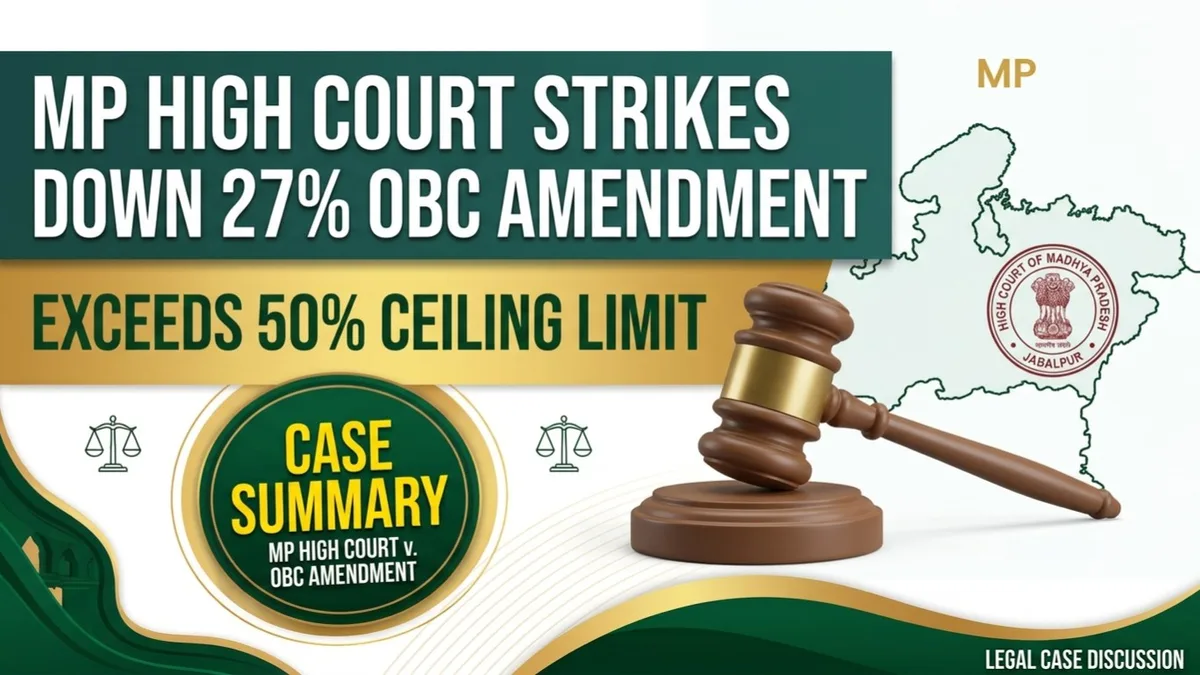
High Court of M.P. reviewed the constitutional validity of the M.P. Lok Seva (Anusuchit Jatiyon, Anusuchit Jan Jatiyon Aur Anya Pichhade Vargon Ke Liye Arakshan) Amendment Act, 2019 (Act No. 14 of 2019) enhancing OBC quota from 14% to 27%. Held that total reservations in state public employment reached 63%, directly violating the 50% ceiling limit established in Indra Sawhney and reaffirmed in Jaishri Laxmanrao Patil. State failed to conduct a contemporaneous empirical survey or establish extraordinary circumstances justifying breach of the ceiling. (Paras 199–217)
Petitioner / Appellant:
Re: Issue (i): 50% Reservation Ceiling
Key Proposition: Statutory enhancement of OBC reservation beyond 14% resulting in overall state reservation exceeding the 50% ceiling limit is unconstitutional in the absence of valid quantitative data and exceptional circumstances.
- Constitution of India – Article 16(4) & Article 14 – Reservation Ceiling – Increase of OBC quota from 14% to 27% – Held, unconstitutional. (Para 217)
- Administrative Law – Quantitative Data & Contemporaneous Survey – Failure to consult National Commission for Backward Classes (NCBC) – Held, fatal to legislative enactment. (Para 43)
- State of M.P. enacted M.P. Reservation Amendment Act, 2019 (Act No. 14 of 2019) increasing OBC quota in public services and educational admissions from 14% to 27%.
- Addition of 27% OBC quota pushed cumulative reservation in the State to 63% (16% SC, 20% ST, 27% OBC).
- Petitioners, being open category candidates and civil service aspirants, challenged Act 14 of 2019 as ultra vires Articles 14 and 16.
- High Court previously granted interim stay restricting OBC quota implementation to 14% pending final judgment.
- Whether the State Legislature has legislative power to increase OBC reservation from 14% to 27% resulting in cumulative reservation exceeding the 50% ceiling limit.
- Whether the State satisfied the constitutional mandate of collecting quantifiable data and conducting contemporaneous survey before enacting the amendment.
Petitioner / Appellant:
- The 50% ceiling limit established in Indra Sawhney and reiterated in M. Nagaraj and Jaishri Laxmanrao Patil is a binding constitutional rule under Article 141.
- State relied on stale 1983 Mahajan Commission data without conducting contemporaneous empirical study of current representation.
- Mandatory consultation with NCBC under Article 338B was entirely omitted prior to enacting the statutory amendment.
- State Legislature possesses plenary competence under Article 16(4) to provide adequate representation to backward classes based on population statistics.
- OBC population in M.P. exceeds 50%, providing sufficient justification to enhance reservation to 27%.
- The 50% limit is not immutable and can be relaxed by the State Legislature to achieve substantive equality.
Re: Issue (i): 50% Reservation Ceiling
- The 50% reservation ceiling is sacrosanct and binding across all States unless extraordinary, far-flung circumstances are demonstrated.
- State failed to demonstrate any exceptional or remote conditions to justify exceeding the 50% ceiling.
- Held: Enhancement of OBC reservation to 27% pushing total quota to 63% is unconstitutional and void. (Para 217)
- State enacted the amendment without fresh empirical data or consultation with NCBC under Article 338B.
- Reliance on decades-old commission reports does not satisfy the requirement of contemporaneous quantifiable data.
- Held: Enactment lacking contemporaneous empirical data and NCBC consultation is constitutionally unsustainable. (Para 43)
Decision & Directions :
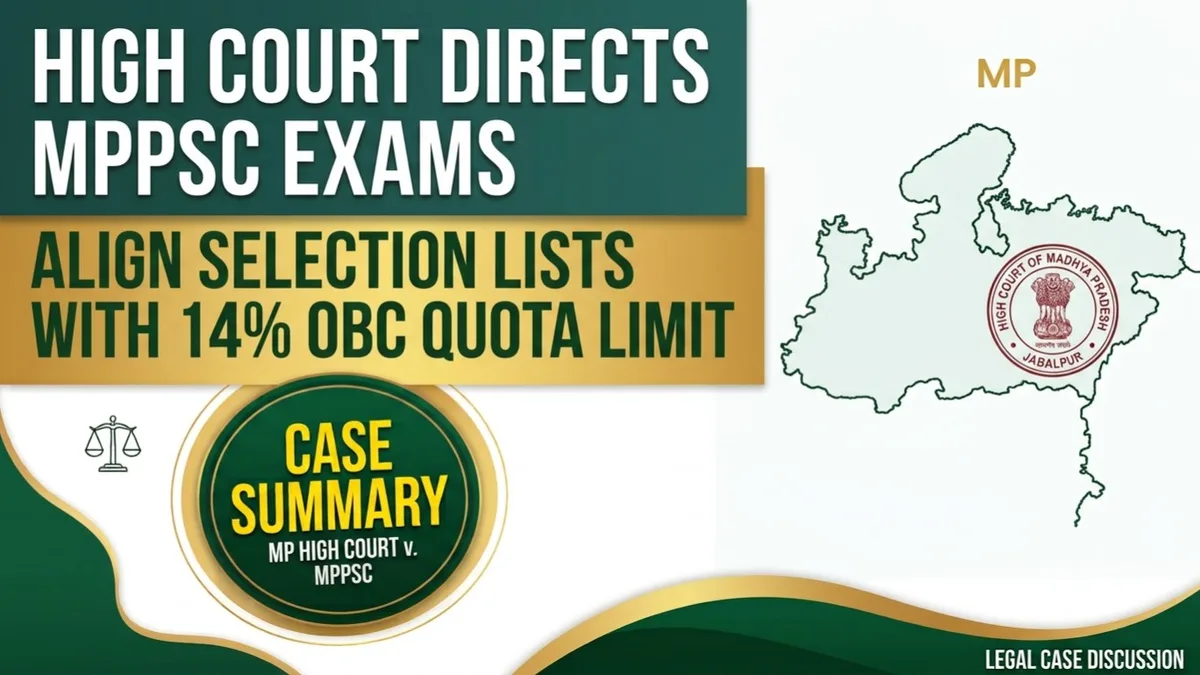
- M.P. Reservation Amendment Act, 2019 (Act No. 14 of 2019) is declared ultra vires the Constitution and struck down.
- OBC reservation in state civil services and educational admissions is restored to 14%.
- State selection authorities directed to finalize recruitment drives and admissions adhering to the 14% OBC quota ceiling.
- Constitution of India – Article 16(4) – Enabling provision for reservation in public employment
- Constitution of India – Article 338B – Mandatory consultation with National Commission for Backward Classes
- M.P. Lok Seva Amendment Act, 2019 (Act No. 14 of 2019) – Section 4 – Unconstitutional extension of OBC quota
- Indra Sawhney v. Union of India, 1992 Supp (3) SCC 217 – Followed (50% reservation ceiling limit)
- Jaishri Laxmanrao Patil v. Chief Minister, Maharashtra, (2021) 8 SCC 1 – Followed (reaffirmation of ceiling)
- M. Nagaraj v. Union of India, (2006) 8 SCC 212 – Relied on (quantifiable data requirements)
- Case / Party Name: Dr. Radha Krishna Mishra & Ors. v. State of Madhya Pradesh & Ors.
- Case Number(s): Writ Petition No. 23252 of 2021 (Lead Petition with connected matters)
- Coram / Judges: Division Bench – Hon'ble Sanjeev Sachdeva, Acting Chief Justice & Hon'ble Vinay Saraf, J.
- Counsel Appearances: Senior Advocates for Petitioners; Advocate General & Additional Advocate General for State of M.P.
Full Judgement / Attachment
Full Judgement
Frequently asked questions about Madhya Pradesh High Court
- Where does the Madhya Pradesh High Court sit and which areas does it cover?
- The Madhya Pradesh High Court has its principal seat at Jabalpur, with benches at Indore and Gwalior. It has jurisdiction over the State of Madhya Pradesh. It took its present form in 1956, when the State of Madhya Pradesh was reorganised.
- How do I check MP High Court cases at Jabalpur, Indore or Gwalior?
- The official website, mphc.gov.in, publishes bench-wise cause lists, case status and orders for the principal seat at Jabalpur and the Indore and Gwalior benches. Records are also on the eCourts High Court Services portal (hcservices.ecourts.gov.in).
- What kinds of cases does the MP High Court hear?
- It hears writs, civil and criminal appeals from across Madhya Pradesh, and income-tax appeals arising from the ITAT Jabalpur and Indore Benches. Cases are listed at the bench that has territorial jurisdiction over the district where they arise.
- What is a Writ Appeal in the MP High Court?
- Under the Madhya Pradesh Uchcha Nyayalaya (Khand Nyaya Peeth Ko Appeal) Adhiniyam, 2005, certain single-judge writ orders can be appealed to a Division Bench as a Writ Appeal. A final judgement can be taken to the Supreme Court by a Special Leave Petition under Article 136, ordinarily within 90 days.
- How can White Collar Professional help with a MP High Court matter?
- Post your requirement on White Collar Professional to receive proposals from verified Advocates, Chartered Accountants and Company Secretaries, compare them, and pay securely through the platform. This page also tracks the latest MP High Court judgements and legal updates as they are reported.