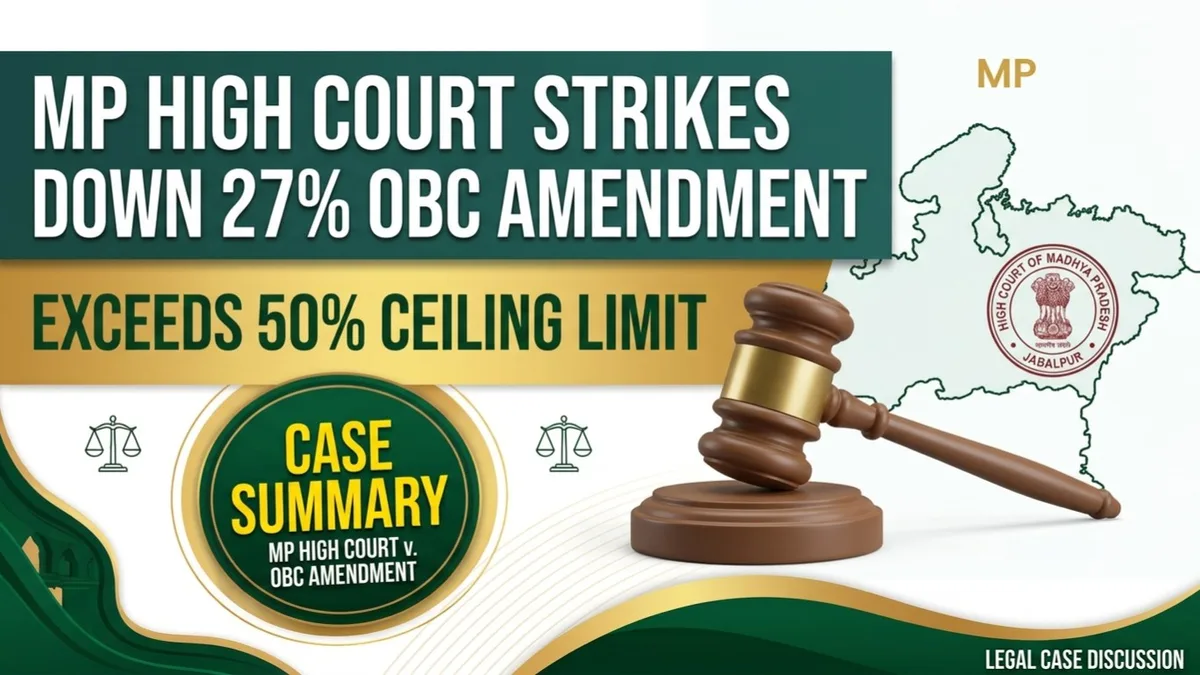
Madhya Pradesh High Court Strikes Down 27% OBC Reservation, Restores 14% Limit
Court / Authority
Madhya Pradesh High Court
Update / Judgement Date
09 Oct 2026
Date of Publication
16 Oct 2026
Case No.
Case Number W.P. No. 5901 of 2019 and connected writ petitions
Source
WCP News Bulletin
Author
Soumya Gupta — WCP Legal Desk
Reading Time
9 min read
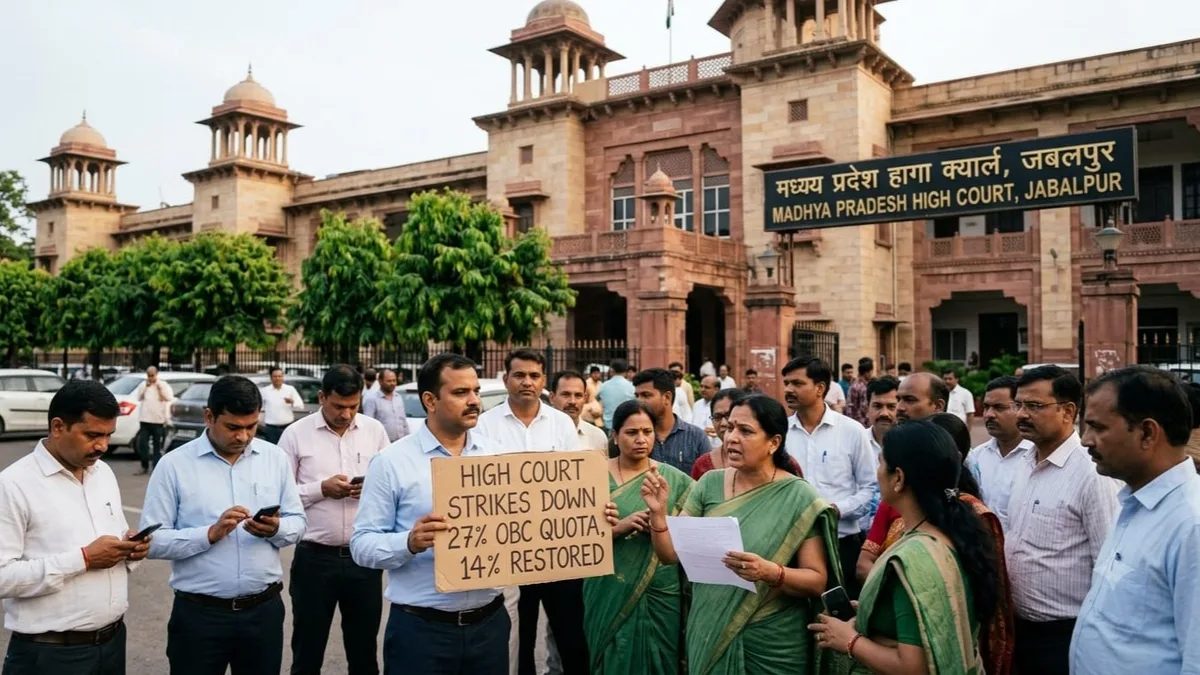
Key Proposition: In the absence of extraordinary circumstances warranting departure from the 50% reservation ceiling, Madhya Pradesh could not increase OBC reservation from 14% to 27% in public services and higher education.
● Constitution of India – Article 16(4) – OBC reservation – Can the State raise OBC reservation from 14% to 27% beyond the applicable 50% ceiling? – Held, no on the record before the Court. (Paras 195–217)
● Constitution of India – Article 213 – Ordinance-making power – Whether the 2019 increase could be sustained – Ordinance and Amendment Act held unconstitutional. (Paras 215–217)
● Constitution of India – Article 338B(9) – Consultation with NCBC – Whether consultation was required for this major policy decision – Discussed as an additional ground. (Paras 209–215)
● Recruitment appointments – Transitional relief – Whether earlier appointments should be disturbed – Appointments made up to 29 September 2022 were saved under the directions. (Paras 218–221)
Background / Synopsis :
● The connected writ petitions challenged Madhya Pradesh Ordinance No. 2 of 2019 dated 8 March 2019 and the Madhya Pradesh Lok Seva (Reservation for Scheduled Castes, Scheduled Tribes and Other Backward Classes) Amendment Act, 2019, which increased OBC reservation from 14% to 27%.
● The lead petition, W.P. No. 5901/2019, was brought by candidates who had appeared in NEET (PG) 2019 and challenged the increase in reservation during the counselling process. The dispute expanded to public-service recruitment, higher education, EWS reservation and horizontal reservation.
● Petitioners sought declarations that the increase, related rules/rosters and recruitment or admission measures were unconstitutional, principally on the ground that total reservation would exceed the 50% ceiling. Some petitions raised distinct claims concerning EWS and horizontal reservation.
● The matters were heard together because of common questions. The Court records that the hearing took place over 15 days, amounting to approximately 30 hours, and that the facts of W.P. No. 5901/2019 were used for factual clarity.
● The interim proceedings included an order dated 19 March 2019, clarification dated 31 January 2020, and a General Administration Department order dated 29 September 2022 under which 87% of appointments were to be made while the remaining 13% remained subject to the final outcome.
Issues For Consideration :
● Whether the increase of OBC reservation from 14% to 27% was constitutionally sustainable in light of the 50% ceiling.
● Whether extraordinary circumstances existed to justify exceeding the ceiling under the principles in Indra Sawhney and Jaishri Laxmanrao Patil.
● Whether the State’s decision and the 2019 legislative amendment complied with constitutional requirements, including consultation with the National Commission for Backward Classes where applicable.
● What effect striking down the amendment should have on appointments made before and after 29 September 2022.
● What disposition should follow for the connected petitions concerning EWS and horizontal reservation.
Submissions Of Parties :
Petitioners / challengers:
● The 27% OBC quota, together with other reservations, breached the 50% ceiling recognised in Indra Sawhney and reiterated in Jaishri Laxmanrao Patil.
● No extraordinary, geographically or historically specific circumstances had been established to justify crossing the ceiling; backwardness alone did not justify breaching it.
● The timing and circumstances of the Ordinance were criticised as inconsistent with the constitutional requirement of an immediate and necessary response under Article 213.
● Counsel also argued that the State had not meaningfully consulted the NCBC on a major policy affecting backward classes, relying on Article 338B(9) and Supreme Court authority.
State / respondents and parties supporting the amendment:
● The respondents opposed the challenges and defended the State’s reservation policy; the judgment records extensive submissions by counsel on both sides.
● The arguments addressed OBC representation, the constitutional framework for affirmative action, the meaning and reach of the 50% rule, and the relationship between OBC, EWS and horizontal reservations.
● The judgment discusses the position that the 50% ceiling may be exceeded only in extraordinary situations, and evaluates whether the material concerning Madhya Pradesh established such a situation.
Court's Observations & Analysis :
Re: Extent of OBC reservation and the 50% ceiling
● The Court distinguished the entitlement to reservation from the quantum of reservation: it accepted that OBCs were entitled to reservation, but found no adequate basis for increasing the percentage from 14% to 27%.
● On its assessment of the data concerning higher education and public services, the Court found OBCs adequately represented for the purposes of Article 16(4) and part of the mainstream in Madhya Pradesh.
● The Bench treated the 50% ceiling in Indra Sawhney as the governing rule and considered Jaishri Laxmanrao Patil to have reiterated that rule. The exception for extraordinary situations was narrow and was not established on the facts before it.
● The Court rejected the proposition that the size of a backward-class population, by itself, established an extraordinary circumstance allowing reservation beyond 50%. It referred to the distinction between adequate and proportionate representation.
● Held: The increase of OBC reservation from 14% to 27% could not be sustained. (Paras 195–208, 215–217; Conclusion)
Re: Constitutional process and NCBC consultation
● The Court considered Article 338B, including the NCBC’s advisory role and the requirement of consultation on major policies affecting Scheduled Castes and Backward Classes.
● It discussed the 102nd and 105th Constitutional Amendments and Supreme Court decisions on consultation. The absence of required consultation was treated as an additional concern in the assessment of the 2019 measure.
● Held: The Court found cumulative grounds for constitutional interference and struck down the 2019 Amendment Act. (Paras 209–217)
Re: Consequences for appointments and connected petitions
● The Court considered the intervening recruitment history and the State GAD order dated 29 September 2022, which had provided for 87% appointments while keeping the remaining 13% provisional.
● Appointments made pursuant to the 2019 Amendment Act up to 29 September 2022 were protected; the affected OBC appointees were not to be removed, and those posts were to be adjusted in the next three recruitment drives.
● For appointments after 29 September 2022, the Court directed that the remaining 13% posts be filled from the unreserved-category list, with recruitment agencies completing the process within three months.
● The petitions seeking additional OBC/EWS reservation and horizontal-reservation relief were treated as dismissed in view of the decision. (Paras 218–221)
Notable Observations: None reproduced as a verbatim quotation in this summary.
Decision & Directions :
1. The petitions challenging the 2019 Amendment Act were allowed; the Madhya Pradesh Lok Seva (Reservation) Amendment Act, 2019 was declared ultra vires the Constitution and struck down.
2. OBC reservation in public services and higher education was held to be 14%, not 27%, on the grounds and material considered by the Court.
3. Appointments made pursuant to the 2019 Amendment Act up to 29 September 2022 were saved and the appointees were not to be removed. The posts were to be subsumed/adjusted in the next three recruitment drives.
4. For the post-29 September 2022 position, appointments were to be made for the remaining 13% from the unreserved category, consistent with the Court’s directions.
5. MPPSC, the Madhya Pradesh State Employees Selection Board and other relevant recruitment agencies were directed to make the 13% unreserved-category appointments within three months as the outer limit.
6. The remaining connected petitions concerning additional OBC/EWS and horizontal-reservation claims were treated as dismissed. Separate opinions: None; the order was authored by Justice Anand Pathak for the Bench.
Legal Provisions Discussed & Precedents Cited :
● Constitution of India – Article 14 – Equality before law; relied on in the constitutional challenges.
● Constitution of India – Articles 15 and 16, particularly Article 16(4) – Equality and reservation in public employment; central to the permissible extent of OBC reservation.
● Constitution of India – Article 19(1)(g) and Article 21 – Cited in the pleadings challenging the reservation measures.
● Constitution of India – Article 213 – Governor’s ordinance-making power and the requirement for immediate action.
● Constitution of India – Article 338B(9) – Consultation with the National Commission for Backward Classes on major policy matters.
● Constitution of India – Article 342A(3) – State power concerning the list of socially and educationally backward classes, discussed in the context of the 105th Amendment.
● Madhya Pradesh Lok Seva (Reservation for Scheduled Castes, Scheduled Tribes and Other Backward Classes) Amendment Act, 2019 – Increased OBC reservation from 14% to 27%; struck down.
● Indra Sawhney v. Union of India, 1992 Supp (3) SCC 217 – Relied on for the 50% ceiling and narrow extraordinary-situation exception.
● Jaishri Laxmanrao Patil v. Chief Minister, (2021) 8 SCC 1 – Relied on as reaffirming the 50% ceiling and limits on exceptions.
● M. Nagaraj v. Union of India, (2006) 8 SCC 212 – Discussed in relation to reservation principles and the numerical ceiling.
● Pattali Makkal Katchi v. A. Mayilerumperumal, (2023) 7 SCC 481 – Discussed on mandatory consultation under Article 338B(9).
● Janhit Abhiyan v. Union of India, (2023) 5 SCC 1 – Discussed in relation to EWS reservation.
● Chebrolu Leela Prasad Rao – Referred to while considering the consequences for appointments made before the final decision.
● Jarnail Singh v. Lachhmi Narain Gupta, (2022) 10 SCC 595 – Referred to in the discussion of reservation doctrine.
Case Details :
Case / Party Name: Ashita Dubey and Others v. State of Madhya Pradesh and Others, with connected writ petitions.
Case Number(s): Lead matter: Writ Petition No. 5901 of 2019; numerous connected writ petitions listed in the judgment.
Coram / Judges: Justice Anand Pathak and Justice Vinay Saraf – Division Bench.
Counsel Appearances: Petitioners included Senior Advocates Aman Lekhi, Gopal Shankarnarayan, Pradeep Sancheti, Ankur Chibbar, Aparajita Singh, Shobha Gupta and Aditya Sanghi, among others. State/respondents included Senior Advocate/Additional Solicitor General K. M. Nataraj and Advocate General Prashant Singh, among others. See the judgment for the full appearance list
Full Judgement / Attachment
Full Judgement
Frequently asked questions about Madhya Pradesh High Court
- Where does the Madhya Pradesh High Court sit and which areas does it cover?
- The Madhya Pradesh High Court has its principal seat at Jabalpur, with benches at Indore and Gwalior. It has jurisdiction over the State of Madhya Pradesh. It took its present form in 1956, when the State of Madhya Pradesh was reorganised.
- How do I check MP High Court cases at Jabalpur, Indore or Gwalior?
- The official website, mphc.gov.in, publishes bench-wise cause lists, case status and orders for the principal seat at Jabalpur and the Indore and Gwalior benches. Records are also on the eCourts High Court Services portal (hcservices.ecourts.gov.in).
- What kinds of cases does the MP High Court hear?
- It hears writs, civil and criminal appeals from across Madhya Pradesh, and income-tax appeals arising from the ITAT Jabalpur and Indore Benches. Cases are listed at the bench that has territorial jurisdiction over the district where they arise.
- What is a Writ Appeal in the MP High Court?
- Under the Madhya Pradesh Uchcha Nyayalaya (Khand Nyaya Peeth Ko Appeal) Adhiniyam, 2005, certain single-judge writ orders can be appealed to a Division Bench as a Writ Appeal. A final judgement can be taken to the Supreme Court by a Special Leave Petition under Article 136, ordinarily within 90 days.
- How can White Collar Professional help with a MP High Court matter?
- Post your requirement on White Collar Professional to receive proposals from verified Advocates, Chartered Accountants and Company Secretaries, compare them, and pay securely through the platform. This page also tracks the latest MP High Court judgements and legal updates as they are reported.