Manish Khandelwal and Others v. Deepak Kumar and Others
Court / Authority
Madhya Pradesh High Court
Update / Judgement Date
09 Oct 2026
Date of Publication
16 Oct 2026
Case No.
Misc. Petition No. 583 of 2020
Source
WCP News Bulletin
Author
Soumya Gupta — WCP Legal Desk
Reading Time
9 min read
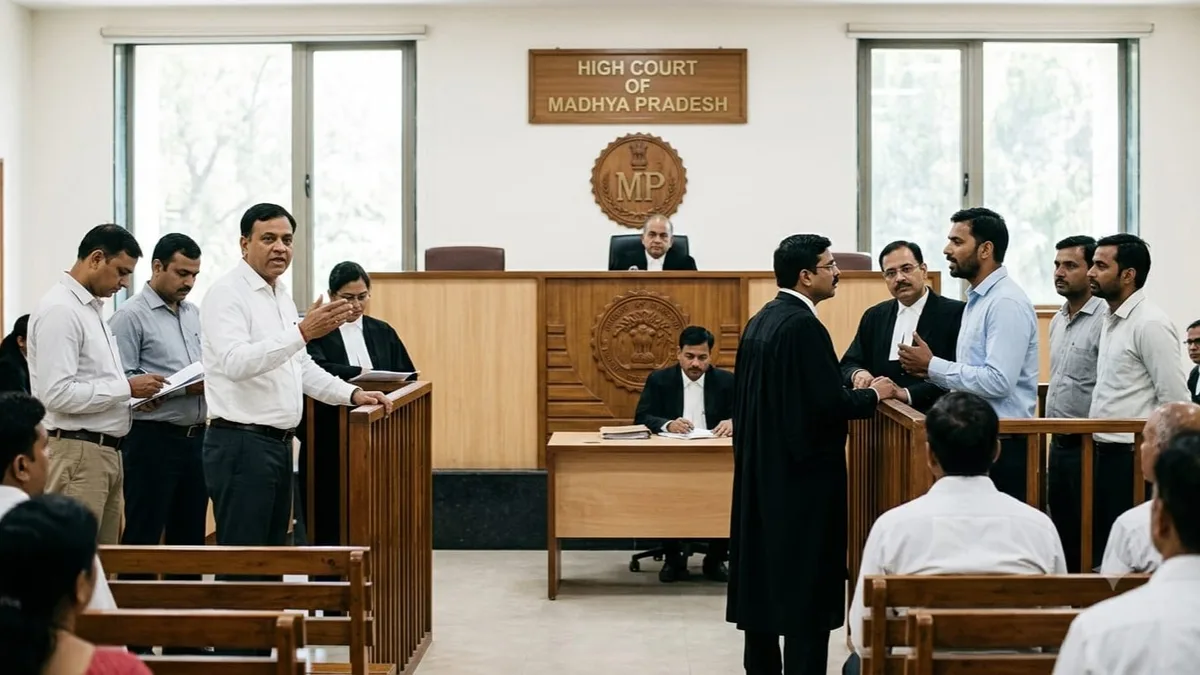
Key Proposition: Where longstanding revenue records and a prior order support private Bhumiswami rights, mutation cannot be refused merely on the basis of an unsupported Patwari report alleging Government ownership; an adverse consequential order affecting purchasers, passed without notice, may also be set aside under Article 227.
Background / Synopsis:
● The petitioners claimed to have purchased land bearing Survey Nos. 669/3, 669/4 and 669/5, total area 2.277 hectares, situated at Village Sanawadiya, Tehsil and District Indore, through a registered sale deed dated 03.08.2010 from respondent Deepak Kumar (also referred to in parts of the order as Deepak Jain).
● The land had earlier been recorded in the names of Kalu, Fuliya and Moolchand. The judgment records that Bhumiswami rights were conferred on the occupants by an order dated 15.04.1986 and that the relevant names continued in revenue records before Chhotelal and his legal heirs were recorded.
● Deepak Kumar purchased the land from Chhotelal’s legal heirs on 31.03.2010 and his name was mutated on 31.05.2010. The petitioners then sought mutation under Sections 109–110 of the M.P. Land Revenue Code, 1959 (MPLRC).
● The Tehsildar rejected the petitioners’ mutation application on 03.11.2016, relying on a Patwari report stating that the land was recorded as Government land in the Misal Bandobast. The SDO dismissed the first appeal on 29.09.2017 and the Additional Commissioner (Revenue) dismissed the second appeal by order dated 25.10.2018.
● During pendency of the writ petition, an Additional Collector passed an ex-parte order on 18.10.2021 cancelling Deepak Kumar’s mutation on the additional ground that the land was patta land and had been transferred without permission. The High Court noted that the petitioners had not been given notice although the land had already been sold to them.
Issues for Consideration:
● Whether the revenue authorities were justified in refusing mutation on the basis of a Patwari report that the land was Government land.
● Whether historical revenue entries and the order dated 15.04.1986 recording Bhumiswami rights, along with registered sale deeds, were properly considered.
● Whether the restrictions introduced by the 1992 amendment to Section 158(3) MPLRC applied to the land and transfers in question.
● Whether the High Court should interfere under Article 227 with the concurrent revenue orders as perverse or legally improper.
● Whether the ex-parte order dated 18.10.2021 cancelling the vendor’s mutation could stand when the petitioners, as subsequent purchasers, had not been given notice.
Submissions on Behalf of the Petitioners:
● The petitioners argued that Bhumiswami rights had accrued to the earlier holders and were reflected in official revenue records before the 1992 amendment came into force on 28.10.1992.
● They submitted that their purchase was through a registered sale deed and that such a document carries a presumption of validity unless set aside by a competent court.
● They challenged the Patwari report as unsupported by the underlying settlement record and argued that it could not override the relevant Khasra entries and prior mutation proceedings.
● They relied on Prem Singh v. Birbal, Ranveer Singh v. State of M.P., Koli Parshottambhai v. State of Gujarat, State of M.P. v. Adhunik Grih Nirman and State of M.P. v. Bharat Singh, among other decisions.
● They also contended that the subsequent order dated 18.10.2021 was passed ex parte and without notice to them, despite their interest as purchasers.
Submissions on Behalf of the State:
● The State argued that mutation is for fiscal purposes and neither creates nor extinguishes title; disputed title should be decided by a competent civil court.
● It contended that a registered sale deed cannot convey a better title than the seller possessed and that the petitioners had not established a legally valid source through which Government land became private property.
● The State relied on the rebuttable nature of the presumption attached to revenue entries and argued that Sections 158(3) and 165(7-b) MPLRC may restrict transfer of Government lease or patta land without the required permission.
● It further argued that the High Court’s supervisory jurisdiction under Article 227 is limited and should not be used as a third round of factual review.
Court’s Observations and Reasoning:
● The Court examined the Additional Commissioner’s order and the stated basis that the Patwari report described the land as Government land under the Misal Bandobast.
● The Court noted the recorded history of the land, including the prior entries in the names of Kalu, Fuliya and Moolchand, the order dated 15.04.1986 granting Bhumiswami rights, subsequent entries in favour of Chhotelal and his heirs, and the mutation in favour of Deepak Kumar in 2010. (Paras 8, 11)
● It held that the 1992 amendment introducing transfer-permission requirements could not simply be applied to disregard Bhumiswami rights which, according to the record discussed by the Court, had accrued before the amendment. (Paras 10–11, 18)
● Relying on Prem Singh v. Birbal, the Court observed that a registered document is prima facie presumed valid and that the party seeking to rebut the presumption bears the burden of proof. It found the Patwari report alone insufficient to deny mutation in the circumstances of this case. (Para 11)
● The Court discussed Ranveer Singh v. State of M.P. and other authorities on the limits of delayed suo motu revenue action and the need to protect settled positions and bona fide purchasers. (Paras 12–15)
● On Article 227, the Court relied on Estralla Rubber v. Dass Estate Pvt. Ltd. and Surya Devi Rai v. Ram Chander Rai to explain that supervisory jurisdiction is not an ordinary appeal, but can be exercised where findings are perverse, unsupported by evidence, or cause grave injustice. (Paras 16–17)
● The Court found the SDO’s and Additional Commissioner’s orders perverse, illegal and improper, and concluded that interference was warranted because the findings did not accord with the record or the applicable law. (Para 18)
● The Court also held that the consequential order dated 18.10.2021, passed ex parte without impleading or notifying the petitioners, could not be sustained. (Para 20)
Decision / Final Directions:
1. The miscellaneous petition was allowed. (Para 20)
2. The challenged orders dated 03.11.2016 (Tehsildar), 29.09.2017 (SDO) and 25.10.2018 (Additional Commissioner/Revenue) were set aside through the relief granted in the petition.
3. The consequential ex-parte order dated 18.10.2021 cancelling the mutation in favour of respondent No. 1 was also set aside, even though it had not been brought into the prayer clause by formal amendment, because it was passed during the pendency of the proceedings and without making the petitioners parties.
4. The petition was disposed of. The order does not set out a separate detailed direction on the mechanics or timing of a fresh mutation entry; the relief is recorded as allowing the prayers in the petition.
Important Legal Provisions:
● Article 227, Constitution of India – Supervisory jurisdiction of the High Court over subordinate courts and tribunals.
● Sections 109–110, M.P. Land Revenue Code, 1959 – Application and proceedings for mutation of names in revenue records.
● Section 158(3), MPLRC – Deemed Bhumiswami status for specified persons holding land under qualifying lease/allotment; the 1992 amendment introduced restrictions on transfer in the circumstances described in the provision.
● Section 165(7-b), MPLRC – Permission requirements referred to in the judgment in relation to transfer of certain lands.
● Section 44, MPLRC – First and second appeals in the revenue hierarchy, as referred to in the procedural history.
Important Cases Referred To:
● Prem Singh v. Birbal, (2006) 5 SCC 353 – Presumption of validity of a registered document and burden to rebut it.
● Ranveer Singh v. State of M.P., 2010 (4) MPLJ 178 – Limits on exercise of suo motu revenue powers after delay, as discussed in the order.
● Koli Parshottambhai v. State of Gujarat, SCA No. 253/2013, decided 17.02.2026 – Long delay in revenue action and protection of bona fide purchasers.
● State of M.P. v. Adhunik Grih Nirman Sahakari Samiti, W.A. No. 275/2013, decided 04.03.2024 – Transfer restrictions, settled property rights and notice to affected persons.
● State of M.P. v. Bharat Singh, W.A. No. 613/2023 – Earlier Bhumiswami rights and applicability of transfer restrictions.
● Estralla Rubber v. Dass Estate Pvt. Ltd., (2001) 8 SCC 97 – Scope and limits of Article 227 supervisory jurisdiction.
● Surya Devi Rai v. Ram Chander Rai, (2003) 6 SCC 675 – Principles governing certiorari and supervisory jurisdiction.
● Sawarni v. Inder Kaur, (1996) 6 SCC 223; Balwant Singh v. Daulat Singh, (1997) 7 SCC 137; Jitendra Singh v. State of M.P., 2021 SCC OnLine SC 802 – Authorities cited in the State’s submissions on the limited effect of mutation entries.
Case Details:
● Neutral Citation: 2026:MPHC-IND:28599.
● Court: High Court of Madhya Pradesh at Indore.
● Coram: Hon’ble Shri Justice Sandeep N. Bhatt.
● Heard on: 01 October 2026; pronounced on: 09 October 2026.
● Petitioners’ counsel: Shri Veer Kumar Jain, Senior Advocate, with Shri Prasanna R. Bhatnagar, Advocate.
● Respondent No. 1’s counsel: Shri Jamil Sheikh, Advocate. State counsel: Ms Pranjali Yajurvedi, Government Advocate.
● Reportable: Yes, as recorded in the judgment
Full Judgement / Attachment
Full Judgement
Frequently asked questions about Madhya Pradesh High Court
- Where does the Madhya Pradesh High Court sit and which areas does it cover?
- The Madhya Pradesh High Court has its principal seat at Jabalpur, with benches at Indore and Gwalior. It has jurisdiction over the State of Madhya Pradesh. It took its present form in 1956, when the State of Madhya Pradesh was reorganised.
- How do I check MP High Court cases at Jabalpur, Indore or Gwalior?
- The official website, mphc.gov.in, publishes bench-wise cause lists, case status and orders for the principal seat at Jabalpur and the Indore and Gwalior benches. Records are also on the eCourts High Court Services portal (hcservices.ecourts.gov.in).
- What kinds of cases does the MP High Court hear?
- It hears writs, civil and criminal appeals from across Madhya Pradesh, and income-tax appeals arising from the ITAT Jabalpur and Indore Benches. Cases are listed at the bench that has territorial jurisdiction over the district where they arise.
- What is a Writ Appeal in the MP High Court?
- Under the Madhya Pradesh Uchcha Nyayalaya (Khand Nyaya Peeth Ko Appeal) Adhiniyam, 2005, certain single-judge writ orders can be appealed to a Division Bench as a Writ Appeal. A final judgement can be taken to the Supreme Court by a Special Leave Petition under Article 136, ordinarily within 90 days.
- How can White Collar Professional help with a MP High Court matter?
- Post your requirement on White Collar Professional to receive proposals from verified Advocates, Chartered Accountants and Company Secretaries, compare them, and pay securely through the platform. This page also tracks the latest MP High Court judgements and legal updates as they are reported.