No Regularisation, But a Call for Policy: MP High Court Refuses Mandamus for Long-Serving Guest Faculty and Urges the State to Absorb Them as a Separate Class
Court / Authority
Madhya Pradesh High Court
Update / Judgement Date
23 Nov 2026
Source
WCP News Bulletin
Author
Arshee Saifi — WCP Legal Desk
Reading Time
7 min read
View Count
Key Proposition: Long, continuous service as guest faculty, even after an advertised selection, does not entitle a teacher to regularisation where the Recruitment Rules make no provision for it and en-bloc absorption would defeat statutory reservations; but the State, having run its colleges on under-paid guest faculty for decades, ought to frame a policy to absorb those who became over-age in its service.
A. Background / Synopsis :
- The appellants were engaged on contract against vacant posts of Assistant Professor, Sports Officer and Librarian in Government Colleges after advertisements and a selection process, holding the prescribed qualifications (Paras 3–4).
- They have served continuously for 10 to 30 years, some as in-charge of institutions, but remain contractual and are denied the pay and benefits of regular appointees (Paras 5–6).
- Their writ petitions seeking regularisation, pay parity and protection from replacement were rejected by the Single Judge (lead: order of 12.03.2026 in W.P. No. 6665/2025), who likened them to guest faculty engaged for one session (Paras 2, 7–9).
- They say steps to discontinue them began as soon as the impugned orders were uploaded (Paras 10–11).
B. Issues For Consideration :
- Whether long-serving guest faculty appointed after advertisement and selection are entitled to regularisation or absorption (Paras 8, 23).
- Whether they are entitled to pay parity and protection against replacement by fresh contractual appointees or transferred regular employees (Paras 10, 21).
C. Submissions Of Parties :
- Appellants (Mr. Colin Gonsalves, Senior Advocate, and others):
Their appointments were not backdoor entries but followed advertisement, selection and the prescribed qualifications (Para 13).
They have worked 10–30 years against vacant sanctioned posts, some as in-charge of colleges, and cannot be equated with one-session guest faculty (Paras 13, 15–16).
Umadevi (2006) 4 SCC 1, Jaggo v. Union of India (2024 INSC 1034) and Somesh Thapliyal (2021) 10 SCC 16 support regularisation; equal pay for equal work applies (Paras 15, 18).
Replacing one contractual employee with another is arbitrary; interim protection is needed (Paras 17, 20–21).
- State:
Courts should not interfere in policy matters (BALCO Employees Union (2002) 2 SCC 333; Directorate of Film Festivals v. Gaurav Ashwin Jain (2007) 4 SCC 737) (Para 22).
D. Court's Observations & Analysis :
- Re: Regularisation under the Rules
The posts are governed by the 1990 Rules, which contain no provision for regularising guest faculty (Para 23).
The 31.12.2024 amendment (Rule 11(8)) gives guest faculty 25% reservation, weightage and age relaxation in MPPSC selection; most have competed, but these appellants have crossed the upper age limit and are ineligible (Para 23).
- Re: Reservation and equality
Recruitment is governed by Article 309 rules, PSC consultation under Articles 315–323 and the reservation statutes and rules for SC/ST/OBC, persons with disabilities (4%), women (30–33%) and EWS (10%) (Para 24).
Regularisation against sanctioned vacant posts would breach these reservations, so the writ court rightly declined mandamus (Para 25).
- Re: The State's responsibility
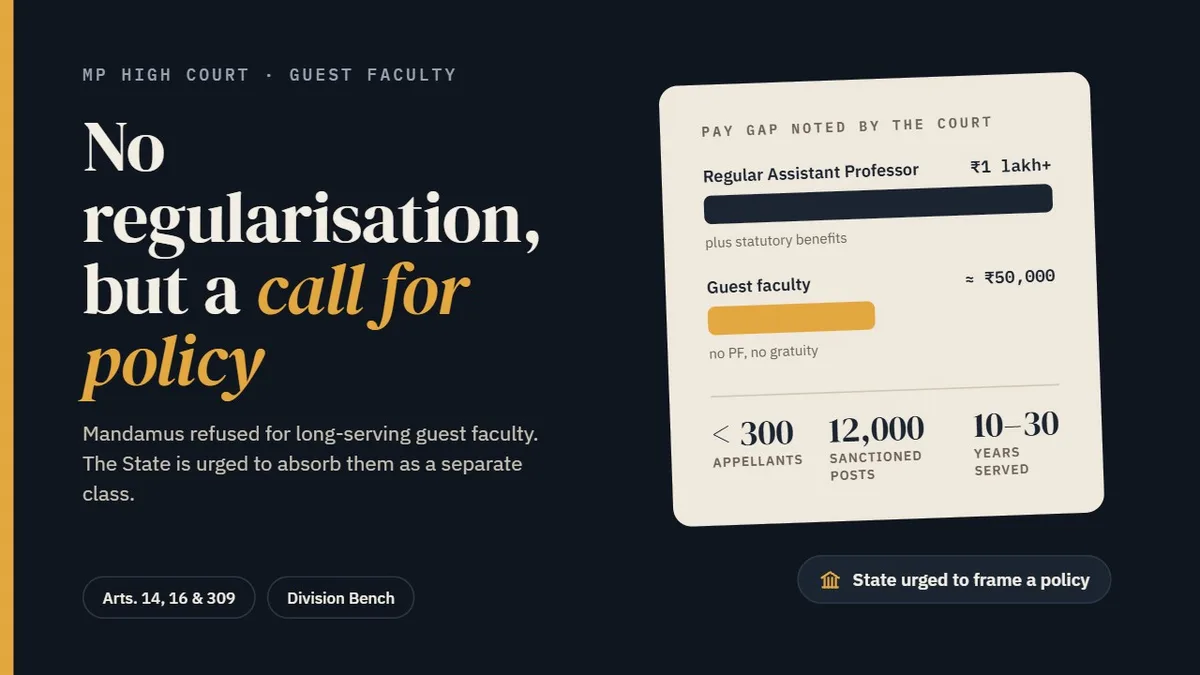
Fewer than 300 such appellants serve against 12,000 sanctioned posts in 571 colleges; the State did not recruit for years and saved crores by paying guest faculty about Rs. 50,000 a month without PF or gratuity, against Rs. 1 lakh plus benefits for regulars (Para 26).
Their engagement was not illegal: the UGC Revised Guidelines of 28.01.2019 require the same selection procedure as for regular Assistant Professors; it was a stop-gap arrangement (Para 26).
Jaggo's observations on long, essential, recurring service are reproduced; the over-age teachers have a legitimate expectation of a policy like the one for daily wagers (Paras 26–27).
Held: No mandamus; the Government should frame a policy to regularise guest faculty as a separate class in addition to regular posts. (Paras 25, 28)
Notable Observations:
"The Government has been saving crores of revenue by not recruiting and paying regular salaries to Assistant Professors and Lecturers and has been taking work from these guest faculty members by paying them almost 1/4th meagre salary…" (Para 26)
"…academicians, lecturers and professors are the intellectual backbone of any nation." (Para 26)
"The Government should come up with a policy to regularise the services of guest faculty as a separate class in addition to the regular post in the government colleges." (Para 28)
E. Decision & Directions :
- Writ appeals disposed of; the Single Judge's refusal of mandamus is not interfered with. (Paras 25, 28)
- Court records its hope and trust that the State will frame a policy to absorb the guest faculty as a separate class, on the lines of the 'Sthai Karmi' policy for daily wagers. (Para 28)
- Record notes: the uploaded file is named WA_1113_2026, but the lead case is WA 1345/2026; para 22 refers to the 'learned Advocate General' though the appearance lists the Government Advocate; the daily-wager policy is dated '7.10.2016' in para 26 but '10.7.2016' in para 28; 'eith', 'Gonsalve'.
- Separate Opinions: None (order written by Vivek Rusia, J.).
F. Legal Provisions Discussed & Precedents Cited :
- Constitution of India – Articles 14, 15, 16, 309 (proviso), 315–323.
- M.P. Educational Service (Collegiate Branch) Recruitment Rules, 1990 – Rule 11(8) (amendment of 31.12.2024).
- M.P. Lok Seva (Anusuchit Jatiyon, Anusuchit Jan Jatiyon Aur Anya Pichhade Vargon Ke Liye Arakshan) Adhiniyam, 1994; Rights of Persons with Disabilities Act, 2016; M.P. Civil Services (Special Provision for Appointment of Women) Rules, 1997; GAD Circular of 02.07.2019 (EWS).
- M.P. Uccha Nyayalaya (Khand Nyayapeeth Ko Appeal) Adhiniyam, 2005 – Section 2(1); UGC Revised Guidelines, 28.01.2019.
- Secretary, State of Karnataka v. Umadevi, (2006) 4 SCC 1 – Relied on by appellants.
- Jaggo v. Union of India, 2024 INSC 1034 – Reproduced; considered.
- Somesh Thapliyal v. Vice Chancellor, H.N.B. Garhwal University, (2021) 10 SCC 16 – Relied on by appellants.
- BALCO Employees Union (Regd.) v. Union of India, (2002) 2 SCC 333 – Relied on by State.
- Directorate of Film Festivals v. Gaurav Ashwin Jain, (2007) 4 SCC 737 – Relied on by State.
G. Case Details :
- Case / Party Name: Dr. Bhawani Singh & Anr. v. State of Madhya Pradesh (and connected writ appeals)
- Case Number(s): Writ Appeal No. 1345 of 2026 with WA Nos. 872, 873, 1113, 1176, 1344 & 1605 of 2026 [2026:MPHC-JBP:92432] (CNR MPHC010292122026)
- Coram / Judges: Vivek Rusia & Pradeep Mittal, JJ. – Division Bench (order by Vivek Rusia, J.)
- Counsel Appearances: For the Appellants: Mr. Colin Gonsalves, Senior Advocate (through VC), with Mr. Devansh Verma; Mr. Ravi Malgani; Mr. Arun Kumar Singh; Mr. Satya Prakash Mishra, Advocates. For the State: Mr. Rajesh Tiwari, Government Advocate. For Respondent No. 5 (WA 1605/2026): Smt. Nirmala Nayak, Advocate.
Disclaimer: This summary is an editorial aid and does not form part of the judgment. Refer to the original judgment before citing.
Full Judgement / Attachment
Full Judgement
Frequently asked questions about Madhya Pradesh High Court
- Where does the Madhya Pradesh High Court sit and which areas does it cover?
- The Madhya Pradesh High Court has its principal seat at Jabalpur, with benches at Indore and Gwalior. It has jurisdiction over the State of Madhya Pradesh. It took its present form in 1956, when the State of Madhya Pradesh was reorganised.
- How do I check MP High Court cases at Jabalpur, Indore or Gwalior?
- The official website, mphc.gov.in, publishes bench-wise cause lists, case status and orders for the principal seat at Jabalpur and the Indore and Gwalior benches. Records are also on the eCourts High Court Services portal (hcservices.ecourts.gov.in).
- What kinds of cases does the MP High Court hear?
- It hears writs, civil and criminal appeals from across Madhya Pradesh, and income-tax appeals arising from the ITAT Jabalpur and Indore Benches. Cases are listed at the bench that has territorial jurisdiction over the district where they arise.
- What is a Writ Appeal in the MP High Court?
- Under the Madhya Pradesh Uchcha Nyayalaya (Khand Nyaya Peeth Ko Appeal) Adhiniyam, 2005, certain single-judge writ orders can be appealed to a Division Bench as a Writ Appeal. A final judgement can be taken to the Supreme Court by a Special Leave Petition under Article 136, ordinarily within 90 days.
- How can White Collar Professional help with a MP High Court matter?
- Post your requirement on White Collar Professional to receive proposals from verified Advocates, Chartered Accountants and Company Secretaries, compare them, and pay securely through the platform. This page also tracks the latest MP High Court judgements and legal updates as they are reported.