Specific Performance of Agreement to Sell: Evidentiary Value of Handwriting Expert Opinion and Restitution under Section 144 CPC
Court / Authority
Madhya Pradesh High Court
Update / Judgement Date
09 Oct 2026
Date of Publication
16 Oct 2026
Case No.
first appeal no. 287/2002
Source
WCP News Bulletin
Author
Soumya Gupta — WCP Legal Desk
Reading Time
8 min read
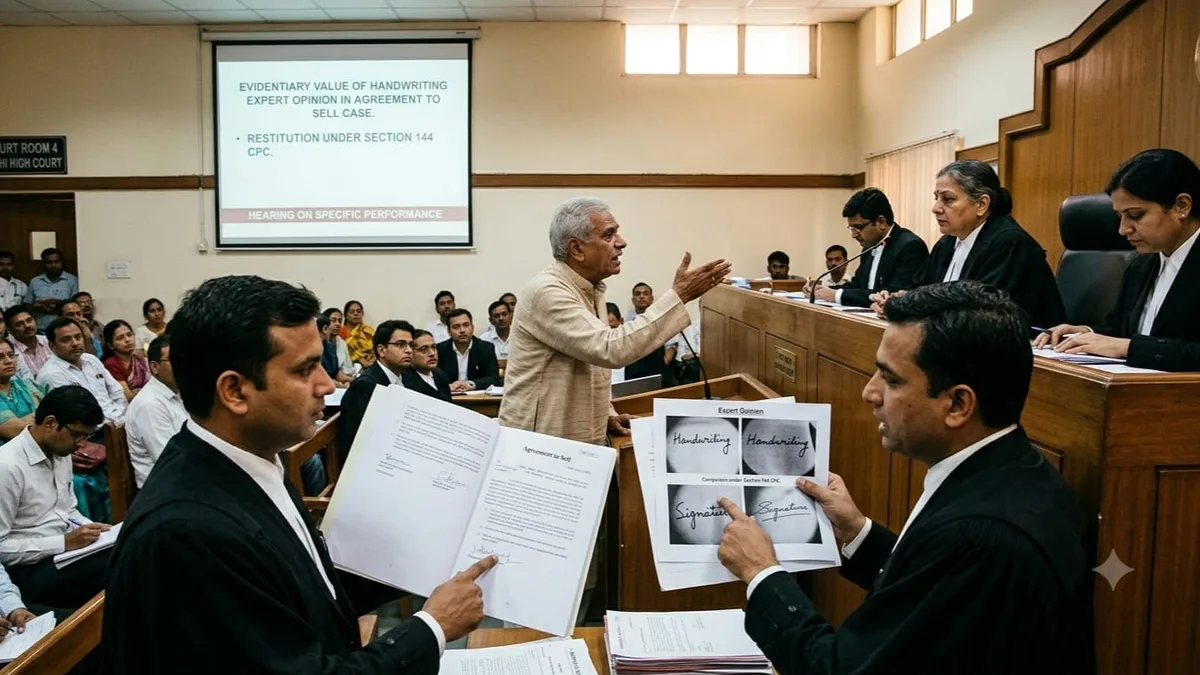
The dispute concerned agricultural land bearing Survey No. 150/2/2, admeasuring 0.85 hectare, situated at Village Rau, Tehsil and District Indore. According to the plaintiff, an agreement/sauda receipt was executed on 5 February 1980 for a total consideration of ₹28,501, out of which ₹5,001 was paid as earnest money. The plaintiff asserted that possession of the land was handed over to him and that he remained ready and willing to pay the balance amount of ₹23,500 and obtain execution of the sale deed.
The plaintiff published a public notice in a newspaper on 6 March 1980, took steps to obtain relevant permissions/NOCs, and sent a legal notice to the defendant on 5 January 1981 asking him to execute the sale deed. The defendant did not execute the sale deed. The dispute included whether the date for performance in the receipt had been altered from 10 April 1980 to 10 April 1981 and whether an entry concerning delivery of possession had been added later.
The original suit had earlier been decreed ex parte in 1995 and, pursuant to execution proceedings, a sale deed was executed in favour of the plaintiff. In 2000, the High Court set aside the earlier ex parte decree in a miscellaneous appeal and remanded the matter for fresh consideration. After reconsideration, the trial court dismissed the suit on 22 March 2002. The plaintiff then filed the present first appeal.
3. Issues Before the High Court
● Whether the trial court misappreciated the pleadings and oral/documentary evidence while dismissing the suit.
● Whether the trial court was justified in relying on the handwriting expert’s opinion despite alleged contradictions, limitations and lack of corroboration.
● Whether the alterations/interpolation alleged in the sauda receipt affected its validity, and whether time was the essence of the contract.
● Whether the plaintiff was entitled to specific performance in light of the earlier decree and the sale deed already executed through court proceedings, including the consequences under Section 144 CPC.
4. Arguments of the Parties
A. Appellant/Plaintiff
The appellant argued that he had paid the earnest money, taken possession, published notice, sought necessary NOCs and repeatedly demonstrated readiness and willingness to pay the balance consideration. He contended that the defendant had admitted important facts in the written statement, including the transaction and receipt of the advance amount. The appellant also challenged the handwriting expert’s report and argued that the trial court had wrongly treated the date of performance as decisive and had failed to properly consider the sale deed already executed in his favour.
B. Respondents/Defendants
The respondents argued that the receipt had been altered without the original defendant’s consent, particularly by changing the date of performance from 10 April 1980 to 10 April 1981 and by adding a statement regarding possession. They maintained that the plaintiff had not fulfilled the contractual conditions within time and had not established the required readiness and willingness. They also relied on the trial court’s findings and argued that the earlier ex parte decree and its execution did not prevent the court from deciding the suit afresh after remand.
5. Relevant Legal Provisions
● Section 96, Code of Civil Procedure, 1908 — appeal from an original decree.
● Order XLI Rule 1, CPC — form of appeal and accompanying judgment.
● Section 144, CPC — restitution where a decree or order is varied, reversed, set aside or modified.
● Order XII Rule 6, CPC — judgment on admissions, referred to in relation to admissions in the written statement.
● Sections 14, 16(c) and 20 of the Specific Relief Act, 1963 (as discussed in the judgment) — specific performance, readiness and willingness, and judicial discretion.
● Sections 2–10 of the Indian Contract Act, 1872 — principles concerning proposals, acceptance and enforceable contracts.
● Sections 39 and 72 of the Bharatiya Sakshya Adhiniyam, 2023 — expert opinion and comparison of signatures/writing, as referred to in the judgment.
6. Court’s Analysis and Findings
A. Handwriting expert’s report
The High Court found that the trial court had relied heavily on the handwriting expert’s report, but the report could not safely be accepted in its entirety. The record did not show that the negatives of the photographs had been filed, and the expert admitted that the photographs had not been taken by him. The Court also found problems with parts of the report, including conclusions that went beyond the expert’s proper role and findings made without appropriate specimen/admitted short signatures. The report lacked sufficient corroboration from the other evidence.
B. Whether time was the essence of the contract
The Court held that the receipt did not expressly state that time was the essence of the contract. Merely mentioning a date for performance does not, by itself, establish that time was essential, particularly in a contract concerning immovable property. The Court also considered the surrounding circumstances, the steps taken to obtain NOCs, the notice issued by the plaintiff, and the fact that the suit was filed within the limitation period.
C. Readiness and willingness
The High Court observed that the defendants had not disputed the plaintiff’s financial capacity and that the plaintiff’s intention to pay the balance consideration was not shown to have been genuinely disputed. The Court considered the public notice, legal notice and steps taken towards obtaining permissions as relevant circumstances supporting the plaintiff’s case.
D. Admissions and the earlier sale deed
The Court considered the admissions made in the written statement regarding ownership/possession and the admitted receipt of earnest money. It also took into account that the earlier ex parte decree had led to execution proceedings and a sale deed in favour of the plaintiff. The Court held that the trial court had committed serious errors in its appreciation of the pleadings and evidence and that the plaintiff’s claim deserved to be allowed.
E. Restitution under Section 144 CPC
The High Court referred to Section 144 CPC and the Supreme Court’s decision in Bhikchand v. Shamabai Dhanraj Gugale. It observed that, following reversal of the impugned judgment and decree, consequential steps concerning restoration of the appellant’s title and possession could be taken in accordance with Section 144 CPC, with the object of avoiding further multiplicity of proceedings.
7. Cases Referred to
● Ramesh Chandra Agrawal v. Regency Hospital Limited, (2009) 9 SCC 709 — expert evidence.
● C. Kamalakkannan v. State of Tamil Nadu, (2025) 4 SCC 487 — relied upon in the discussion of expert evidence.
● Chand Rani v. Kamal Rani, (1993) 1 SCC 519 — whether time is the essence of a contract for sale of immovable property.
● Gomathinayagam Pillai v. Palaniswami Nadar, AIR 1967 SC 868 — contractual time stipulations.
● J.P. Builders v. A. Ramadas Rao, (2011) 1 SCC 429 — readiness and willingness for specific performance.
● K. Prakash v. B.R. Sampath Kumar, (2015) 1 SCC 597 — exercise of discretion in granting specific performance.
● Bhikchand v. Shamabai Dhanraj Gugale, 2024 SCC OnLine SC 929 — restitution under Section 144 CPC.
● Meghmala v. G. Narasimha Reddy, (2010) 8 SCC 383; State of A.P. v. T. Suryachandra Rao, (2006) 6 SCC 149; Ram Chandra Singh v. Savitri Devi, (2003) 8 SCC 319 — fraud and its effect on legal proceedings, cited by the respondents.
8. Final Decision
The Madhya Pradesh High Court allowed First Appeal No. 287 of 2002 under Section 96 CPC and set aside the trial court’s judgment and decree dated 22 March 2002 dismissing the suit. The Court held that the plaintiff’s prayers were required to be granted and directed that a decree be drawn accordingly. It further directed that the trial court record be returned with a copy of the judgment after necessary formalities.
The Court also observed that consequential action regarding restoration of the appellant’s title and possession should be considered in accordance with Section 144 CPC, in light of the sale deed already executed pursuant to the earlier decree.
9. Legal Significance
● A date mentioned in an agreement for sale of immovable property does not automatically make time the essence of the contract; the document and surrounding circumstances must be considered.
● Expert handwriting evidence is relevant but is not conclusive by itself and should be assessed for reliability and corroboration.
● Readiness and willingness for specific performance are assessed from the pleadings, conduct and surrounding evidence.
● Where a decree is reversed or modified after execution, Section 144 CPC may provide a mechanism for restitution so that parties can be restored, as far as possible, to their prior position.
10. Conclusion
In Chanderlal Navlani (Dead) through LRs v. Madhusudan (Dead) through LRs, First Appeal No. 287 of 2002, decided on 9 October 2026, the Madhya Pradesh High Court found that the trial court had misappreciated material evidence, placed undue reliance on a questionable handwriting expert’s report, and failed to properly assess whether time was the essence of the contract and whether the plaintiff was ready and willing to perform his obligations. The appeal was allowed, the dismissal of the specific-performance suit was reversed, and the Court directed that the plaintiff’s prayers be granted, with consequential restitution-related action to be considered under Section 144 CPC
Full Judgement / Attachment
Full Judgement
Frequently asked questions about Madhya Pradesh High Court
- Where does the Madhya Pradesh High Court sit and which areas does it cover?
- The Madhya Pradesh High Court has its principal seat at Jabalpur, with benches at Indore and Gwalior. It has jurisdiction over the State of Madhya Pradesh. It took its present form in 1956, when the State of Madhya Pradesh was reorganised.
- How do I check MP High Court cases at Jabalpur, Indore or Gwalior?
- The official website, mphc.gov.in, publishes bench-wise cause lists, case status and orders for the principal seat at Jabalpur and the Indore and Gwalior benches. Records are also on the eCourts High Court Services portal (hcservices.ecourts.gov.in).
- What kinds of cases does the MP High Court hear?
- It hears writs, civil and criminal appeals from across Madhya Pradesh, and income-tax appeals arising from the ITAT Jabalpur and Indore Benches. Cases are listed at the bench that has territorial jurisdiction over the district where they arise.
- What is a Writ Appeal in the MP High Court?
- Under the Madhya Pradesh Uchcha Nyayalaya (Khand Nyaya Peeth Ko Appeal) Adhiniyam, 2005, certain single-judge writ orders can be appealed to a Division Bench as a Writ Appeal. A final judgement can be taken to the Supreme Court by a Special Leave Petition under Article 136, ordinarily within 90 days.
- How can White Collar Professional help with a MP High Court matter?
- Post your requirement on White Collar Professional to receive proposals from verified Advocates, Chartered Accountants and Company Secretaries, compare them, and pay securely through the platform. This page also tracks the latest MP High Court judgements and legal updates as they are reported.