Termination Set Aside After Disciplinary Enquiry Was Found Procedurally Unfair
Court / Authority
Madhya Pradesh High Court
Update / Judgement Date
23 Nov 2026
Date of Publication
26 Nov 2026
Case No.
Writ Petition No. 16987 of 2018
Source
WCP News Bulletin
Author
Dipanshi Bansal — WCP Legal Desk
Reading Time
4 min read
View Count

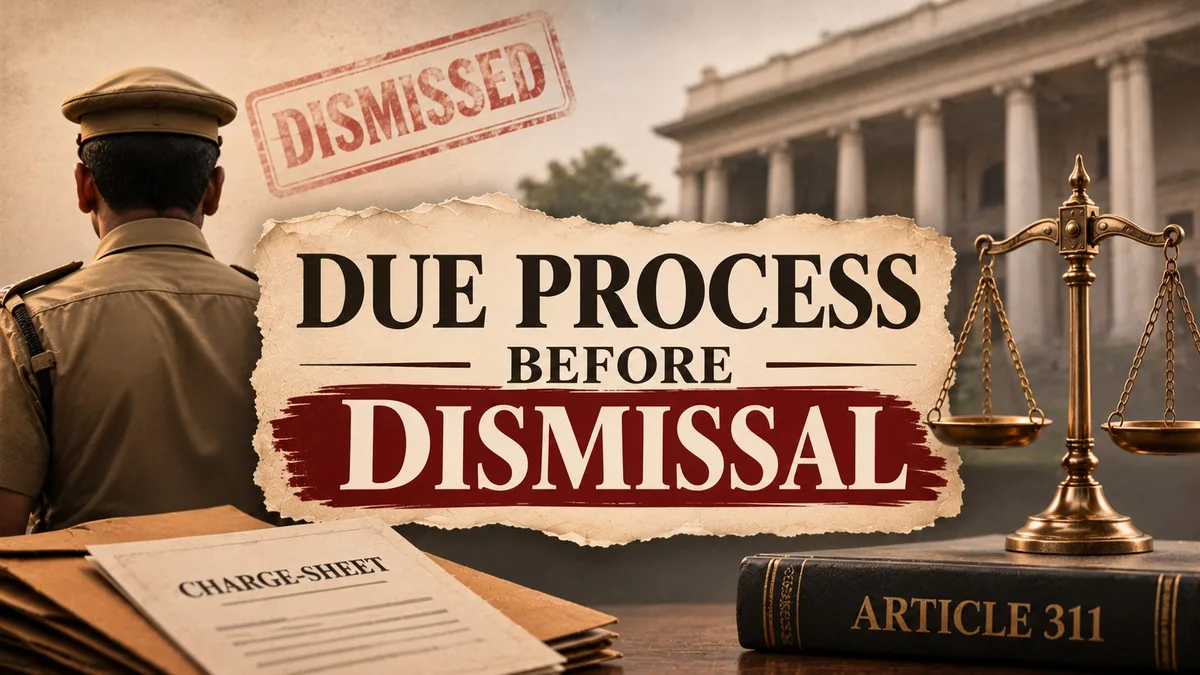
The High Court quashed the termination of a long-serving Panchayat employee after finding serious procedural defects in the disciplinary process, including the absence of a Presenting Officer, non-consideration of the employee’s reply and an enquiry process in which the Enquiry Officer had effectively acted as prosecutor. As the employee had superannuated, the Court directed consequential benefits and 40% back wages. (Paras 15–17)
Key Proposition: A disciplinary enquiry cannot be sustained where the process is structurally unfair, the employee’s defence is not properly considered and the Enquiry Officer assumes the role of presenting the prosecution case.
- Service law – departmental enquiry – Presenting Officer – whether the Enquiry Officer could effectively conduct the prosecution – Held, such a process was impermissible. (Para 15)
- Natural justice – disciplinary proceedings – employee’s reply – whether failure to consider the reply vitiated termination – Held, yes in the circumstances. (Para 15)
- Article 226 – judicial review – termination – whether procedural unfairness justified interference – Held, yes. (Paras 15–17)
Background / Synopsis :
- The petitioner was appointed as Assistant Grade-III on 13 March 1987 in Janpad Panchayat Lahar, District Bhind.
- While he was on sanctioned leave from 9 to 15 June 2016, an inspection on 14 June 2016 treated him as absent and he was suspended.
- A charge-sheet dated 19 September 2016 was issued; he denied the allegations in his reply dated 19 October 2016.
- The General Administration Committee resolved to terminate his services in April 2017, followed by approval by the General Body.
- The petitioner challenged the termination order dated 13 July 2018 under Article 226.
Issues For Consideration :
- Whether the disciplinary enquiry and consequent termination complied with the requirements of natural justice.
- Whether the role assumed by the Enquiry Officer in conducting the prosecution rendered the enquiry unfair.
- What relief should follow after the petitioner had attained superannuation.
Submissions Of Parties :
Petitioner:
- The petitioner challenged the fairness of the disciplinary process and the legality of the termination.
- He relied on the failure to appoint a Presenting Officer and on the failure to properly consider his reply.
State / Respondents:
The respondents defended the disciplinary action and the termination on the basis of the departmental proceedings.
Court's Observations & Analysis :
Re: Fairness of the disciplinary enquiry
- The Court found that the procedural structure of the enquiry was defective because the Enquiry Officer had acted in the role of prosecutor and conducted cross-examination of witnesses.
- The petitioner’s reply to the charge-sheet had not been properly considered.
- The defects were not merely technical; they affected the fairness of the adjudicatory process.
- Held: The impugned termination order dated 13 July 2018 was quashed. (Para 15)
Re: Relief after superannuation
- The petitioner had already attained the age of superannuation by the time of the judgment.
- The Court therefore directed consequential monetary benefits rather than restoration of service.
- Held: The respondents were directed to pay 40% of back wages and all consequential monetary benefits to which the petitioner was entitled. (Para 16)
Notable Observations:
“the respondent have not acted fairly and only the inquiry officer has been appointed and Presenting Officer has not been appointed.” (Para 15)
Decision & Directions :
- The impugned order dated 13 July 2018 was quashed.
- The respondents were directed to grant consequential benefits.
- The petitioner was awarded 40% of back wages and consequential monetary benefits.
- Compliance was directed within three months from receipt of the certified copy; failing that, interest at 6% per annum would apply from entitlement until payment.
- The writ petition was allowed and disposed of.
Legal Provisions Discussed & Precedents Cited :
- Constitution of India, Article 226 – judicial review of disciplinary action.
- Principles of natural justice – fair disciplinary adjudication.
- Departmental enquiry procedure – separation between the Enquiry Officer and the presenting/prosecuting function.
- Mansukhlal Vithaldas Chauhan v. State of Gujarat – Referred to in the context of judicial review and decision-making.
- Ruiz Torija v. Spain, (1994) 19 EHRR 553 – Referred to regarding reasons.
- Anya v. University of Oxford, [2001] EWCA Civ 405 – Referred to on fairness/reasons.
- Union of India and Others v. Mohd. Naseem – Referred to in the discussion of disciplinary fairness.
- Ram Prakash Singh v. State of M.P. and Others – Referred to in the service-law discussion.
Case Details :
- Case / Party Name: Akhilesh Narayan Saxena v. The State of Madhya Pradesh and Others
- Case Number(s): Writ Petition No. 16987 of 2018; CNR No. MPHC030174822018
- Coram / Judges: Hon’ble Shri Justice Anand Singh Bahrawat – Single Judge
- Counsel Appearances: Shri Udit Saxena for the petitioner; Shri Prabhat Pateriya, Government Advocate for the State/respondents; Shri D. P. Singh for Respondent No. 5/caveator.
Disclaimer: This summary is an editorial aid and does not form part of the judgment. Refer to the original judgment before citing.
Full Judgement / Attachment
Full Judgement
Frequently asked questions about Madhya Pradesh High Court
- Where does the Madhya Pradesh High Court sit and which areas does it cover?
- The Madhya Pradesh High Court has its principal seat at Jabalpur, with benches at Indore and Gwalior. It has jurisdiction over the State of Madhya Pradesh. It took its present form in 1956, when the State of Madhya Pradesh was reorganised.
- How do I check MP High Court cases at Jabalpur, Indore or Gwalior?
- The official website, mphc.gov.in, publishes bench-wise cause lists, case status and orders for the principal seat at Jabalpur and the Indore and Gwalior benches. Records are also on the eCourts High Court Services portal (hcservices.ecourts.gov.in).
- What kinds of cases does the MP High Court hear?
- It hears writs, civil and criminal appeals from across Madhya Pradesh, and income-tax appeals arising from the ITAT Jabalpur and Indore Benches. Cases are listed at the bench that has territorial jurisdiction over the district where they arise.
- What is a Writ Appeal in the MP High Court?
- Under the Madhya Pradesh Uchcha Nyayalaya (Khand Nyaya Peeth Ko Appeal) Adhiniyam, 2005, certain single-judge writ orders can be appealed to a Division Bench as a Writ Appeal. A final judgement can be taken to the Supreme Court by a Special Leave Petition under Article 136, ordinarily within 90 days.
- How can White Collar Professional help with a MP High Court matter?
- Post your requirement on White Collar Professional to receive proposals from verified Advocates, Chartered Accountants and Company Secretaries, compare them, and pay securely through the platform. This page also tracks the latest MP High Court judgements and legal updates as they are reported.