Unregistered Sale Document Did Not End Tenancy; Landlord Wins Eviction for Default and Bona Fide Need
Court / Authority
Madhya Pradesh High Court
Update / Judgement Date
23 Oct 2026
Date of Publication
27 Oct 2026
Case No.
Second Appeal No. 2713 of 2023
Source
WCP News Bulletin
Author
Dipanshi Bansal — WCP Legal Desk
Reading Time
6 min read
View Count
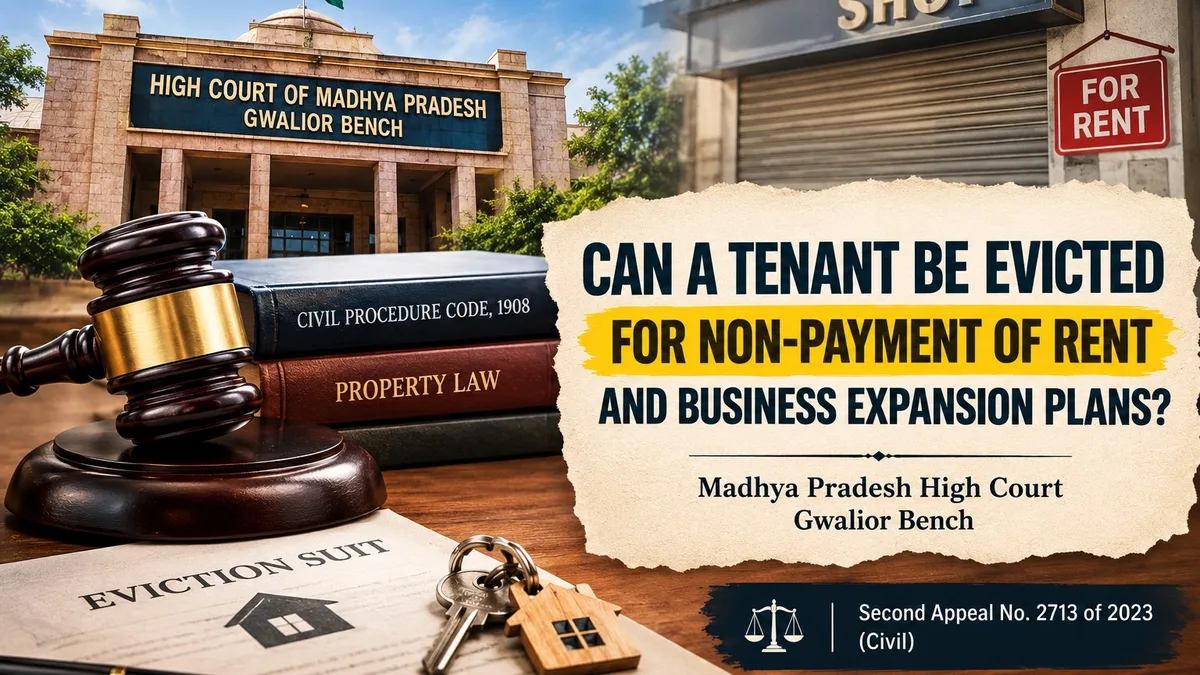
The Madhya Pradesh High Court held that an unregistered document recording a purported sale of the shop did not transfer title and did not terminate the tenancy where termination was premised on conferral of ownership. The defendants’ admission of the original tenancy, rent notes and later rent payments established the landlord–tenant relationship. As rent had not been paid from December 2017 and the landlord proved bona fide need for his son’s proposed supermarket, eviction was decreed under Sections 12(1)(a) and 12(1)(f) of the Madhya Pradesh Accommodation Control Act, 1961. Eviction under Section 12(1)(c) was refused because that ground had not been pleaded. (Paras 14–22)
Key Proposition: An unregistered instrument cannot convey title to the shop, and where its purported termination of tenancy depends on conferring ownership that it legally fails to convey, the tenancy is not thereby terminated.
- Registration Act, 1908 – Section 17; Transfer of Property Act, 1882 – Section 54 – Unregistered sale instrument – Whether it conveyed title to the shop? Held, no. (Para 15)
- M.P. Accommodation Control Act, 1961 – Sections 12(1)(a) and 12(1)(f) – Rent default and bona fide requirement – Whether eviction was warranted? Held, yes. (Paras 20–22)
- M.P. Accommodation Control Act, 1961 – Section 12(1)(c) – Ground not specifically pleaded – Whether eviction could be granted on this ground? Held, no. (Para 20)
Background / Synopsis :
- The plaintiff sought eviction of the defendants from a 108-square-foot shop in Ashoknagar, alleging that the shop had been let to their father and that the tenancy continued after his death.
- The plaintiff alleged that rent had been paid only up to November 2017 and that his educated but unemployed son needed the shop, together with adjoining accommodation, to establish a larger supermarket. The plaintiff said the defendants had another vacant shop available to them.
- The defendants denied the plaintiff’s title and tenancy, claiming that the plaintiff’s father had sold the shop to their grandfather on 20 May 1976 for ₹9,400 through an unregistered document.
- The trial court dismissed the eviction suit on 20 March 2023; the first appellate court affirmed that decision on 5 September 2023. The High Court admitted the second appeal on substantial questions of law on 22 July 2024.
Issues For Consideration :
- Whether the courts below misread evidence or applied the law incorrectly when rejecting the eviction suit.
- Whether the plaintiff established a landlord–tenant relationship with the defendants.
- Whether eviction could be ordered under Sections 12(1)(a), 12(1)(c) and 12(1)(f) of the Madhya Pradesh Accommodation Control Act, 1961.
Submissions Of Parties :
Petitioner / Appellant:
- The plaintiff argued that the defendants’ written statement admitted the original tenancy and that rent notes, rent receipts and payments through November 2017 established continuation of the landlord–tenant relationship.
- He argued that the 1976 sale document was unregistered and could not transfer title, and that the courts below wrongly disregarded material evidence on a technical pleading ground.
- He relied on non-payment of rent and his son’s bona fide need for a larger supermarket.
Respondent / State:
- The defendants argued that a title dispute existed and that the eviction suit could not determine it.
- They relied on the 20 May 1976 document, contending that their grandfather had purchased the shop and the tenancy ended then, even if the unregistered instrument did not itself transfer title.
- They disputed the rent receipts/signatures and argued that payments by cheque related to repayment of a loan rather than rent.
Court's Observations & Analysis :
Re: Landlord–tenant relationship and the 1976 document
- The defendants’ written statement admitted that their father had taken the shop on rent in 1965. The Court considered that admission alongside rent notes dated 22 December 1972 and 14 November 1977.
- Under Section 17 of the Registration Act, 1908 read with Section 54 of the Transfer of Property Act, 1882, the unregistered document could not transfer title to property worth more than ₹100.
- The document’s recital connected termination of the tenancy with conferral of ownership. Since ownership was not conveyed, the document did not terminate the tenancy. Rent payments through November 2017 also supported continuation of the tenancy.
- The courts below had ignored material evidence and misapplied the law; their finding that no landlord–tenant relationship existed was perverse. (Paras 14–19)
Re: Default and bona fide requirement
- The defendants admittedly did not pay rent from December 2017 and did not comply with Section 13(1) during the suit, first appeal or second appeal. Eviction was therefore warranted under Section 12(1)(a).
- The plaintiff pleaded that his son needed the premises to expand a supermarket. Starting the business temporarily in an adjoining vacant shop did not defeat the need, because the plaintiff explained that the existing space was insufficient for the proposed larger supermarket.
- The Court found the bona fide requirement established and granted eviction under Section 12(1)(f). Section 12(1)(c) relief was unavailable because the plaintiff had not pleaded that ground in the suit. (Para 20)
Notable Observations: None
Decision & Directions :
- The second appeal was allowed. The judgments and decrees of the trial court dated 20 March 2023 and the first appellate court dated 5 September 2023 were set aside.
- The eviction suit was decreed under Sections 12(1)(a) and 12(1)(f) of the Madhya Pradesh Accommodation Control Act, 1961; eviction under Section 12(1)(c) was not granted.
- The defendants were directed to deliver vacant possession by the end of December 2026.
- The defendants were directed to deposit all rent arrears from December 2017 through December 2026 within one month from the date of the judgment. On default, the plaintiff could begin execution without waiting until the possession deadline.
- If the defendants failed to vacate by the end of December 2026, they were directed to pay mesne profits of ₹10,000 per month from January 2027.
- The defendants were directed to bear the plaintiff’s litigation costs.
Legal Provisions Discussed & Precedents Cited :
- Code of Civil Procedure, 1908 – Section 100: Governs the second appeal on substantial questions of law.
- Registration Act, 1908 – Section 17: Requires registration of instruments of the relevant kind to convey immovable-property title.
- Transfer of Property Act, 1882 – Section 54: Governs transfer of ownership by sale and the requirement of a registered instrument for the property in issue.
- Madhya Pradesh Accommodation Control Act, 1961 – Section 12(1)(a): Eviction ground based on rent default.
- Madhya Pradesh Accommodation Control Act, 1961 – Section 12(1)(c): Eviction ground invoked in the appeal but unavailable because it was not pleaded.
- Madhya Pradesh Accommodation Control Act, 1961 – Section 12(1)(f): Eviction ground based on bona fide requirement for the landlord’s business use.
- Madhya Pradesh Accommodation Control Act, 1961 – Section 13(1): Tenant’s obligations regarding deposit/payment of rent during proceedings.
- No precedents are discussed by name in the judgment.
Full Judgement / Attachment
Full Judgement
Frequently asked questions about Madhya Pradesh High Court
- Where does the Madhya Pradesh High Court sit and which areas does it cover?
- The Madhya Pradesh High Court has its principal seat at Jabalpur, with benches at Indore and Gwalior. It has jurisdiction over the State of Madhya Pradesh. It took its present form in 1956, when the State of Madhya Pradesh was reorganised.
- How do I check MP High Court cases at Jabalpur, Indore or Gwalior?
- The official website, mphc.gov.in, publishes bench-wise cause lists, case status and orders for the principal seat at Jabalpur and the Indore and Gwalior benches. Records are also on the eCourts High Court Services portal (hcservices.ecourts.gov.in).
- What kinds of cases does the MP High Court hear?
- It hears writs, civil and criminal appeals from across Madhya Pradesh, and income-tax appeals arising from the ITAT Jabalpur and Indore Benches. Cases are listed at the bench that has territorial jurisdiction over the district where they arise.
- What is a Writ Appeal in the MP High Court?
- Under the Madhya Pradesh Uchcha Nyayalaya (Khand Nyaya Peeth Ko Appeal) Adhiniyam, 2005, certain single-judge writ orders can be appealed to a Division Bench as a Writ Appeal. A final judgement can be taken to the Supreme Court by a Special Leave Petition under Article 136, ordinarily within 90 days.
- How can White Collar Professional help with a MP High Court matter?
- Post your requirement on White Collar Professional to receive proposals from verified Advocates, Chartered Accountants and Company Secretaries, compare them, and pay securely through the platform. This page also tracks the latest MP High Court judgements and legal updates as they are reported.