Your Own Revision Can Cost You Your Job: Madhya Pradesh High Court Holds RPF Revisional Authority May Reverse Exoneration and Impose Compulsory Retirement Under Rule 219.4
Court / Authority
Madhya Pradesh High Court
Update / Judgement Date
26 Oct 2026
Date of Publication
28 Oct 2026
Case No.
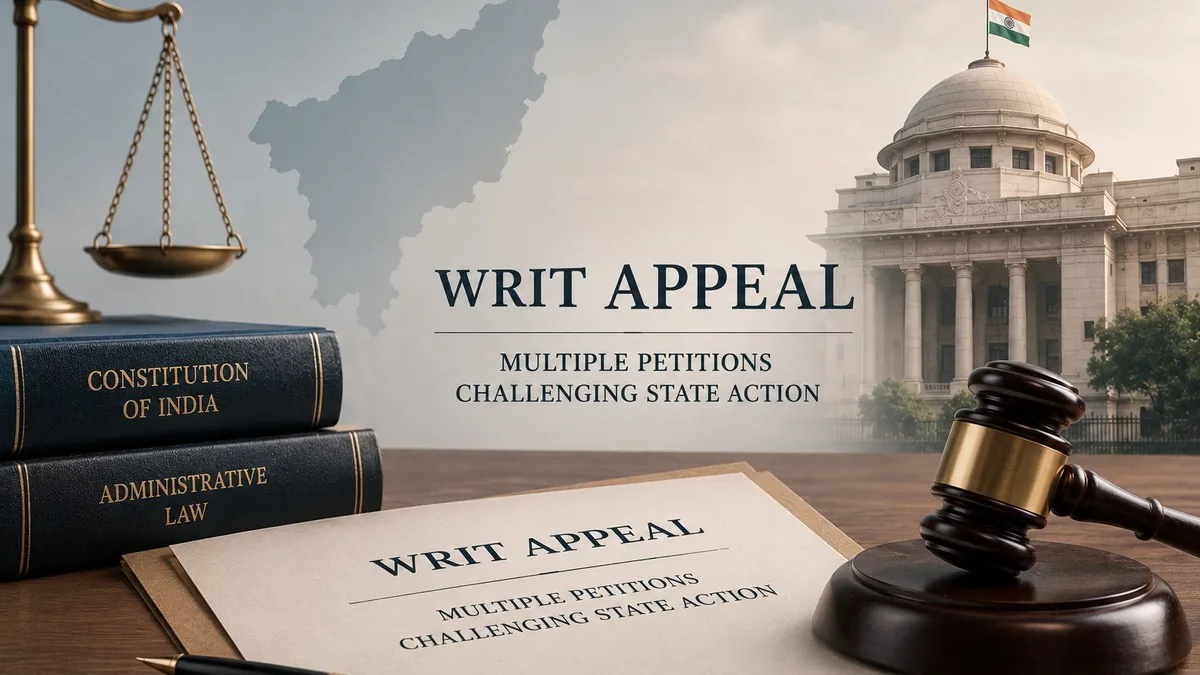
WA 3508/2026
Source
WCP News Bulletin
Author
Arshee Saifi — WCP Legal Desk
Reading Time
8 min read
View Count
Key Proposition: Under Clause 219.4 of the Railway Protection Force Rules, 1987, the superior authority may, 'on its own motion, or otherwise', revisit findings of exoneration and impose punishment where none was imposed, even when the disciplinary record comes before it through a revision filed by the delinquent member himself; and withdrawal of that revision after a show-cause notice for enhancement does not, by itself, defeat this power.
Background / Synopsis :
- The respondent joined the RPF as a Constable in 2001 and was serving as an Assistant Sub-Inspector at the Biaora-Rajgarh outpost (Para 2).
- After a preliminary inquiry, a charge-sheet dated 01.11.2022 framed three charges: demanding Rs. 30,000 from pantry-car employees, assaulting women rag-pickers on railway premises, and demanding Rs. 20,000 from two accused persons being produced before the Railway Court at Indore (Paras 2–3).
- The inquiry held Charge 2 (assault) proved and Charges 1 and 3 (illegal gratification) not proved. The Disciplinary Authority (11.09.2023) reduced him from ASI to Head Constable for two years; the Appellate Authority affirmed on 30.01.2024 (Para 3).
- On his revision, the Revisional Authority issued a show-cause notice for enhancement and, after a hearing, by order dated 14.07.2024 held all three charges proved and imposed compulsory retirement (Para 4).
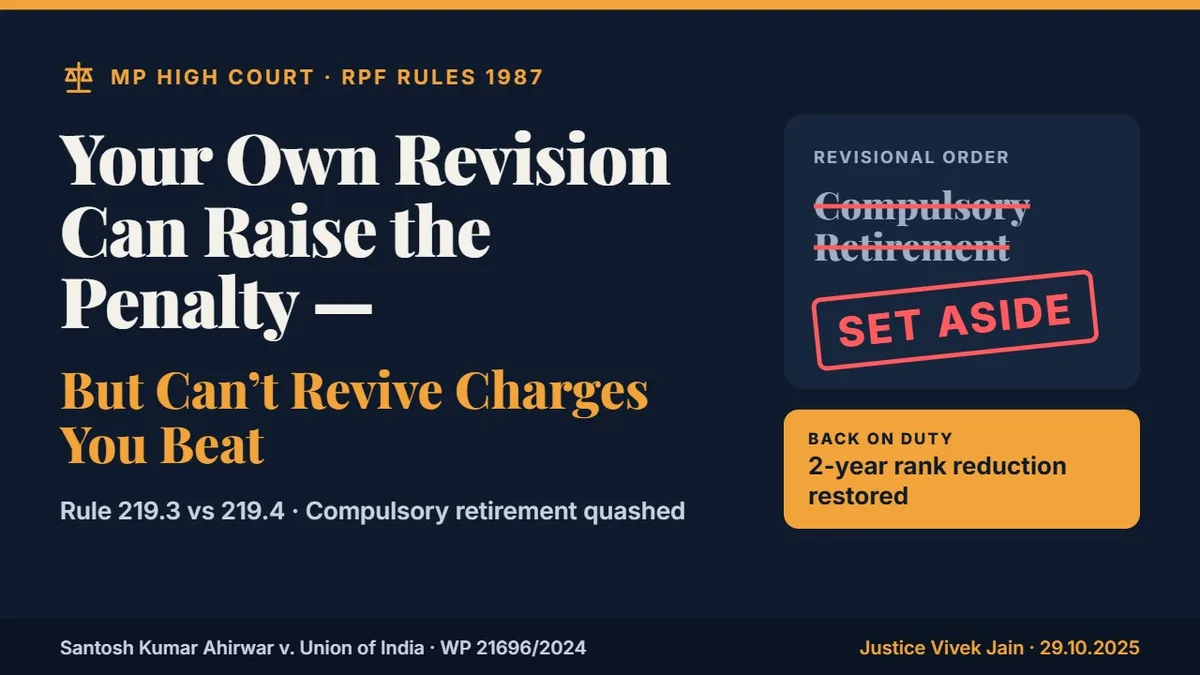
- The Single Judge allowed W.P. No. 21696 of 2024 on 29.10.2025, holding that in a revision filed by the employee the authority could not reconsider charges on which no punishment had been imposed. The Union of India appealed (Paras 1, 4).
Issues For Consideration :
- Whether, in a revision petition filed by the delinquent member, the Revisional Authority is confined to Clause 219.3 or may exercise the wider powers under Clause 219.4, including reversing findings of exoneration and imposing punishment on those charges (Para 10).
- Whether a revisionist can withdraw the revision as of right after a show-cause notice proposing enhancement has been issued (Para 18).
Submissions Of Parties :
- Appellants (Union of India and RPF authorities):
The Single Judge wrongly read Clauses 219.3 and 219.4 by restricting revision to enhancing punishment on charges already proved (Para 5).
Clause 219.4 expressly allows a superior authority, 'on its own motion, or otherwise', to call for the record and impose punishment where none was imposed; a revision filed by the employee does not extinguish that power (Para 5).
All three charges were part of one charge-sheet and one inquiry, so the entire record was open; a show-cause notice and hearing were given (Para 6).
Permitting withdrawal of the revision after the show-cause notice cannot defeat the statutory power (Para 6).
- Respondent (RPF member):
The Revisional Authority exceeded its jurisdiction by holding proved two charges that the Inquiry Officer had found not proved and the Disciplinary Authority had accepted (Para 7).
A revision filed by the employee is governed by Clause 219.3, which permits only enhancement; the wider powers under Clause 219.4 apply only when the superior authority independently acts on its own motion (Para 7).
Revisional power must be exercised strictly within the Rules; the Single Judge rightly restored the original punishment (Para 8).
Court's Observations & Analysis :
- Re: Issue (i): Scope of Clauses 219.3 and 219.4
Clause 219.3 deals with enhancing punishment while deciding a revision application, with a show-cause requirement; Clause 219.4 confers a wider supervisory power to confirm, modify or set aside an order, impose punishment where none was imposed, remit, or pass any other order (Paras 11–12).
The words 'or otherwise' show that the power is not confined to suo motu initiation; the Single Judge, by treating the origin of the proceedings as decisive, gave no meaning to those words and would defeat the express power in Clause 219.4(b) (Para 13).
A.P. Singh v. Union of India (Calcutta HC, DB, A.P.O. No. 103 of 2002, decided 13.08.2008) recognised that exoneration does not place a matter beyond the reach of Clause 219.4, though that case was suo motu (Para 14).
The supervisory power cannot be made dependent on whether the employee chose to file a revision; it remains subject to the prescribed limits and natural justice (Para 15).
Clause 219.3 gives no power to modify or set aside a punishment, so it must be read with Clause 219.4; the two operate in their own fields (Paras 16–17).
Held: The filing of a revision by the employee is no bar to the exercise of the wider powers under Clause 219.4. (Paras 17, 21)
- Re: Issue (ii): Withdrawal of the revision
Ordinarily a revisionist may withdraw before a final order, but the right is not absolute; withdrawal may be declined where it would prejudice others, frustrate statutory obligations or run against the public interest (Para 18).
Held: Since the authority could act on its own motion under Clause 219.4, permitting withdrawal as of right after the show-cause notice would frustrate that provision. (Para 18)
Re: Remedy available to the employee
Under the second proviso to Clause 219.3, an order enhancing punishment is treated as an original order for appeal, so the respondent is not remediless (Para 19).
The mere fact that an order has been examined by the Appellate Authority does not, by itself, exclude the suo motu revisional power; Clauses 219.3 and 219.4 must be read harmoniously (Para 20).
Notable Observations:
"Had the rule-making authority intended to confine the wider powers under Clause 219.4 exclusively to proceedings initiated suo motu, there would have been no necessity to employ the additional expression 'or otherwise'." (Para 13)
"The exercise of such supervisory power cannot be made contingent upon the conduct of the delinquent employee…" (Para 15)
Decision & Directions :
Writ appeal allowed. (Para 22)
Order of the Single Judge dated 29.10.2025 in W.P. No. 21696 of 2024 set aside. (Para 22)
Revisional order dated 14.07.2024 imposing compulsory retirement restored. (Para 22)
The respondent may challenge the enhanced punishment by appeal under the second proviso to Clause 219.3. (Para 19)
Not discussed: the judgment does not address the first proviso to Clause 219.4 (no action after one year from the order) or whether it was met here. Para 20 also attributes to the Single Judge a ground (that Clause 219.4 applies only to original orders) that is not mentioned where the Single Judge's reasoning is summarised in Paras 4 and 10.
Legal Provisions Discussed & Precedents Cited :
- Railway Protection Force Rules, 1987 – Clauses 219.3 (with provisos), 219.4 (with provisos) and 212(2).
- Railway Protection Force Act, 1957 – Section 9(2) (appeal period, referred to in Clause 219.4).
- Madhya Pradesh Uchcha Nyayalaya (Khand Nyayapeeth Ko Appeal) Adhiniyam, 2005 – Section 2(1).
- Doctrines applied: give meaning to every word of a statute; harmonious construction; natural justice (show-cause before enhancement).
- A.P. Singh v. Union of India & Ors., A.P.O. No. 103 of 2002, decided 13.08.2008 (Calcutta High Court, Division Bench) – Relied upon.
Case Details :
- Case / Party Name: Union of India & Ors. v. Santosh Kumar Ahirwar
- Case Number(s): Writ Appeal No. 3508 of 2025 [Neutral Citation: 2026:MPHC-JBP:85774] (CNR MPHC010862262025)
- Coram / Judges: Anand Pathak and B.P. Sharma, JJ. – Division Bench (opinion by B.P. Sharma, J.)
- Counsel Appearances: For the Appellants: Shri Sunil Jain, Additional Solicitor General / Senior Advocate, with Shri Shyam Yadav, Advocate. For the Respondent: Shri Prahlad Choudhary, Senior Advocate, with Ms. Vijaya Laxmi Choudhary, Advocate.
Disclaimer: This summary is an editorial aid and does not form part of the judgment. Refer to the original judgment before citing.
Full Judgement / Attachment
Full Judgement
Frequently asked questions about Madhya Pradesh High Court
- Where does the Madhya Pradesh High Court sit and which areas does it cover?
- The Madhya Pradesh High Court has its principal seat at Jabalpur, with benches at Indore and Gwalior. It has jurisdiction over the State of Madhya Pradesh. It took its present form in 1956, when the State of Madhya Pradesh was reorganised.
- How do I check MP High Court cases at Jabalpur, Indore or Gwalior?
- The official website, mphc.gov.in, publishes bench-wise cause lists, case status and orders for the principal seat at Jabalpur and the Indore and Gwalior benches. Records are also on the eCourts High Court Services portal (hcservices.ecourts.gov.in).
- What kinds of cases does the MP High Court hear?
- It hears writs, civil and criminal appeals from across Madhya Pradesh, and income-tax appeals arising from the ITAT Jabalpur and Indore Benches. Cases are listed at the bench that has territorial jurisdiction over the district where they arise.
- What is a Writ Appeal in the MP High Court?
- Under the Madhya Pradesh Uchcha Nyayalaya (Khand Nyaya Peeth Ko Appeal) Adhiniyam, 2005, certain single-judge writ orders can be appealed to a Division Bench as a Writ Appeal. A final judgement can be taken to the Supreme Court by a Special Leave Petition under Article 136, ordinarily within 90 days.
- How can White Collar Professional help with a MP High Court matter?
- Post your requirement on White Collar Professional to receive proposals from verified Advocates, Chartered Accountants and Company Secretaries, compare them, and pay securely through the platform. This page also tracks the latest MP High Court judgements and legal updates as they are reported.