A Family Company Is Still a Company: NCLAT Sets Aside Dismissal of Hotel Oppression Petition, Calls NCLT's Demand for a Forensic Report 'Circular' and Orders Joint Bank Signatures Pending Remand
Court / Authority
NCLT & NCLAT
Update / Judgement Date
24 Nov 2026
Date of Publication
25 Nov 2026
Source
WCP News Bulletin
Author
Arshee Saifi — WCP Legal Desk
Reading Time
10 min read
View Count
Key Proposition: An oppression petition cannot be dismissed as a mere family or managerial dispute where it alleges specific financial irregularities; and where the books are with the majority, a tribunal cannot refuse relief for want of a forensic report the minority had no means to obtain – it must itself decide whether an independent, tribunal-supervised forensic audit is needed.
Background / Synopsis :
- The company, incorporated on 08.12.2006, runs a hotel at Mangalam Place, Sector-3, Rohini; the dispute is among family members who are shareholders and directors (Para 2).
- Appellant No. 1 holds 13.49% and Appellant No. 2 1.41%; the company has 72 members; its loan account with the PNB consortium has been an NPA since December 2018, with a restructuring proposal approved (Paras 3, 19, 41).
- Appellant No. 1 was Head of Finance and sole bank signatory; on 24.04.2024 a circular resolution changed the signatory matrix, ratified on 27.04.2024 over his objection of 25.04.2024 (Paras 20, 33, 36).
- On 29.04.2024 a refund of about Rs. 1.53 crore came in, and four cheques of about Rs. 1.45 crore were issued to Respondents 2–5; they were not honoured (Para 33).
- On 20.02.2025 he sought details of the Rs. 5,41,86,000 cash-in-hand; on 26.02.2025 an office order restricted his access, and circular resolutions of 18.05.2025 restricted his entry and proposed an inquiry committee of R2, R3 and R5 (Paras 12, 36).
- The NCLT dismissed the petition on 10.04.2026 as a managerial dispute within a family-owned company (Paras 1, 28).
Issues For Consideration :
- Whether the appeal raises a serious question of financial mismanagement beyond a managerial dispute (Para 28).
- Whether an independent forensic audit or investigation should be considered, and by whom (Paras 38–49).
- What interim protection is needed pending fresh consideration (Para 51).
Submissions Of Parties :
- Appellants:
The NCLT gave no reasoned findings on oppression and mismanagement; relatedness of the parties is no answer (Para 6).
Booking sheets and invoices for January 2024–January 2025 show a gap of about Rs. 30.89 crore; the respondents' reply admits about Rs. 9.20 crore (Paras 8–9).
The cash-in-hand of Rs. 5.42 crore is unexplained; the Rs. 1.45 crore cheques were an attempt to move company money to personal accounts; he was excluded after raising concerns (Paras 10–12).
A forensic audit can be ordered even without a specific application (Able Automobiles v. Rekha Singhal; Archer Power Systems v. Cascade Energy; Shailesh B. Bhandari v. Electrotherm) (Paras 13–14).
- Respondents:
Section 242 relief is exceptional; the appellants are a minority, his directorship is intact and the signatory change was administrative and ratified (Paras 18–20).
Booking estimates and final invoices naturally differ by 10–15%; over 7,500 invoices are on record; the PNB consortium's ASM and audited accounts make a forensic audit unnecessary (Paras 21–22, 30).
The cheques were to repay R4's Rs. 1.56 crore short-term loan for a performance guarantee and the money went to the lender (Para 23).
Appellant No. 1 removed records, cheque books and CCTV, ran a parallel business, took personal loans in the company's name and transferred Rs. 58.35 lakh to his daughter (Para 24).
No prima facie case, balance of convenience or irreparable injury is shown (Para 26).
Court's Observations & Analysis :
- Re: Family dispute or financial mismanagement
The complaint concerns diversion of funds, understated invoices, unrecorded cash receipts and an unexplained cash balance in a company with a mortgaged hotel, lenders and a large workforce (Para 28).
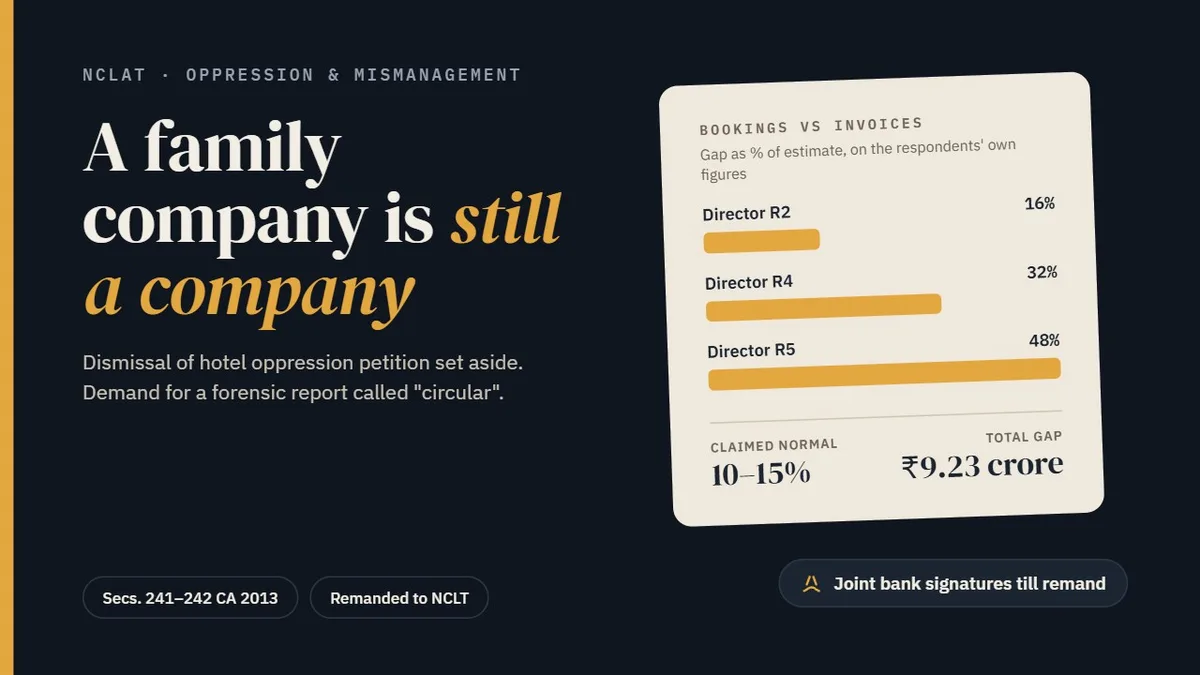
On the respondents' own figures the differences are Rs. 9.23 crore – about 16% (R2), 32% (R4) and 48% (R5) of the estimates; the explanation cannot be tested on pleadings alone (Para 29).
No specific answer was found to the allegation of cash receipts against booking sheets marked 'Received' and not entered in the books (Para 30).
The cash balance, the cheques, the signatory change and the use of hotel premises by R6–R8 (one a firm in which A1's son is a partner) can be resolved only on the records (Paras 32–34).
- Re: The respondents' allegations against A1
Serious but untested; they cannot deny interim relief, but explain why A1 should not be restored to sole control of finance, and any audit must examine them too (Paras 35, 45).
Sequence noted without a finding on motive: the director who raised financial concerns was removed from finance and the records within days, and an inquiry into him was proposed by members of the other group (Para 36).
- Re: Forensic audit
A board committee of a divided board is unsuitable; an independent professional examination is needed if one is directed (Para 38).
The ASM's scope may differ from a forensic audit of these allegations (Paras 31, 39, 46).
The NCLT's reasoning was circular: a party denied access to the books cannot produce a forensic report on them (Para 40).
Held: The impugned order cannot be sustained; the petition is remitted for the NCLT to decide on, scope and supervise any audit – not to be undertaken first at the appellate stage. (Paras 47–49)
Notable Observations:
"A company does not stop being a company because its directors are related." (Para 28)
"A party who cannot get access to the books can hardly be expected to produce a forensic report on them." (Para 40)
"If the allegations are unfounded, the report will clear the Respondents. If they are well founded, it will show their extent." (Para 40)
Decision & Directions :
Appeal allowed in part; NCLT order of 10.04.2026 set aside and C.P. No. 145 (ND) of 2025 restored for fresh consideration; no costs. (Paras 52, 61)
1. NCLT to hear the petition on priority and decide afresh whether an independent forensic audit or investigation is needed; any auditor to be an independent registered firm with no conflict with the company, parties, statutory auditors or the lenders' monitoring agency, under NCLT supervision. (Para 53)
2. Indicative scope: booking sheets v. invoices and cash receipts; the Rs. 5,41,86,000 cash-in-hand; the 29.04.2024 refund and the Rs. 1.45 crore cheques; the arrangements with R6–R8 and licence fees; the respondents' financial allegations against A1; any connected issue. (Para 54)
3. All parties, including A1, to cooperate and give access to records under confidentiality safeguards; report to be supplied to all for objections. (Para 55)
4. Interim: no rights issue, allotment, placement or conversion diluting the appellants' shareholding without NCLT permission. (Para 56)
5. Interim: bank accounts operated jointly – A1 plus one existing signatory nominated by R2–R5 (nominee within 7 days; bank to be informed within a further 7 days); this does not restore A1 as Head of Finance; no unreasonable delay of ordinary payments; no payments to directors, shareholders, relatives or related entities except documented bona fide dues. (Paras 57–58)
6. Interim: all books, invoices, booking sheets, vouchers, bank records, electronic data and minutes to be preserved; no unconditional access for A1 – questions of access go to the NCLT. (Para 59)
7. Administrator, unconditional access, restraint on R6–R8 and declarations against the 2025 resolutions and office order not granted; left open before the NCLT. (Para 60)
8. NCLT to endeavour to decide within six months of the parties' first appearance. (Para 61)
Record notes: Para 5 calls the judgment an 'interim order' though it finally disposes of the appeal; Para 33 says the four cheques aggregated '₹ 45 crore' (₹1.45 crore elsewhere); Para 30 opens mid-phrase ('the rest of the amount, …'); the Bench of three has one Judicial and two Technical Members.
Separate Opinions: None (judgment by Arun Baroka, Member (Technical)).
Legal Provisions Discussed & Precedents Cited :
- Companies Act, 2013 – Sections 213, 241, 242, 421.
- National Company Law Tribunal Rules, 2016 – Rule 43.
- Able Automobiles Pvt. Ltd. v. Smt. Rekha Singhal, C.A. (AT) (CH) No. 60 of 2022 – Referred to.
- Archer Power System Pvt. Ltd. v. Cascade Energy Pvt. Ltd., C.A. (AT) No. 213 of 2017 – Cited by appellants.
- Shailesh B. Bhandari v. Electrotherm (India) Ltd., C.A. (AT) No. 57 of 2021 – Cited by appellants.
Case Details :
- Case / Party Name: Jagan Nath Dang & Anr. v. Seven Seas Hospitality Pvt. Ltd. & Ors.
- Case Number(s): Company Appeal (AT) No. 232 of 2026 (with I.A. No. 4204 of 2026) – against NCLT New Delhi Bench-IV order of 10.04.2026 in C.P. No. 145 (ND) of 2025
- Coram / Judges: Justice Sharad Kumar Sharma, Member (Judicial); Arun Baroka, Member (Technical); Indevar Pandey, Member (Technical)
- Counsel Appearances: For the Appellants: Mr. Virender Ganda, Senior Advocate, with Mr. Vishal Ganda, Ms. Chhavi Jain and Mr. Aseem Shrivastava. For the Respondents: Mr. Ramji Srinivasan, Senior Advocate, with Mr. Jai Mohan, Mr. Aayush Gupta, Mr. Shivansh Gupta, Ms. Shefali and Mr. Aryansh.
Disclaimer: This summary is an editorial aid and does not form part of the judgment. Refer to the original judgment before citing.
Full Judgement / Attachment
Full Judgement
Frequently asked questions about NCLT & NCLAT
- What are the NCLT and NCLAT?
- The National Company Law Tribunal (NCLT) and the National Company Law Appellate Tribunal (NCLAT) were constituted on 1 June 2016 under the Companies Act, 2013. The NCLT sits in benches across India, and the NCLAT hears appeals from it, with its principal bench in New Delhi and a bench in Chennai.
- What cases does the NCLT hear?
- The NCLT is the Adjudicating Authority for corporate insolvency under the IBC. It also hears company law matters, including oppression and mismanagement petitions, schemes of merger and demerger, reduction of capital, and class action suits.
- What is the time limit to appeal an NCLT order to the NCLAT?
- Under the Companies Act, the appeal is due within 45 days, extendable by up to 45 days. Under the IBC, it is due within 30 days, extendable by up to 15 days. These outer limits are strictly applied.
- How can I check NCLT case status or orders?
- Case status, cause lists and orders are available on the NCLT website (nclt.gov.in) and the NCLAT website (nclat.nic.in), searchable by case number, party name or bench.
- How can White Collar Professional help with a NCLT or NCLAT matter?
- Post your requirement on White Collar Professional to receive proposals from verified Company Secretaries, Insolvency Professionals and Advocates, compare them, and pay securely through the platform. This page also tracks the latest NCLT or NCLAT NCLT and NCLAT judgements as they are reported.