Loss-Making Subsidiary May Merge into Profitable Parent: NCLT Bengaluru Sanctions Renesas Amalgamation After Answering Every Regulator Objection
Court / Authority
NCLT & NCLAT
Update / Judgement Date
20 Nov 2026
Source
WCP News Bulletin
Author
Arshee Saifi — WCP Legal Desk
Reading Time
7 min read
View Count
1
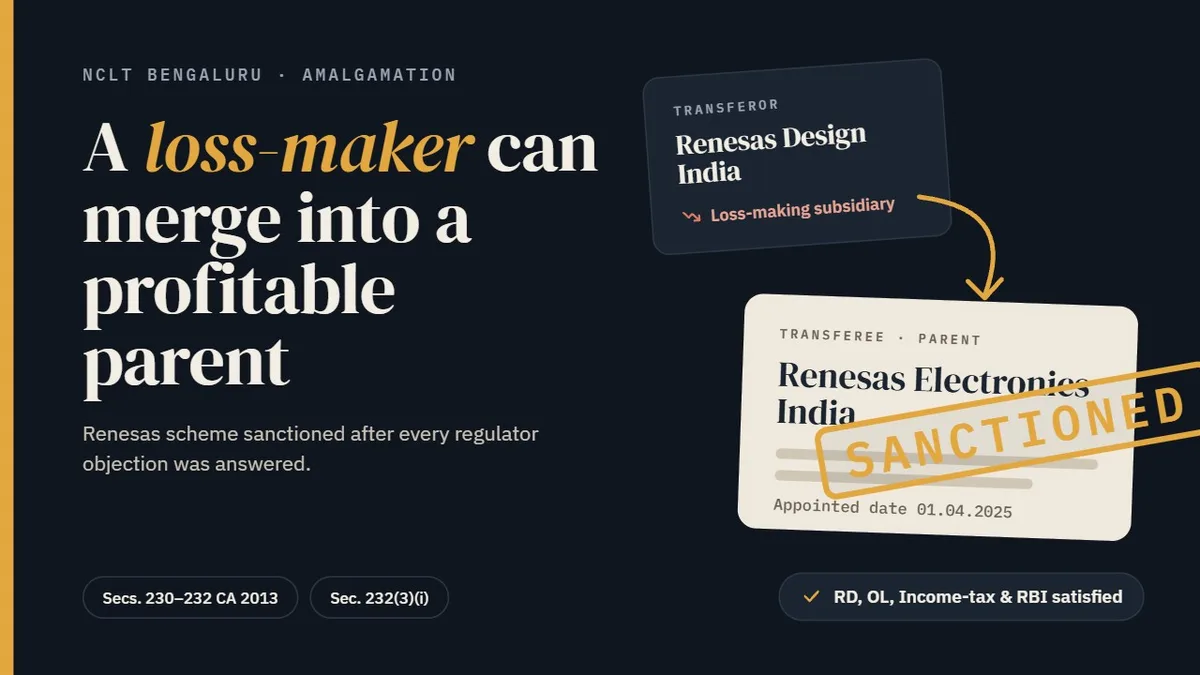
Key Proposition: Sections 230–232 of the Companies Act, 2013 do not bar a loss-making company from merging into a profitable one; where the Boards approve the scheme in their commercial wisdom and every statutory authority's observation is met by an explanation or a binding undertaking, the Tribunal may sanction the scheme, but the sanction grants no exemption from stamp duty, tax or any other liability.
Background / Synopsis :
The second-motion petition was filed on 24.02.2026; on the first-motion application, C.A. (CAA) No. 48/BB/2025, the meetings of all classes of shareholders and the unsecured creditors of both companies were dispensed with (Paras 1–2).
On 27.02.2026 notice issued under Section 230(5) and Rule 8 to the Regional Director, RoC, Official Liquidator, Income-tax authority and sectoral regulators, with publication in English and Kannada newspapers; service was proved by affidavit dated 30.04.2026 (Paras 3–4).
The transferor is wholly owned by the transferee, so no shares are issued as consideration and the transferor's shares stand cancelled (Para 12(e), Scheme Clause 8).
Board resolutions of 05.11.2025, the statutory auditor's certificate under Section 133 on the accounting treatment (Clause 9), and affidavits stating there are no sectoral regulators, no debt restructuring and no pending investigations were filed (Paras 6–8).
Issues For Consideration :
- Whether the Scheme of Amalgamation complied with Sections 230–232 and deserved sanction (Paras 15–17).
- Whether the observations of the Regional Director, Official Liquidator, Income-tax Department and RBI had been satisfactorily met (Para 16).
Submissions Of Parties :
- Regional Director (report dated 22.05.2026):
Show compliance with Section 90 (BEN-1/BEN-2) for the holding companies (Para 11(4)).
Justify merging a loss-making transferor into a profitable transferee (Para 11(6)).
Clause 12.1 clubbing of authorised capital is not in line with Section 232(3)(i); pay the fee difference (Para 11(7)).
Undertakings on statutory dues (Rs. 55,41,950 and Rs. 1,724.84 lakh), MSME dues (Rs. 70,170), FEMA/RBI compliance, employees and ESOPs, object clause, accounting treatment and Section 239; Section 240 liability continues (Paras 11(8)–(16)).
- Petitioner companies (replies of 02.07.2026 and 19.08.2026):
BEN-1/BEN-2 do not apply because no individual holds a majority in the parent; the parent will answer for any past non-compliance of the subsidiary (Para 11.1(a)).
Sections 230–232 do not restrict a profit-making and loss-making merger; the Boards approved it in their commercial wisdom (Para 11.1(b)).
Undertakings to pay the differential authorised-capital fee, clear statutory and MSME dues, protect employees under Clause 5, preserve the transferor's books and pay any tax demands that crystallise; ESOPs continue unchanged; both companies are in semiconductors, so no object-clause change is needed (Paras 11.1(c)–(l), 13.1).
Official Liquidator, Income-tax Department and RBI:
OL: the transferor is a going concern (revenue Rs. 45.88 crore in FY 2023-24 and Rs. 52.45 crore in FY 2024-25); MSME dues to be settled; employee terms preserved (Para 12).
- Income-tax: no demand pending, but Section 143(3) assessments for AY 2024-25 and 2025-26 are pending (time-barring date 31.03.2027) and will continue against the transferee; the Department reserves its rights; an outstanding TDS of Rs. 2,180 for FY 2017-18 was paid by memo dated 09.09.2026 (Paras 13–13.2).
RBI: companies must comply with FEMA themselves; the RBI does not vet individual schemes, so as not to preclude later action (Para 14).
Court's Observations & Analysis :
- Re: Compliance and sanction
- The authorities' reports and the replies are reproduced in detail; the undertakings have been furnished and certification completed (Para 16).
- The statutory authorities are, perceptibly, satisfied that their concerns have been addressed, and there is no impediment to approval (Para 16).
- Held: The Scheme is approved with appointed date 01.04.2025 and binds the directors, shareholders and creditors of both companies. (Para 17)
- Notable Observations:
- "While approving the Scheme, it is clarified that this order should not be construed as an order in anyway granting exemption from payment of any stamp duty, taxes, or any other civil/criminal liability…" (Para 17)
- "The Petitioner Companies have given various undertakings in response to observations made by the Statutory Authorities, which are all accepted. They shall remain bound by the terms thereof…" (Para 17(v))
Decision & Directions :
- C.P. (CAA) No. 10/BB/2026 allowed; Scheme of Amalgamation sanctioned with appointed date 01.04.2025. (Paras 17, 19)
- Certified copy to be filed with the RoC, Karnataka within 30 days. (Para 17(i))
- Compliance with Section 314 of the Income-tax Act, 2025 (former Section 170A) within the stipulated period; records preserved under Section 239. (Para 17(ii))
- Liberty to any interested person to apply for directions; no exemption from the Income-tax Act, the Companies Act or any other statute. (Para 17(iii)–(iv))
- All undertakings accepted and binding. (Para 17(v))
- Registry to issue Form CAA-7 on the transferee filing, by affidavit, a schedule of the transferor's freehold and leasehold properties. (Para 18)
- Record notes: the file opens with the one-page order sheet (Item No. 04) recording that the petition is allowed by separate order; the OL report is dated '18.05.2025', which predates the petition (filed 24.02.2026) and is probably 2026; Para 5 refers to a first-motion order dated 30.01.2026; 'deemed fir' (Para 1), 'Foreign Exchange Management Act, 199' (Para 14) and 'dairy No.' are typographical slips.
- Separate Opinions: None.
Legal Provisions Discussed & Precedents Cited :
- Companies Act, 2013 – Sections 90, 133, 230(5), 230–232, 232(3)(i), 234, 239, 240.
- Companies (Compromises, Arrangements and Amalgamations) Rules, 2016 – Rules 7, 8; Form CAA-7.
- Companies (Significant Beneficial Owners) Amendment Rules, 2019 – Rule 8(b).
- Income-tax Act, 2025 – Section 314 (Income-tax Act, 1961 – Sections 143(3), 170A).
- Micro, Small and Medium Enterprises Development Act, 2006; Foreign Exchange Management Act, 1999.
- None cited.
Case Details :
- Case / Party Name: In re Renesas Design India Pvt. Ltd. and Renesas Electronics India Pvt. Ltd.
- Case Number(s): C.P. (CAA) No. 10/BB/2026 (second motion; first motion C.A. (CAA) No. 48/BB/2025) – Sections 230–232 r/w Section 234, Companies Act, 2013
- Coram / Judges: Sunil Kumar Aggarwal, Member (Judicial) & Radhakrishna Sreepada, Member (Technical) – Division Bench
- Counsel Appearances: For the Petitioner Companies: Shri Saji P John, Advocate. For the Income-tax Department: Shri Ganesh R Ghale. For the RoC: Shri Kumar M N.
Disclaimer: This summary is an editorial aid and does not form part of the judgment. Refer to the original judgment before citing.
Full Judgement / Attachment
Full Judgement
Frequently asked questions about NCLT & NCLAT
- What are the NCLT and NCLAT?
- The National Company Law Tribunal (NCLT) and the National Company Law Appellate Tribunal (NCLAT) were constituted on 1 June 2016 under the Companies Act, 2013. The NCLT sits in benches across India, and the NCLAT hears appeals from it, with its principal bench in New Delhi and a bench in Chennai.
- What cases does the NCLT hear?
- The NCLT is the Adjudicating Authority for corporate insolvency under the IBC. It also hears company law matters, including oppression and mismanagement petitions, schemes of merger and demerger, reduction of capital, and class action suits.
- What is the time limit to appeal an NCLT order to the NCLAT?
- Under the Companies Act, the appeal is due within 45 days, extendable by up to 45 days. Under the IBC, it is due within 30 days, extendable by up to 15 days. These outer limits are strictly applied.
- How can I check NCLT case status or orders?
- Case status, cause lists and orders are available on the NCLT website (nclt.gov.in) and the NCLAT website (nclat.nic.in), searchable by case number, party name or bench.
- How can White Collar Professional help with a NCLT or NCLAT matter?
- Post your requirement on White Collar Professional to receive proposals from verified Company Secretaries, Insolvency Professionals and Advocates, compare them, and pay securely through the platform. This page also tracks the latest NCLT or NCLAT NCLT and NCLAT judgements as they are reported.