
The Division Bench dismissed the connected writ appeals, while making a limited modification to the Single Judge’s findings concerning the Bar Council of Kerala. In light of…
Civil Law
Court / Authority
Himachal Pradesh High Court
Update / Judgement Date
31 Oct 2026
Date of Publication
03 Nov 2026
Case No.
CWP No. 11377 of 2025
Source
WCP News Bulletin
Author
Arshee Saifi — WCP Legal Desk
Reading Time
8 min read
View Count
7
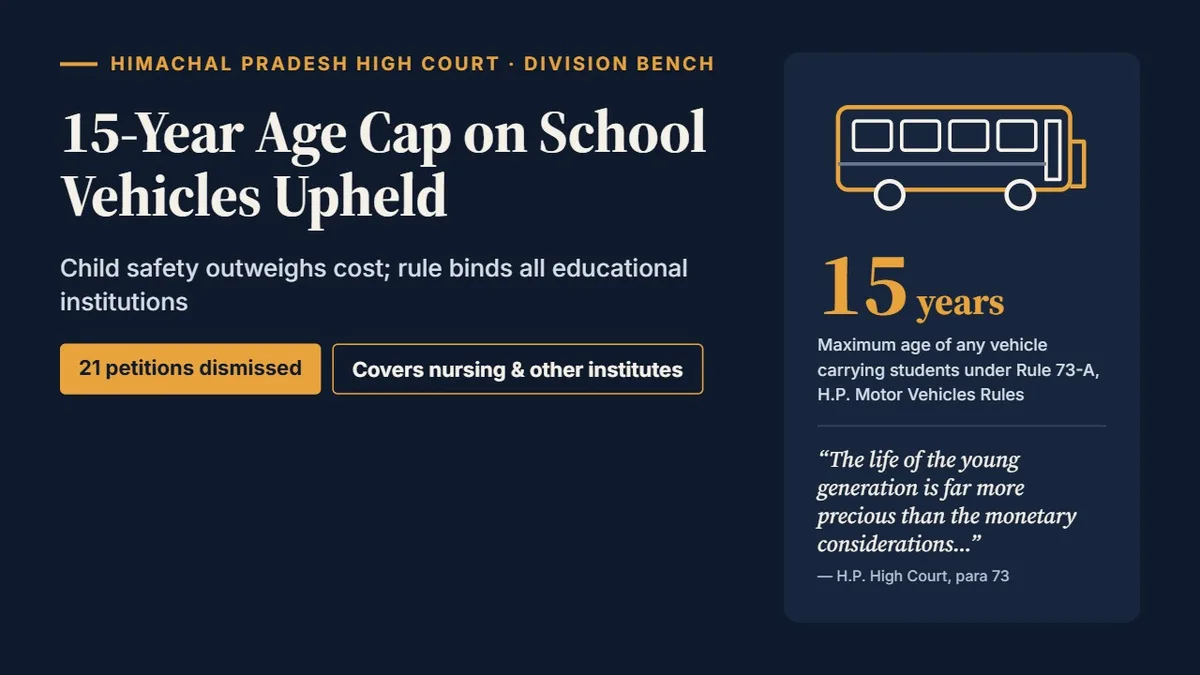
Twenty-one schools, nursing institutes and educational societies challenged Clause (xi) of Rule 73-A(1)A of the Himachal Pradesh Motor Vehicles Rules, 1999, inserted on 12.10.2018 after the Nurpur school-bus accident, which bars vehicles older than 15 years from providing transport to schools (Paras 2–5, 17, 36–37). The Division Bench held that the clause does not fix the 'life of a motor vehicle' – a power reserved to the Centre under Section 59 of the Motor Vehicles Act, 1988 – but only limits the period for which a vehicle may serve schools, and that it falls within the State's power under Section 96 to make rules carrying Chapter V (including permits under Section 76) into effect (Paras 41–58, 61–65). The 15-year limit is not arbitrary: it matches or is more lenient than the rules of Chhattisgarh (12 years), Uttar Pradesh and Haryana (15 years), and financial hardship cannot outweigh the safety of students (Paras 66–73). Read harmoniously, 'School' in Rule 73-A covers every educational institution bound by its other conditions, including nursing and pharmacy institutes (Para 80). All petitions were dismissed and interim orders vacated (Para 81).
Key Proposition: A State rule under Section 96 of the Motor Vehicles Act, 1988 limiting vehicles that transport students to 15 years from manufacture is a valid permit condition that does not trench on the Centre's power under Section 59 to specify the life of a motor vehicle, and it applies to every educational institution bound by the school-transport conditions, not only to schools up to Class 10 or 10+2.
A. Background / Synopsis :
Full Judgement / Attachment
Full Judgement
© 2026 White Collar Professional Technologies Pvt. Ltd. All rights reserved. CIN: U74999MH2024PTC000001
B. Issues For Consideration :
C. Submissions Of Parties :
Only the Central Government can fix a vehicle's life under Section 59; the State's residuary power under Section 96(2)(xxxiii) cannot create an age-based disability with the same effect (relied on Naresh Chandra Agrawal v. ICAI). (Paras 11, 13–14)
Roadworthiness, certified by transport officers, and not age should be the test; institutional buses run very few kilometres; replacement costs will pass to students. (Paras 11–12)
Nursing and pharmacy institutes are not 'schools' within Clause (xi). (Para 11)
Section 96 empowers the State to frame such rules; the rule followed a consultative process after the Nurpur tragedy and forms part of a road-safety policy under the Supreme Court-appointed Committee on Road Safety. (Paras 16–18)
Older vehicles suffer structural fatigue and failure risks that periodic fitness checks cannot detect; Government vehicles too are scrapped after 15 years (Notification dated 07.02.2024). (Para 18)
Chhattisgarh (12 years), Uttar Pradesh and Haryana (15 years) have similar rules, and a Three-Judge Bench of the Chhattisgarh High Court upheld the Chhattisgarh rule. (Paras 19–22)
D. Court's Observations & Analysis :
Section 59 lets the Centre specify a vehicle's life, after which it cannot be used at all; Clause (xi) only limits how long a vehicle may serve schools and leaves it free for other lawful use. (Paras 42–46)
Section 96 empowers the State to make rules carrying Chapter V into effect, including Section 76 permits, and the matters in Section 96(2) do not limit that general power. (Paras 51–55)
The State cannot alter the life fixed by the Centre: if the Centre fixes 10 years, a vehicle cannot serve schools for 15. (Paras 57–58)
Applying the three-step test from P. Krishnamurthy and Naresh Chandra Agrawal (source of power, meaning of the rule, consistency with the delegated power), the rule is intra vires. (Paras 59–65)
Held: Rule 73-A and Clause (xi) are within the State's competence. (Paras 65, 68)
Financial viability cannot be weighed against children's safety; vehicles over 15 years may still be used for other purposes. (Para 69)
That students also travel in older public or private vehicles does not invalidate a rule for identified school vehicles. (Para 70)
Roadworthiness cannot be the sole criterion; in a hilly State the 15-year limit is, if anything, lenient compared with Chhattisgarh's 12. (Paras 71–72)
Held: the 15-year limit is not arbitrary. (Paras 69–73)
Rule 73-A's heading and opening paragraph cover 'School/Educational Institutions'; Clause (xi) sits among general conditions (yellow paint, signage, first aid and others) that the petitioners accept they must follow. (Paras 74–77, 80)
Held: whichever institution is bound by Clauses (i) to (x) and (xii) to (xx) of Rule 73-A(1)A is also bound by Clause (xi). (Para 80)
Notable Observations: “The life of the young generation is far more precious than the monetary considerations of the petitioners.” (Para 73); “One fatal incident on account of an aged vehicle can ruin and shatter the lives of families forever.” (Para 73)
E. Decision & Directions :
All writ petitions dismissed; Notification dated 12.10.2018 and Clause (xi) of Rule 73-A(1)A upheld. (Para 81)
Clause (xi) applies to all educational institutions to which the general conditions in Rule 73-A(1)A apply, and is not restricted to schools teaching up to Class 10 or 10+2. (Para 81)
Interim orders vacated forthwith; no order as to costs. (Para 81)
F. Legal Provisions Discussed & Precedents Cited :
G. Case Details :
Disclaimer: This summary is an editorial aid and does not form part of the judgment. Refer to the original judgment before citing.
The Division Bench dismissed the connected writ appeals, while making a limited modification to the Single Judge’s findings concerning the Bar Council of Kerala. In light of…

The High Court held that the trial court was not justified in directing the parties to undergo fresh DNA testing when the existing expert report had not been rejected for legally…
The High Court held that a subsequently communicated minimum 20% local-content requirement, including an indigenously developed EMS software condition, could not be…
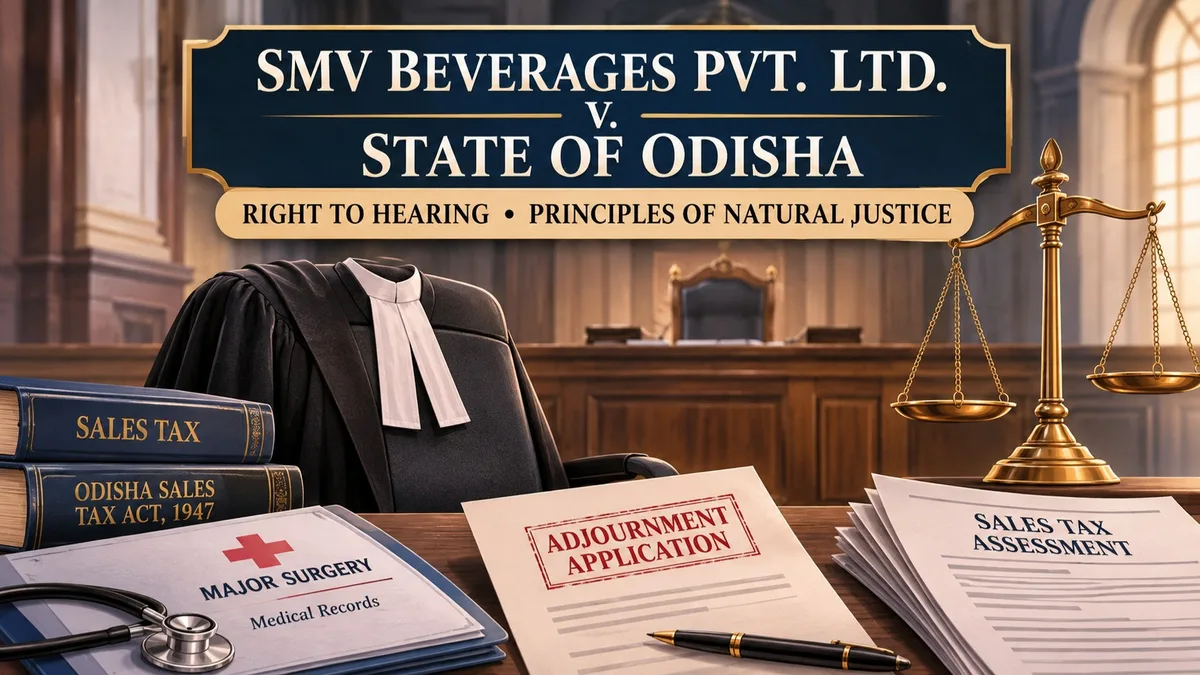
The Division Bench held that the petitioner had been deprived of a reasonable opportunity to present its case before the Commissioner of Sales Tax. An adjournment request must be…

The High Court exercised its inherent jurisdiction to quash a POCSO FIR and the pending trial after obtaining independent reports verifying the parties’ marriage, family…

The Division Bench held that the writ court had exceeded the proper scope of the dispute between the supplier and KSBCL by deciding, in effect, the Revenue’s separate tax…

The High Court considered the petitioners’ request for regular bail in an Enforcement Directorate prosecution alleging money laundering under the Prevention of Money Laundering…

The High Court upheld the appellant’s conviction under Section 18 c of the NDPS Act for possession of opium but reduced the sentence of seven years’ rigorous imprisonment to the…

The High Court dismissed the State’s appeal against acquittal, holding that the trial court’s view was a reasonably possible view on the evidence and that material inconsistencies…
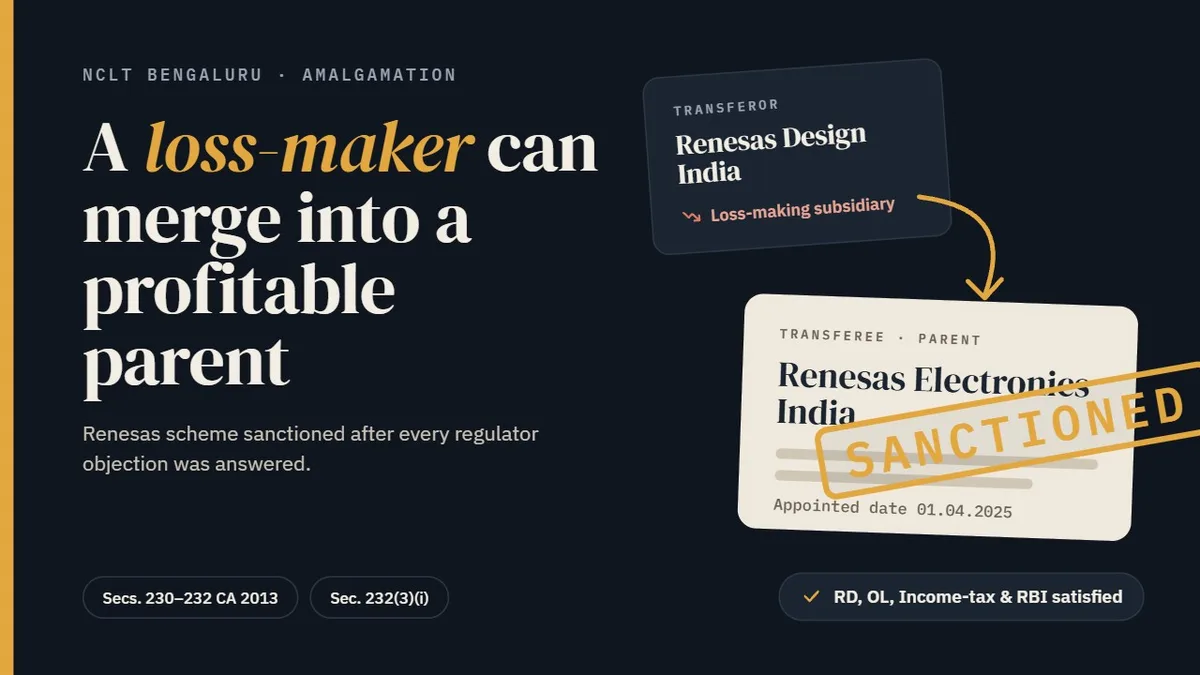
Renesas Design India Pvt. Ltd., a loss-making wholly owned subsidiary engaged in semiconductor design, and its parent Renesas Electronics India Pvt. Ltd. sought sanction of a…