The Madhya Pradesh High Court held that where a party obtains a certified copy of an arbitral award, limitation for an application under Section 34 of the Arbitration and…
ACC’s VAT Reimbursement Claim Must Be Reconsidered Under Odisha’s 2007 Industrial Policy
Court / Authority
Orissa High Court
Update / Judgement Date
16 Oct 2026
Date of Publication
27 Oct 2026
Case No.
W.P.(C) No. 7530 of 2015
Source
WCP News Bulletin
Author
Dipanshi Bansal — WCP Legal Desk
Reading Time
6 min read
View Count
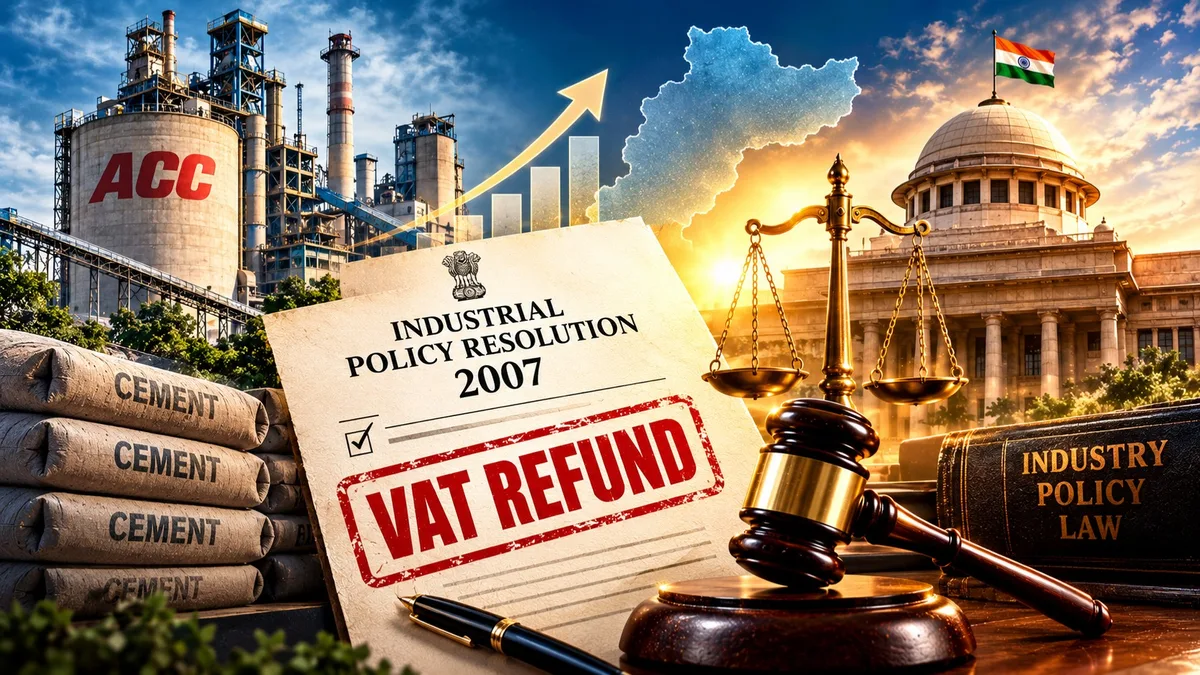
ACC sought VAT reimbursement under Odisha’s Industrial Policy Resolution, 2007 for expansion of its Bargarh Cement Works. The State had declined to consider the claim on the ground that the unit was not a new industrial unit. The Court noted that the expansion occurred after IPR 2007 came into force, that the policy expressly contemplated benefits for existing units undertaking expansion, and that a later Government Resolution retrospectively deleted the word “new” from the relevant entries. Inspection reports also recorded substantial investment and use of industrial waste products. The impugned rejection was set aside, with directions for the competent authority to determine eligibility and, if satisfied, quantify and release any admissible reimbursement (Paras 24–35).
Key Proposition: A claim for industrial-policy incentives arising from post-policy expansion cannot be rejected merely because the original industrial unit pre-dated the policy; the competent authority must assess the expansion, the applicable retrospective amendment, the unit’s actual industrial activity and the policy eligibility criteria.
- Industrial Policy Resolution, 2007 – Clause 18.4(iv) – existing industrial unit – expansion – VAT reimbursement – Held, eligibility must be assessed with reference to the expansion and applicable policy criteria, not merely the age of the original unit (Paras 24–31).
- Industrial Policy Resolution, 2007 – Annexure-I – downstream Thrust Sector – retrospective deletion of “new” – Held, the obsolete objection could not sustain refusal to consider the claim (Paras 25–33).
Background / Synopsis :
- ACC acquired IDCOL Cement Ltd., Bargarh in 2003 and merged the unit with itself in 2005.
- IPR 2007 came into force on 2 March 2007. ACC’s first fixed-capital investment towards expansion was made on 6 March 2007.
- The expansion increased installed capacity from 0.96 million tonnes per annum to 2.5 million tonnes per annum; commercial production after expansion commenced on 1 January 2011.
- Inspection and verification in 2011 recorded ₹585.57 crore fixed-capital investment and 118 direct employees and stated that the unit could be considered a downstream Thrust Sector industry.
- On 4 March 2015, the Additional Director of Industries declined consideration because the unit was not a new industrial unit. The writ petition was filed on 17 April 2015.
- On 9 December 2015, the Government retrospectively deleted the word “new” from the relevant entries with effect from 2 March 2007.
Issues For Consideration :
- Whether Ultratech Cement Ltd. v. State of Odisha applied to ACC’s claim.
- Whether ACC was entitled to consequential consideration of VAT reimbursement under Clause 18.4(iv) of IPR 2007.
- Whether the competent authority could reject the claim merely because the original unit was established before IPR 2007.
Submissions Of Parties :
Petitioner / Appellant:
- Clause 18.4(iv) expressly covered existing units undertaking expansion, modernisation or diversification.
- The expansion was undertaken after IPR 2007 and substantially increased capacity and investment.
- The inspection and verification reports supported downstream Thrust Sector status and recorded use of slag and fly ash as inputs.
- The 9 December 2015 Resolution had retrospectively removed the “new” requirement.
- Ultratech Cement supported the proposition that cement manufacturing could not be classified merely as grinding or mixing without examining the actual industrial activity.
Respondent / State:
- The State disputed eligibility and maintained that the incentive could be claimed only if the applicable policy conditions were fulfilled.
- It argued that the petitioner’s claim had not culminated in a final sanction and that Ultratech did not automatically confer reimbursement.
Court's Observations & Analysis :
Re: Application of Ultratech Cement
- Ultratech held that industrial activity cannot be classified merely by one process such as grinding when the actual manufacturing activity and value addition are material.
- The present case was factually different because ACC had not obtained a final sanction of reimbursement before the dispute arose.
- Therefore, Ultratech supported the method of examining the industrial activity but did not itself establish automatic entitlement to payment.
- Held: The petitioner’s claim had to be determined on its own record and under IPR 2007.
Re: Effect of the 2015 retrospective amendment
- The original rejection relied on the unit not being “new”.
- The Government’s 9 December 2015 Resolution deleted that word retrospectively from the relevant entries.
- The objection therefore could no longer sustain refusal to consider the claim.
- Held: The impugned letter was unsustainable insofar as it declined consideration solely because the original unit was not new.
Re: Downstream Thrust Sector eligibility and reimbursement
- The 2011 verification recorded substantial investment and employment and supported downstream Thrust Sector status.
- The 2012 RIC report recorded slag usage of 52.6% and fly ash usage of 26.2%, relevant to the amended downstream-industry definition.
- However, the record did not establish that a final reimbursement amount had already been sanctioned.
- The competent authority therefore had to determine eligibility and quantify the admissible amount under Clause 18.4(iv).
- Held: The claim required fresh determination rather than automatic reimbursement.
Decision & Directions :
- The impugned letter dated 4 March 2015 was set aside insofar as it declined consideration on the ground that the unit was not new.
- The competent authority was directed to reconsider downstream Thrust Sector status in light of the 2011 verification, 2012 RIC report and the 2015 Resolutions.
- The claim could not be rejected merely because the original unit pre-dated IPR 2007 or because the manufacturing process involved grinding or mixing.
- If eligibility was established, the authorities were to determine VAT reimbursement for increased commercial production under Clause 18.4(iv), including applicable tax adjustments, percentage and ceiling.
- The reasoned exercise was to be completed within three months from receipt of the judgment and any admissible amount released within four weeks thereafter.
- The writ petition was allowed; no order as to costs.
Legal Provisions Discussed & Precedents Cited :
- Constitution of India – Articles 226 and 227 – writ jurisdiction.
- Industrial Policy Resolution, 2007 – Clause 18.4(iv) – VAT reimbursement for existing industrial units undertaking expansion, modernisation or diversification.
- IPR 2007 – Annexure-I – downstream Thrust Sector classification.
- Government Resolution dated 3 March 2015 – amended downstream-industry definition by introducing a 50% utilisation requirement.
- Government Resolution dated 9 December 2015 – retrospectively deleted “new” from the relevant entries with effect from 2 March 2007.
- Ultratech Cement Limited v. State of Odisha, 2022 SCC OnLine Ori 13 – followed for the principle that industrial classification must consider actual activity/value addition rather than merely the description of grinding or mixing.
Full Judgement / Attachment
Full Judgement