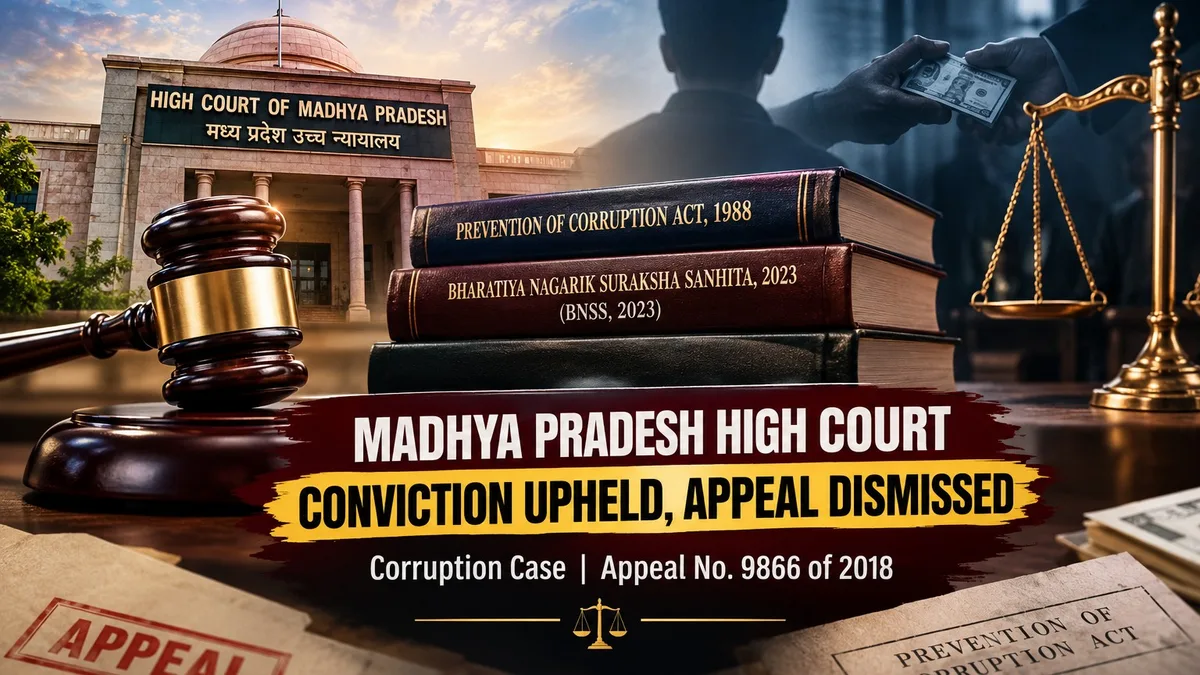
The Madhya Pradesh High Court set aside Bharat Bairagi’s conviction under Section 7 of the Prevention of Corruption Act, 1988, holding that the prosecution failed to prove a clear demand for illegal gratification beyond reasonable doubt. The audio transcript did not establish an unequivocal demand; the complainant’s phone was not seized, the electronic record lacked the required authentication and Section 65-B certificate, and the currency was recovered from beneath a register on an open table rather than from the appellant’s person. The Court upheld the trial court’s acquittal under Section 13(1)(d) read with Section 13(2) and dismissed the State’s application for leave to appeal. (Paras 17–39)
Key Proposition: Proof of a clear demand for illegal gratification is indispensable to a conviction under Section 7 of the Prevention of Corruption Act; doubtful and unauthenticated electronic evidence and recovery from an accessible open table did not prove the demand and acceptance in this case.
- Prevention of Corruption Act, 1988 – Section 7 – Demand of illegal gratification – Whether demand was proved beyond reasonable doubt? Held, no. (Paras 19–36)
Indian Evidence Act, 1872 – Section 65-B – Electronic evidence – Whether the recording/transcript could safely establish demand without seizure and authentication of the primary device and the required certificate? Held, no. (Paras 25–36)
- Prevention of Corruption Act, 1988 – Sections 13(1)(d) and 13(2) – Acceptance/obtaining gratification – Whether acquittal required interference? Held, no. (Paras 37–39)
Background / Synopsis :
- The prosecution alleged that Assistant Sub-Inspector Bharat Bairagi demanded ₹20,000 from complainant Dalsingh Baghel in connection with a village dispute and allegedly received ₹5,000 on 24 February 2016 and ₹2,000 on 25 February 2016, later asking for a further amount.
- The complainant approached the Lokayukta and supplied a memory card containing an alleged telephone recording. A trap was arranged on 29 February 2016; ₹10,000 in tainted notes was recovered from beneath a register on the appellant’s office table. The appellant’s hand-wash reportedly tested positive.
- The Special Judge convicted the appellant under Section 7 of the Prevention of Corruption Act, 1988, sentencing him to two years’ rigorous imprisonment, but acquitted him under Section 13(1)(d) read with Section 13(2).
- The appellant appealed against the Section 7 conviction. The State/Lokayukt sought leave to appeal against the acquittal under Section 13.
Issues For Consideration :
- Whether the prosecution proved a clear demand and acceptance of illegal gratification sufficient to sustain the Section 7 conviction.
- Whether the recorded conversation and transcript were reliable and admissible electronic evidence.
- Whether recovery of the tainted currency from beneath an open table register proved acceptance/obtaining of gratification under Section 13(1)(d) read with Section 13(2).
- Whether the trial court’s partial acquittal warranted appellate interference.
Submissions Of Parties :
Petitioner / Appellant:
- The appellant argued that neither demand nor acceptance had been proved beyond reasonable doubt and that the currency was not recovered from his person.
- He challenged the recording because the original mobile phone was not seized, no hash values or forensic authentication were obtained, and no Section 65-B certificate was produced. The recorder supplied for the trap failed to record the conversation.
- He also relied on the absence of an independent shadow witness, gaps in the Roznamcha entries, and the possibility of false implication arising from the village dispute.
Respondent / State:
- The State argued that the complainant supported the demand and delivery of money, the tainted currency was recovered from beneath the register on the appellant’s table, and independent panch witness Rajendra Mandloi corroborated parts of the trap proceedings.
- The State sought leave to appeal against the trial court’s acquittal on the Section 13(1)(d) read with Section 13(2) charge.
Court's Observations & Analysis :
Re: Proof of demand under Section 7
- Under Neeraj Dutta v. State (Government of NCT of Delhi), proof of demand and acceptance/obtainment is a foundational requirement; it may be proved by direct or circumstantial evidence, but presumptions arise only after foundational facts are established.
- The complainant’s evidence did not provide a consistent, unequivocal account of a bribe demand. The conversation concerned village disputes, cross-complaints, adjustments and police papers.
- The investigating officer admitted that the transcript did not state that the appellant demanded ₹20,000 to suppress the case or that ₹5,000 or ₹2,000 had previously been paid. The proceedings under Sections 107/116 CrPC had already been initiated against the complainant, and the Court considered the complainant’s possible motive to implicate the appellant.
- The Court concluded that the foundational fact of a clear demand was not proved beyond reasonable doubt. (Paras 19–24, 30–36)
Re: Electronic evidence
- The complainant’s original mobile phone was not seized; the memory card was not scientifically authenticated; hash values were not extracted; and no valid Section 65-B certificate was obtained for the secondary electronic record.
- The Court also noted the failure of the supplied voice recorder to record the trap conversation and the absence of voice examination or a witness familiar with the appellant’s voice.
- The transcript was therefore not safe to rely upon to establish a criminal demand. (Paras 25–29, 33–36)
Re: Acceptance, recovery and State’s appeal
- The tainted notes were recovered from beneath an open register on a table accessible to others, not from the appellant’s personal search or clothing. No independent shadow witness observed or overheard the alleged transaction.
- Chemical evidence marked Articles D1, D2 and D3 had been destroyed before reaching the Court, without an explanation from the prosecution.
- The trial court’s finding that acceptance/obtaining under Section 13(1)(d) read with Section 13(2) was not proved was not perverse or illegal. Under the principles in Chandrappa and Murali, a reasonable acquittal view should not be disturbed merely because another view may be possible. (Paras 26, 35–37)
- Notable Observations: None recorded as a separate set of obiter quotations. The judgment reproduces and discusses the rule in Neeraj Dutta on demand and acceptance (para 18).
Decision & Directions :
- Criminal Appeal No. 9866 of 2018 was allowed. The conviction under Section 7 of the Prevention of Corruption Act, 1988 was set aside and the appellant was acquitted of that charge.
- The appellant’s bail bonds were discharged; any deposited fine was directed to be refunded in accordance with the rules.
- M.Cr.C. No. 17021 of 2019, filed by the State/Lokayukt seeking leave to appeal against the acquittal under Section 13(1)(d) read with Section 13(2), was dismissed.
- A copy of the judgment was directed to be sent to the trial court for compliance.
Legal Provisions Discussed & Precedents Cited :
- Prevention of Corruption Act, 1988 – Section 7: Charge of obtaining illegal gratification; conviction set aside because demand was not proved.
- Prevention of Corruption Act, 1988 – Sections 13(1)(d) and 13(2): Charges relating to criminal misconduct; trial court’s acquittal affirmed.
- Prevention of Corruption Act, 1988 – Section 20: Statutory presumption discussed in the context of foundational facts and rebuttal.
- Indian Evidence Act, 1872 – Section 65-B: Certificate requirement for secondary electronic evidence.
- Indian Evidence Act, 1872 – Section 114(g): Adverse inference discussed regarding the recording evidence.
- Code of Criminal Procedure, 1973 – Sections 107/116: Proceedings already initiated against the complainant; Section 374 (appeal against conviction) and Section 378 (State appeal/leave) referenced in the judgment.
- Bharatiya Nagarik Suraksha Sanhita, 2023 – Section 415(3): Equivalent appellate provision cited by the judgment alongside Section 374 CrPC.
- Old–new evidence-code note: Indian Evidence Act, 1872, Section 65-B corresponds broadly to Bharatiya Sakshya Adhiniyam, 2023, Section 63; the judgment itself adjudicated the electronic evidence under Section 65-B of the Evidence Act.
- Neeraj Dutta v. State (Government of NCT of Delhi), (2023) 4 SCC 731 – Relied on for the foundational requirement of proof of demand and acceptance.
- P. Satyanarayana Murthy v. State of A.P., (2015) 10 SCC 152 – Relied on regarding proof of demand
- B. Jayaraj v. State of A.P., (2014) 13 SCC 55 – Relied on regarding demand and mere recovery.
- Anvar P.V. v. P.K. Basheer, AIR 2015 SC 180 / (2014) 10 SCC 473 – Relied on regarding admissibility of secondary electronic evidence.
- Ram Singh v. Col. Ram Singh, (1985) Supp SCC 611 – Referred to on authentication/voice evidence.
- Sudeep v. State of M.P., Cr.A. No. 1013/2016, order dated 8 July 2024; also cited as (2025) 1 MPLJ (Cri.) 134 – Relied on regarding electronic evidence.
- Mukhtiar Singh v. State of Punjab, (2017) 8 SCC 136 – Referred to regarding proof in corruption cases.
- Suraj Mal v. State (Delhi Administration), (1979) 4 SCC 725 – Referred to regarding evidentiary reliability.
- Chandrappa v. State of Karnataka, (2007) 4 SCC 415 – Relied on regarding appellate restraint in appeals against acquittal.
- Murali v. State, (2021) 1 SCC 726 – Relied on regarding interference with acquittal.