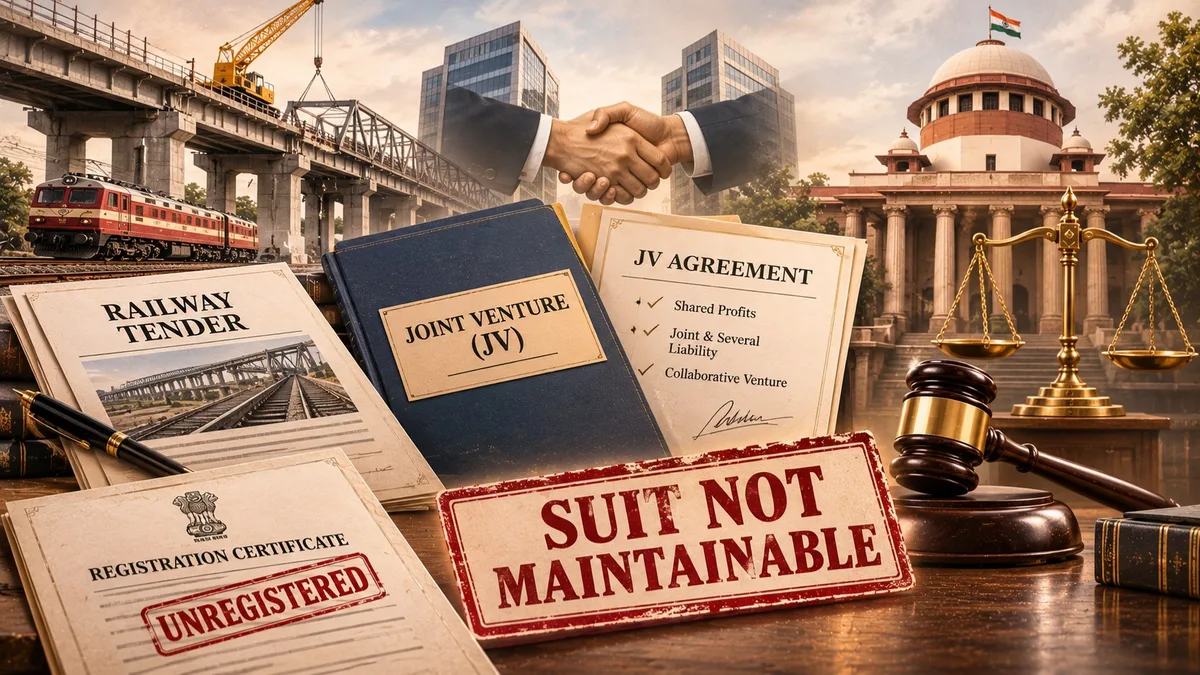
Calcutta High Court Holds Unregistered Railways Joint Venture to Be a Partnership and Dismisses Its Contractual Suit
Court / Authority
Calcutta High Court
Update / Judgement Date
13 Nov 2026
Date of Publication
16 Nov 2026
Case No.
AD-COM/7/2026
Source
WCP News Bulletin
Author
Dipanshi Bansal — WCP Legal Desk
Reading Time
10 min read
View Count
1
Civil LawCorporate Law & Governance
Calcutta High Court · WCP News Bulletin
A joint venture formed by two companies was a partnership on the substance of its agreement, including the project business, profit-sharing and mutual agency; because the partnership was unregistered, its suit to enforce contractual rights was barred by Section 69(2) of the Partnership Act.
Key Proposition: Indian Partnership Act, 1932 – Sections 4 and 6 – Joint venture or partnership – Whether the MOU and JV agreement created a partnership? Held, yes, on the facts and terms of the agreements. (Paras 40–56)Indian Partnership Act, 1932 – Section 69(2) – Unregistered partnership – Contractual suit – Whether the suit was maintainable? Held, no. (Paras 66–76)Code of Civil Procedure, 1908 – Order I Rule 8 – Constituent members joined as plaintiffs – Whether joinder cured the Section 69(2) bar? Held, no, in a suit to enforce contractual rights of the unregistered partnership. (Para 75)
Background / Synopsis :
South East Central Railway and another appealed against a judgment and decree dated 10 March 2026 in C.S. (COM) No. 56 of 2024. The Single Judge had directed the Railways to refund security and earnest money deposits, the bank-guarantee amount and bill amount with interest, awarded ₹1,00,000 as costs, and dismissed the Railways’ counterclaims.
The suit arose from a railway contract for designing and constructing the foundation, substructure, approaches and allied works of Bridge No. 182 between IB and Brajraj Nagar Railway Station in the Champa–Jharsuguda section. The tender notice dated 23 February 2010 permitted participation by a joint venture and prescribed special conditions and guidelines for such participation.
Rahee Infratech Limited and GPT Infraprojects Limited formed Rahee-GPT (JV) through a memorandum of understanding dated 20 February 2010 and a joint venture agreement dated 29 November 2010. The Railways issued a letter of acceptance in favour of the JV. The respondents alleged that the Railways prevented performance and challenged notices including termination dated 5 March 2014, invocation of a bank guarantee and forfeiture of security.
During the appeal, the Division Bench raised the question whether Rahee-GPT (JV), described as the first plaintiff, was in substance a partnership firm and whether its suit was barred by Section 69(2) of the Indian Partnership Act, 1932 because it was not registered under that Act.
Full Judgement / Attachment
Full Judgement
Issues For Consideration :
Whether Rahee-GPT (JV), constituted by Rahee Infratech Limited and GPT Infraprojects Limited, was in substance a partnership firm within the meaning of the Indian Partnership Act, 1932.
Whether the JV was registered under the Partnership Act, 1932.
Whether the suit to enforce contractual rights was barred by Section 69(2) of the Partnership Act because the JV was an unregistered partnership.
Whether the objection under Section 69(2) could be considered in appeal although it had not been raised in the written statement or memorandum of appeal.
Submissions Of Parties :
Railways / Appellants: The respondents had constituted a partnership in the form of a JV. Since the JV was not registered under the Partnership Act, the suit was barred by Section 69(2). The appellants relied on GVPREL-MEE (J.V.) v. Government of Andhra Pradesh and Another, AIR 2006 AP 169.
Respondents: The tender expressly permitted a JV and prescribed the format of the JV agreement. The two constituent companies had entered into the MOU and JV agreement in that prescribed format. The first respondent was an unincorporated association, not a partnership; alternatively, it was argued that an unincorporated association could sue if its constituent members joined the proceedings. The respondents also argued that the objection had not been pleaded in the written statement and could not be raised for the first time in appeal.
Respondents further relied on the distinction between a JV and a partnership, including the role of a lead member, the limited project-specific nature of the arrangement, the allocation of profit shares and responsibilities, and the absence of the ordinary mutual agency associated with a partnership.
Court's Observations & Analysis :
Legal character depends on substance: The Court held that the label “Joint Venture” or “partnership” was not decisive. The relationship had to be determined from the agreement and established facts. For a partnership, the relevant elements were an agreement, a business, sharing of profits and mutual agency; an agreement to share profits was relevant but not conclusive by itself. (Paras 40–42)
Unincorporated JV and legal personality: The Court reviewed authorities holding that an unincorporated association does not have a separate legal personality merely by being called an association or JV. The tender conditions required a JV entity legally capable of entering into the contract and of suing or being sued. On the Court’s interpretation, the contemplated entity had to be a company or a partnership firm, rather than an entity with no legal capacity to litigate. (Paras 57–62)
Terms of the MOU and JV agreement: The MOU and JV agreement recorded that the two constituent companies would execute the project jointly, share profits and liabilities, and be jointly and severally responsible. Rahee Infratech was identified as lead partner and authorised to represent the JV, sign documents and deal with the Railways. The agreement allocated 70% and 30% shares and responsibilities between the two companies. (Paras 49–56)
Mutual agency and partnership finding: On the combined terms of the MOU and JV agreement, the Court found an agreement to undertake a business/project, share its profits and create agency between the constituent companies. The Court therefore concluded that the arrangement satisfied the ingredients of a partnership for the purposes of the Partnership Act. (Paras 52–56)
Section 69(2): The respondents admitted that the JV was not registered under the Partnership Act. The Court held that Section 69(2) barred the suit because the plaintiffs were seeking to enforce contractual rights arising from the contract with the Railways. The fact that the constituent members had joined as plaintiffs did not cure the statutory bar in a suit seeking enforcement of contractual rights by an unregistered partnership. (Paras 66–76)
Burden and timing of the objection: The Court held that the plaintiff suing as a partnership must establish that the Section 69(2) bar does not apply. It treated the bar as affecting the Court’s jurisdiction to entertain the suit and held that it could not be waived even by consent. Although the Railways had not raised the point in the written statement, the Court had itself raised the query during appeal, permitted both sides to address it and receive relevant material, and considered the issue in the appeal, which it described as a continuation of the original proceedings. (Paras 68–75)
Distinguishing the procedural objection: The Court respectfully disagreed with the approach in Nortrans Marine Services on the facts before it, holding that the burden to establish registration or non-application of Section 69(2) lay on the plaintiff partnership. It also noted that the respondents’ plaint and reverification described the first plaintiff as a partnership through the person who verified it as a partner. (Paras 68–74)
Decision & Directions :
The appeal AD-COM/7/2026 was allowed.
The judgment and decree dated 10 March 2026 in C.S. (COM) No. 56 of 2024 were set aside.
The commercial suit was dismissed as not maintainable under Section 69(2) of the Indian Partnership Act, 1932, because the first plaintiff was an unregistered partnership firm seeking to enforce contractual rights.
No order as to costs.
Legal Provisions Discussed :
Indian Partnership Act, 1932 – Section 4: Definition and essential character of partnership, as relevant to the Court’s analysis of the relationship between the constituent companies.
Indian Partnership Act, 1932 – Section 6: Determination of partnership from the real relation between parties, including the substance of their agreement and conduct.
Indian Partnership Act, 1932 – Section 69(2): Bar on a suit by or on behalf of an unregistered firm to enforce a right arising from a contract against a third party.
Indian Partnership Act, 1932 – Section 8: Particular partnership / partnership for a particular adventure, referred to in the authorities discussed.
Code of Civil Procedure, 1908 – Order I Rule 8: Representative suits; considered in the context of whether constituent members joining proceedings could cure the defect.
Commercial Courts Act, 2015 – Section 2(1)(c)(xi) and (xv): Referred to in submissions to distinguish commercial disputes involving partnership and joint-venture arrangements.
Companies Act, 2013: Referred to in determining whether the JV was an incorporated company or another legally recognised entity.
Registration Act, 1908: The respondents referred to registration of the JV agreement under this Act; the Court’s central inquiry was whether the partnership itself was registered under the Partnership Act.
Precedents Cited :
Director General Ordnance Factories Employees Association v. Union of India, AIR 1969 Cal 149 – Applied for the distinction between an incorporated body with legal personality and an unincorporated association.
Gandhabanik Mahasabha v. Gandhabanik Mahasabha, Bardhaman Sakha Samity, 2008 SCC OnLine Cal 680 – Referred to on the ability of an unincorporated association to sue and the requirements for representative proceedings.
BPL-BBC Joint Venture v. Mumbai Metropolitan Region Development Authority, Commercial Suit No. 585 of 2017, Bombay High Court, 1 September 2026 – Referred to for the proposition that a JV is not by itself a juristic entity unless incorporated or otherwise legally constituted.
Hindustan Petroleum Corporation Ltd. v. Om Construction, 2026 SCC OnLine Bom 217 – Relied on in the submissions concerning the legal character of a JV and the distinction between JV and partnership.
Jagatheesh v. Chandrasekharapillai, CRP (MD) No. 200 of 2024, decided 4 October 2024 – Referred to for the distinction between partnership and JV, including mutual agency and the terms of the agreement.
GVPREL-MEE (J.V.) v. Government of Andhra Pradesh and Another, AIR 2006 AP 169 – Cited by the Railways; the judgment notes that the Single Judge decision relied upon by the respondents had been reversed by a Division Bench.
Nortrans Marine Services (P) Ltd. v. Cargo Care International, 2020 SCC OnLine Ker 5017 – Considered on whether an objection under Section 69(2) must be pleaded in the written statement; the Court took a different view on the burden and jurisdictional character in the present case.
Asia Foundation & Constructions Ltd. v. State, 1985 SCC OnLine Guj 316 – Relied on for the elements of partnership and the limited scope of rights and liabilities in a particular joint venture adventure.
C. Prakash v. State of Karnataka, 2018:KHC:8653-DB – Referred to for the distinction between a partnership and a joint venture arrangement involving companies.
Ganga Metal Refining Co. Pvt. Ltd. v. Commissioner of Income Tax, West Bengal, AIR 1967 Cal 429 – Discussed in relation to whether a JV arrangement constitutes a partnership or an association of persons.
Case Details :
Case / Party Name: South East Central Railway and Another v. Rahee-GPT (JV) and Others
Case Number(s): AD-COM/7/2026; C.S. (COM) No. 56 of 2024
Coram / Judges: Debangsu Basak, J. and Aryak Dutt, J. – Division Bench
Judgment Authored By: Debangsu Basak, J.; Aryak Dutt, J. agreed
Date of Decision: 13 November 2026
Nature of Proceedings: Commercial appeal from a judgment and decree in a commercial suit
Letters Patent / Appeals: Commercial appeal AD-COM/7/2026 arising from C.S. (COM) No. 56 of 2024
Counsel Appearances: For appellants: Pramod Kumar Drolia and Santosh Kumar Pandey. For respondents 1–3: Samrat Sen, Senior Advocate; Nirmalya Dasgupta, R. L. Mitra and Priyanka Dhar.
Disclaimer: This summary is an editorial aid and does not form part of the judgment. Refer to the original judgment before citing.
Calcutta High Court Holds Unregistered Railways Joint Venture to Be a Partnership and Dismisses Its Contractual Suit — News & Judgements | White Collar Professional
The Supreme Court dismissed the husband’s appeals and upheld the enhancement of interim maintenance payable to his wife from ₹75,000 to ₹1,50,000 per month. The Court found the…
The Supreme Court allowed the appeal of a woman who suffered severe electrocution injuries, resulting in amputation of her right hand and permanent disability. It set aside the…
The Supreme Court dismissed the Delhi Development Authority’s appeals and upheld directions requiring release of gratuity to two retired employees who had been honourably…
The Supreme Court dismissed the challenge by candidates to the recruitment process for Excise Constables in Nagaland. It held that the recruitment was governed by the Nagaland…
The Supreme Court dismissed the State of Kerala’s appeal against a finding that 12 acres of land in Edakkara Village, Malappuram District, did not constitute private forest and…
The Supreme Court allowed the Union of India’s transfer petitions and directed that two cases registered in Jammu and Kashmir and Haryana be transferred to the NIA Special Court…
The Supreme Court examined the termination of an Associate Professor during probation at the Indian Institute of Science, Bengaluru. The central question was whether a termination…
The Supreme Court considered a batch of appeals arising from the insolvency resolution processes of Videocon Industries Limited VIL , twelve other Videocon group companies and…
Although no fundamental right exists to carry on the liquor trade, the State cannot keep temporary licences suspended beyond the election period without disclosing cogent reasons…
In the LDA/24 recruitment examination, candidates who selected either of the two disputed answers to Question No. 70 were directed to receive the mark and have the negative…