
The Karnataka High Court quashed a private complaint, the Magistrate’s referral order and the resulting FIR alleging medical negligence against an eye hospital and its doctors.…
Criminal Law
23/11/20264 min read
Court / Authority
Bombay High Court
Update / Judgement Date
29 Oct 2026
Date of Publication
02 Nov 2026
Case No.
Criminal Appeal No. 294 of 2020
Source
WCP News Bulletin
Author
Pranjal Jha — WCP Legal Desk
Reading Time
8 min read
View Count
8
Introduction
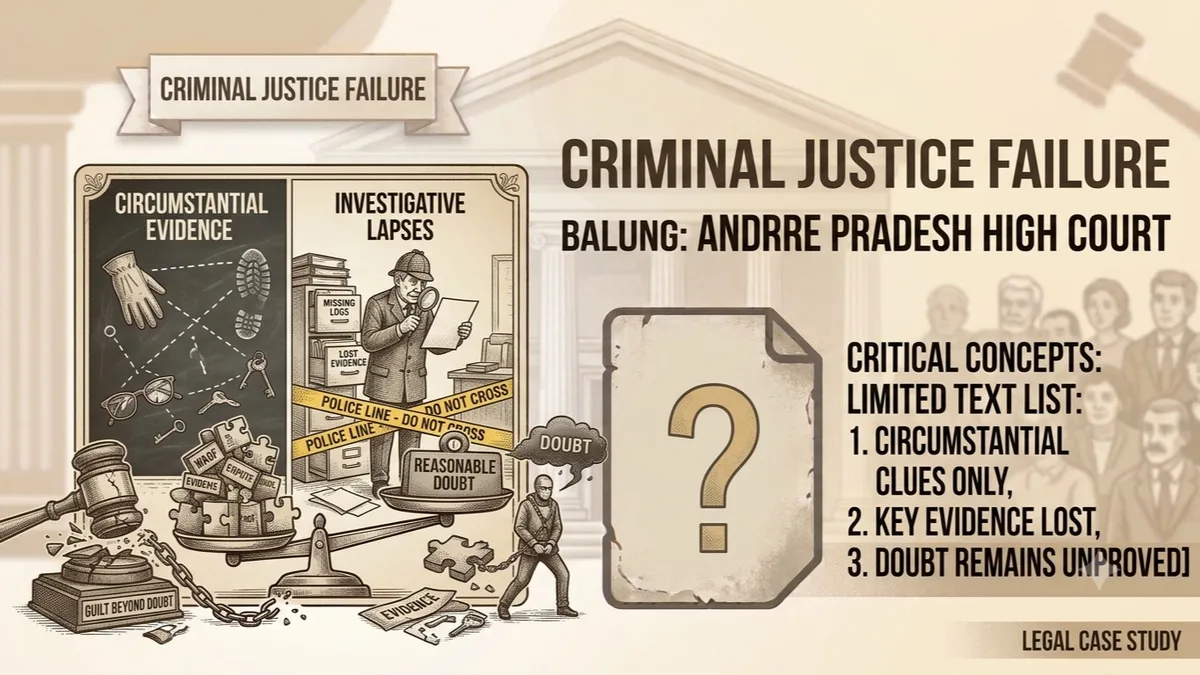
The Bombay High Court, comprising Justice Manish Pitale and Justice Shreeram V. Shirsat, considered a criminal appeal challenging the conviction of Manishprasad Narsingh Gaud for the kidnapping and murder of a five-year-old child, along with causing the disappearance of evidence. The appeal arose from the Sessions Court's judgment dated 5 May 2018, which had convicted the appellant under Sections 302, 363 and 201 of the Indian Penal Code. The prosecution's case was entirely based on circumstantial evidence, including last-seen testimony, alleged ransom calls, recovery of the child's dead body, mobile phone records and forensic evidence. The central question before the High Court was whether these circumstances formed a complete chain sufficient to establish the appellant's guilt beyond reasonable doubt.
Background and Facts
The case concerned the disappearance of a five-year-old boy, Sagar Sharma, from Kandivali, Mumbai, on 26 August 2012. Following his disappearance, his father allegedly received telephone calls demanding ₹50,000 for the child's return. The investigation led the police to the appellant, who was arrested on 30 August 2012. The prosecution claimed that the appellant's disclosure statement led to the recovery of the child's dead body on 31 August 2012. It further relied on the recovery of the appellant's clothes and mobile phone, the testimony of witnesses who allegedly saw him with the child, and the evidence relating to the ransom calls.
The Sessions Court convicted the appellant under Sections 302, 363 and 201 IPC and imposed life imprisonment for murder, along with additional fixed-term sentences. All sentences were directed to run consecutively. Challenging the conviction, the appellant argued that the prosecution had failed to establish a complete chain of circumstances and that the evidence relied upon by the trial court was unreliable.
Issues Before the Court
The High Court primarily examined whether the prosecution had established the appellant's guilt through reliable circumstantial evidence. It considered the credibility of the last-seen witnesses, the alleged ransom motive, the evidentiary value of the recovery of the dead body and other articles, and the admissibility of electronic evidence relating to the telephone calls. The Court also examined whether the prosecution had established the essential ingredients of kidnapping under Section 361 IPC and whether the trial court was legally justified in directing life imprisonment and fixed-term sentences to run consecutively.
Full Judgement / Attachment
Full Judgement
Submissions of the Parties
Court's Observations and Analysis
Decision and Final Directions
The Bombay High Court concluded that the prosecution had failed to establish a complete chain of circumstances connecting the appellant with the kidnapping and murder of the child. Although the Court accepted that the death was homicidal, it found insufficient evidence to establish that the appellant was responsible. It therefore allowed the appeal and quashed the convictions and sentences under Sections 302, 363 and 201 IPC. The appellant was acquitted of all charges and directed to be released forthwith, subject to completion of procedural formalities and unless required in another case. He was also directed to execute a personal bond of ₹50,000 under Section 481 of the Bharatiya Nagarik Suraksha Sanhita, 2023.
Important Legal Principles and Precedents
The judgment reiterates several important principles concerning criminal trials based on circumstantial evidence.
Editorial Assessment
The judgment is particularly relevant for its practical application of the law of circumstantial evidence and the evidentiary requirements governing electronic records. It demonstrates that serious allegations and suspicious circumstances cannot substitute for legally admissible and reliable evidence. Its strongest classification is Procedural / Practical, with Academic / Doctrinal as the second-best category, owing to its detailed examination of witness credibility, Section 27 recoveries, Section 65B certification and the last-seen theory.
Editorial status: Pending. No final selection decision has been made.
© 2026 White Collar Professional Technologies Pvt. Ltd. All rights reserved. CIN: U74999MH2024PTC000001
The Karnataka High Court quashed a private complaint, the Magistrate’s referral order and the resulting FIR alleging medical negligence against an eye hospital and its doctors.…

The Karnataka High Court allowed an appeal and granted anticipatory bail in a case invoking the SC/ST Prevention of Atrocities Act. The Court took note of the 13-day delay in…

The Karnataka High Court quashed criminal proceedings against two former Karnataka State Open University functionaries after holding that the Magistrate had exceeded jurisdiction…

The Orissa High Court held that a registering authority cannot refuse registration of an arbitral award in its entirety merely because one of the properties covered by the award…

The Bombay High Court granted bail to an accused charged in a dacoity case involving the MCOC Act, taking into account his limited alleged role as a lookout, the absence of…

The petitioner, a retired employee of the Indian Institute of Public Administration IIPA , sought continuation of Central Government Health Scheme CGHS facilities that he had…
Following an inter-corporate deposit of Rs. 1,00,00,000/- made by the complainant company to M/s. Tantia Constructions Limited, a cheque of Rs. 1,00,00,000/- issued towards…

Respondent no. 1 claimed marriage and cohabitation with the appellant, giving birth to respondent no. 2, while prior proceedings under Section 9 of the Hindu Marriage Act, 1955…

The appellant-plaintiff occupied Suit Property-I as a tenant and later sought specific performance of three Agreements to Sell dated 22.04.2017, 25.05.2017, and 30.12.2017,…

The applicant sought anticipatory bail in connection with a complaint filed before Paldi Police Station, Ahmedabad City alleging offences under Sections 316 and 318 of the…