
The Division Bench dismissed the connected writ appeals, while making a limited modification to the Single Judge’s findings concerning the Bar Council of Kerala. In light of…
Civil Law
Court / Authority
Delhi High Court
Update / Judgement Date
17 Nov 2026
Date of Publication
18 Nov 2026
Case No.
W.P.(C) 14795/2025
Source
WCP News Bulletin
Author
Soumya Gupta — WCP Legal Desk
Reading Time
6 min read
View Count
1
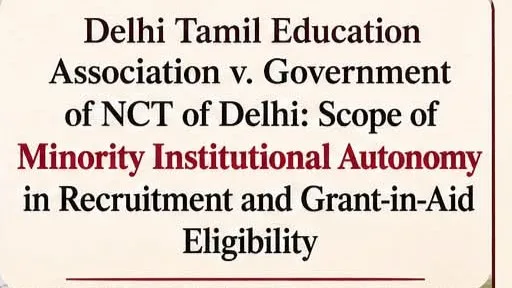
Background / Synopsis :
• The Delhi Tamil Education Association (DTEA) administers seven recognized, government-aided minority schools catering to nearly 7,000 students, receiving 95% grant-in-aid towards staff salary expenditures. • Following earlier litigation concluding with Supreme Court orders affirming DTEA's right to fill vacancies without prior departmental approval, DTEA advertised 107 vacancies and filled 100 positions across its schools in 2024. • When DTEA forwarded appointment dossiers for release of grant-in-aid, the Directorate of Education (DoE) raised numerous objections concerning teacher qualifications (specifically B.Ed. vs. JBT/BTC for primary teachers), selection committee constitution, reservation compliance, and direct recruitment norms. • On 4th November 2025, the DoE passed a composite order rejecting grant-in-aid for all 100 appointments, prompting DTEA to file W.P.(C) 14795/2025 challenging the rejection, and the aggrieved appointees to file W.P.(C) 17099/2025 seeking salaries and release of grant-in-aid.
Issues For Consideration : Whether linguistic minority institutions can appoint teaching and non-teaching staff without adhering to the statutory qualifications prescribed under the Delhi School Education Rules and applicable Recruitment Rules for the purpose of claiming grant-in-aid. Whether a B.Ed. degree serves as a valid qualification for Assistant Teachers (Primary) in aided schools under the 1989 Recruitment Rules. Whether the DoE's collective rejection of all 100 appointments without individual scrutiny is legally sustainable. Whether employees who have rendered services are entitled to remuneration from the institution or the State notwithstanding disputes over grant-in-aid eligibility.
Submissions Of Parties :
Petitioner / Appellant:
• DTEA contended that as a linguistic minority institution protected under Article 30(1), it has the absolute right to appoint staff without prior departmental approval, and the DoE cannot impose restrictions via grant-in-aid that it could not lawfully impose at recruitment. • It relied on the 2022 Recruitment Notification recognizing B.Ed. as an eligible qualification and argued that the DoE's refusal to participate in selection committees cannot invalidate selections duly made through properly constituted bodies. • The employees submitted that they joined pursuant to formal appointment letters, discharged duties, and are entitled to salaries under Section 10 of the DSE Act and the deemed approval doctrine under Rule 98(4) of the DSE Rules. Respondent / State: • The GNCTD/DoE argued that constitutional protection under Article 30(1) does not exempt minority institutions from mandatory statutory qualification requirements when seeking public funds. • It maintained that the 1989 Recruitment Rules govern aided schools, prescribing JBT/BTC for Assistant Teachers, and that B.Ed. without elementary-teacher training is insufficient. • It defended its objections regarding selection committee composition, reservation quotas, promotional feeder cadres, and incomplete records.
Full Judgement / Attachment
Full Judgement
Court's Observations & Analysis : Re: Issue (i): Minority Autonomy vs. Regulatory Standards • Article 30(1) protects minority administration rights, but this right is not absolute and does not include the right to maladminister or bypass educational standards and statutory qualifications attached to public grant-in-aid. • The management's authority to make appointments without prior departmental approval must be distinguished from the eligibility of those appointments for grant-in-aid. Held: Minority status exempts institutions from prior approval requirements for appointments, but not from mandatory qualifications or statutory conditions governing public financial aid. (Paras 12, 14) Re: Issue (ii): Qualifications for Assistant Teachers • Rule 100 of the DSE Rules links qualifications in aided schools to corresponding government school rules, specifically the 1989 Recruitment Rules which mandate JBT/BTC for Assistant Teachers. • The 2022 notification relied upon by DTEA governed direct recruitment in DoE's own establishment and did not extend to private aided schools; furthermore, B.Ed. is specialized for higher classes and is not equivalent to elementary training (JBT/BTC). Held: B.Ed. alone, without JBT/BTC, does not satisfy the essential qualification for Assistant Teachers under the applicable 1989 Rules. (Paras 16-24) Re: Issue (iii): Legality of Collective Rejection • The DoE's impugned order of 4th November 2025 lumped diverse objections of varying legal character together to reject all 100 appointments summarily. • Objections regarding qualifications, experience, age limits, vacancy availability, and procedural compliance require individual, appointment-wise verification. Held: A collective rejection of all appointments without individual, reasoned scrutiny is unsustainable in law. (Paras 15, 58) Re: Issue (iv): Employee Remuneration and State Liability • State liability to pay salary via grant-in-aid arises only when statutory requirements are complied with. However, refusal of grant-in-aid does not extinguish the institution's independent contractual or restitutionary liability (under Section 70 of the Indian Contract Act) to remunerate employees for services actually rendered. Held: DTEA remains liable to compensate employees who worked, independently of the State's grant-in-aid obligations. (Paras 59-60)
Notable Observations: • "The grant of State aid does not alter the nature or character of the minority institution or dilute its right to administer. The right is, however, not absolute and does not include the right to maladminister." (Para 12) • "An appointment founded upon B.Ed. cannot qualify for regular grant-in-aid merely because the candidate was selected, appointed or permitted to teach." (Para 24)
Decision & Directions : • Both writ petitions are partly allowed; the DoE's collective rejection order dated 4th November 2025 is set aside. • DTEA must furnish an indexed, employee-wise detailed statement within two weeks containing post, qualifications, experience, and service particulars. • The Director of Education shall designate an Additional Director within one week to conduct a fresh, appointment-wise examination based on existing records and submissions. • The designated officer shall issue a single deficiency statement, afford personal hearings where necessary, and complete the individual reasoned determinations within twelve weeks. • For appointments found eligible, the DoE shall disburse its 95% share of salary and arrears within four weeks of determination, while DTEA deposits its matching share under Section 10(2) of the DSE Act. • Where grant-in-aid is refused, the refusal is confined to State funding and does not terminate employment or extinguish the employee's claim against DTEA for services rendered under applicable law (such as Section 70 of the Contract Act).
© 2026 White Collar Professional Technologies Pvt. Ltd. All rights reserved. CIN: U74999MH2024PTC000001
The Division Bench dismissed the connected writ appeals, while making a limited modification to the Single Judge’s findings concerning the Bar Council of Kerala. In light of…

The High Court held that the trial court was not justified in directing the parties to undergo fresh DNA testing when the existing expert report had not been rejected for legally…

The High Court held that a subsequently communicated minimum 20% local-content requirement, including an indigenously developed EMS software condition, could not be…
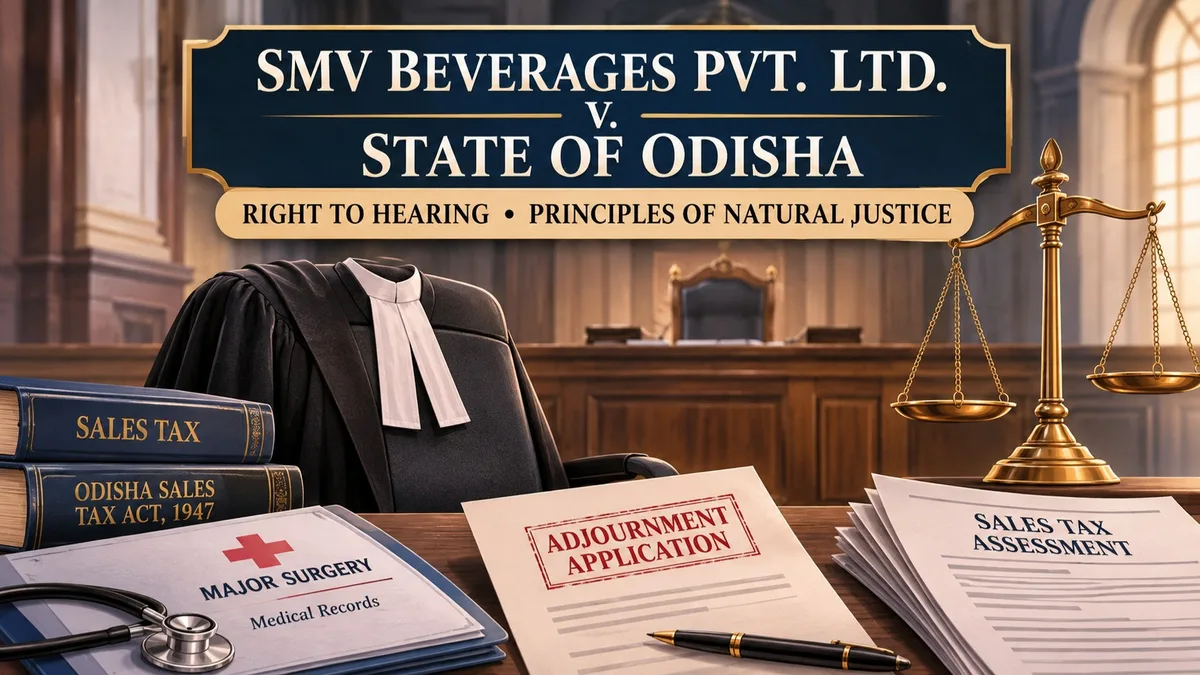
The Division Bench held that the petitioner had been deprived of a reasonable opportunity to present its case before the Commissioner of Sales Tax. An adjournment request must be…

The High Court exercised its inherent jurisdiction to quash a POCSO FIR and the pending trial after obtaining independent reports verifying the parties’ marriage, family…

The Division Bench held that the writ court had exceeded the proper scope of the dispute between the supplier and KSBCL by deciding, in effect, the Revenue’s separate tax…

The High Court considered the petitioners’ request for regular bail in an Enforcement Directorate prosecution alleging money laundering under the Prevention of Money Laundering…

The High Court upheld the appellant’s conviction under Section 18 c of the NDPS Act for possession of opium but reduced the sentence of seven years’ rigorous imprisonment to the…

The High Court dismissed the State’s appeal against acquittal, holding that the trial court’s view was a reasonably possible view on the evidence and that material inconsistencies…
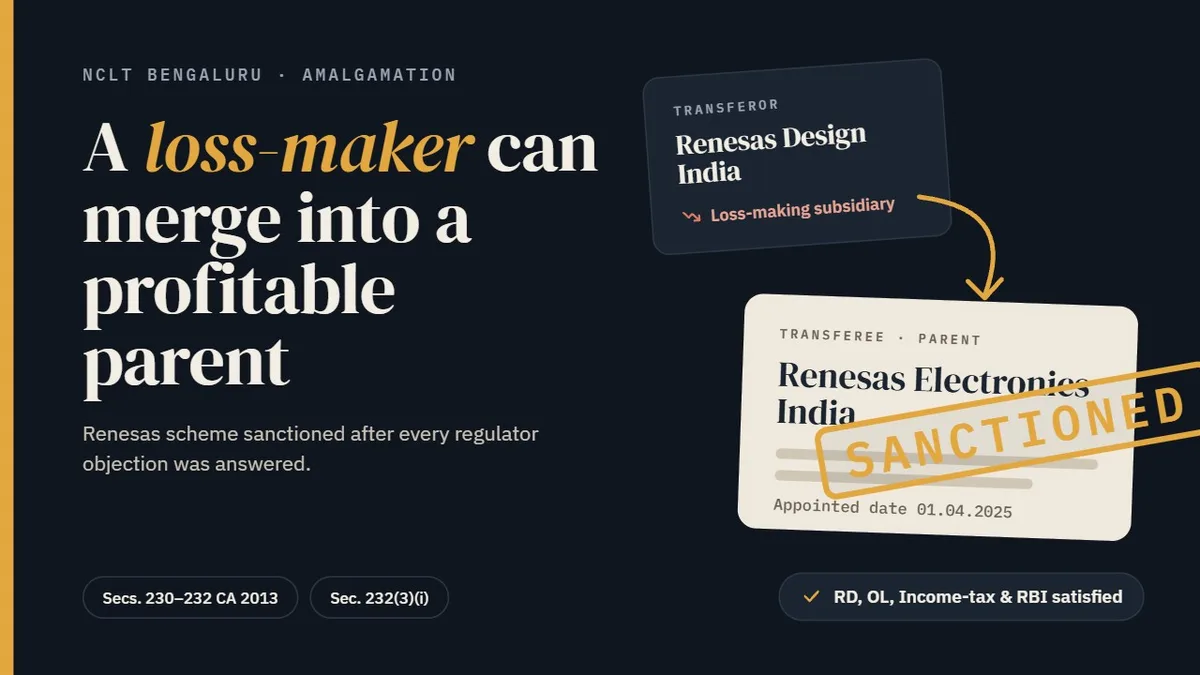
Renesas Design India Pvt. Ltd., a loss-making wholly owned subsidiary engaged in semiconductor design, and its parent Renesas Electronics India Pvt. Ltd. sought sanction of a…