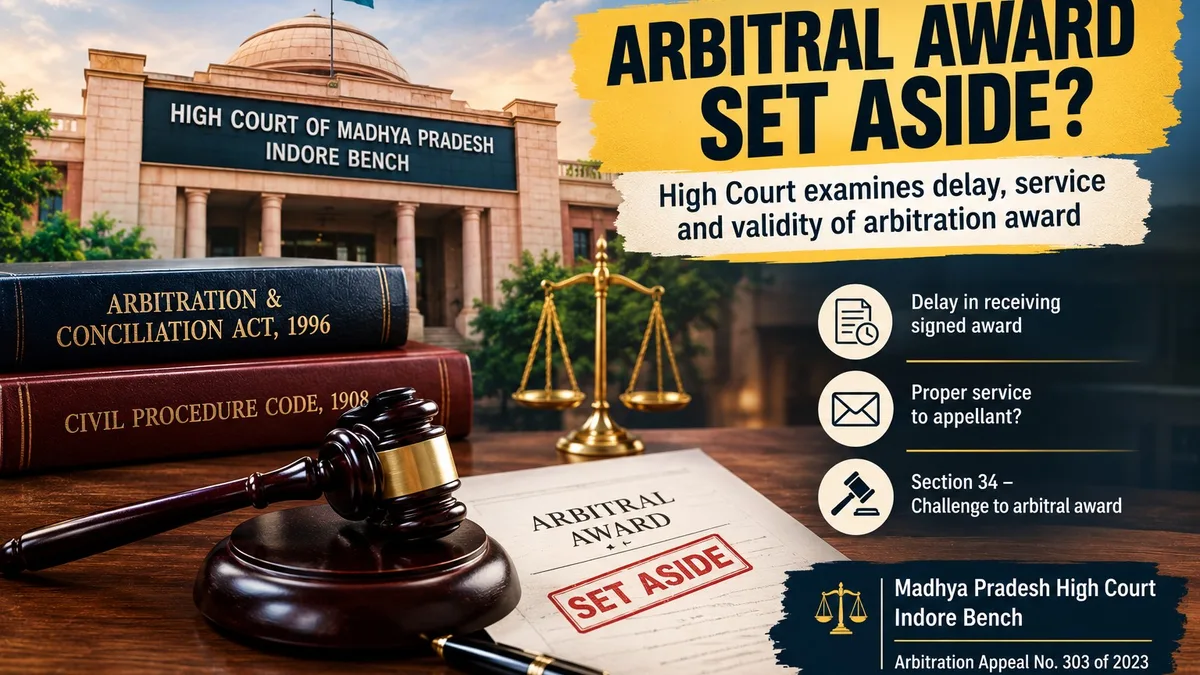
The Madhya Pradesh High Court held that where a party obtains a certified copy of an arbitral award, limitation for an application under Section 34 of the Arbitration and…
Other Legal Matters
Court / Authority
Delhi High Court
Update / Judgement Date
16 Oct 2026
Date of Publication
27 Oct 2026
Case No.
MAC.APP. 402/2023
Source
WCP News Bulletin
Author
Arshee Saifi — WCP Legal Desk
Reading Time
7 min read
View Count
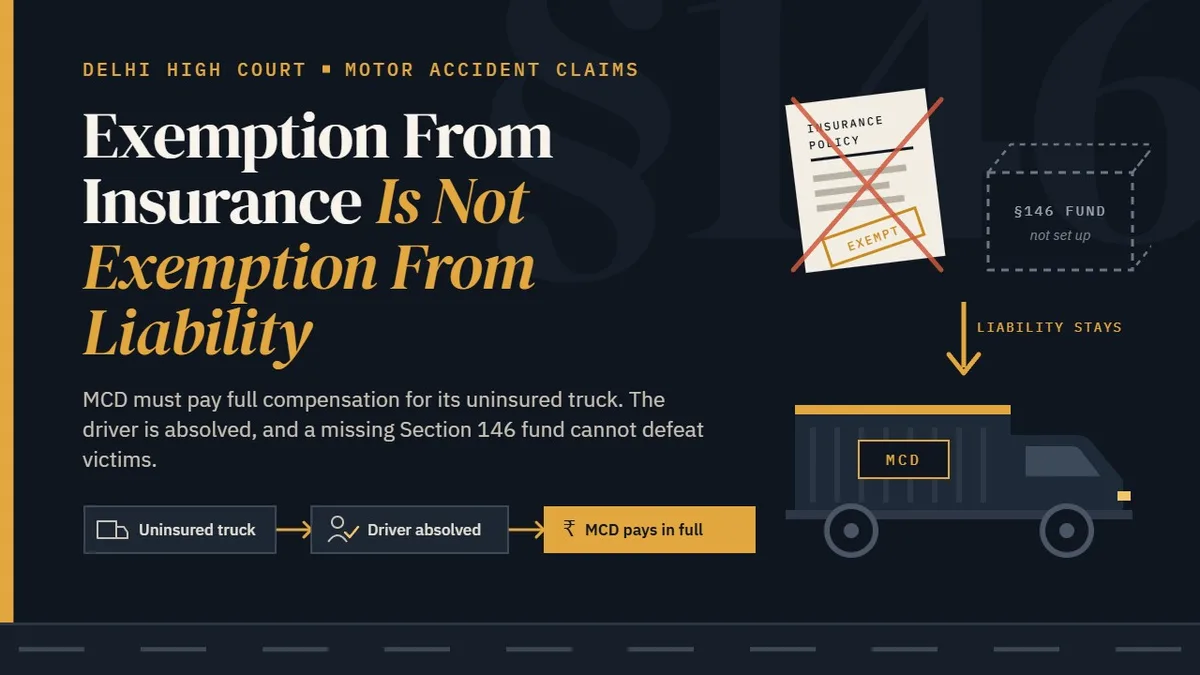
Key Proposition: A government or local-authority vehicle exempt from compulsory insurance under Section 146 of the Motor Vehicles Act, 1988 carries no immunity from compensation: the owning authority, being vicariously liable for its employee-driver acting in the course of employment, must satisfy the whole award in place of an insurer, and its failure to establish or maintain the statutory fund cannot shift the burden to the driver or defeat the claimants.
Background / Synopsis :
On 18 December 2014, at about 9:30 a.m., Sujeet Kumar, aged 26 and working as a service technician, was riding his motorcycle towards Dwarka when an MCD truck (DL-1GC-1424) driven by the Appellant hit him from behind near Shiksha Bharti School; he was declared brought dead at Rockland Hospital. The driver fled (Para 2).
FIR No. 834/2014 was registered at PS Dwarka (South) (Para 3).
The truck belonged to the Assistant Commissioner, DEMS HQ, Najafgarh Zone of the South Delhi Municipal Corporation, since merged into the unified MCD; it was not insured (Paras 22, 26).
By judgment dated 25 January 2023 in MACT No. 747/2016, the Tribunal at Dwarka Courts found rash and negligent driving and awarded Rs. 22,05,000 with 9% interest, fastening liability jointly and severally on the driver and the owner (Paras 1, 3–4).
The driver appealed only against the apportionment of liability (Para 4).
Issues For Consideration :
Submissions Of Parties :
The entire liability should fall on the MCD as employer, since the truck was driven in the course of employment; vicarious liability applies (State of Rajasthan v. Smt. Shekhu, Raj HC) (Paras 5, 10).
Under Section 146(2) and (3) of the MV Act, government and local-authority vehicles are exempt from insurance but the authority must maintain a fund; though the truck was uninsured, the liability is covered by that fund (Paras 7–8).
The fund obligation was not disputed, but the MCD should pay at most 50%, with the remaining 50% payable by the negligent driver (Para 9).
Relied on Urmila v. Sushma, Mohd. Sabuddin v. Mohd. Zakir, Oriental Insurance v. Meena Variyal and T.O. Anthony v. Karvarnan (Para 20).
No submission on apportionment is recorded in the judgment.
Court's Observations & Analysis :
The MV Act is beneficial legislation; Section 146(1) makes third-party insurance compulsory, and the exemption for government vehicles was never meant to leave claimants without compensation (Para 27).
The fund requirement transfers the responsibility from an insurance company to the authority itself; Rules 148 and 151–158 of the CMV Rules set up an institutional mechanism for third-party liability (Paras 27–28).
Kanchanmala urged extra care in judging the liability of exempted authorities and a liberal approach to compensation; Kamla Bai (MP HC) and Bajaj Allianz (SC) noted the problem of unpaid awards against uninsured public vehicles (Paras 16, 18–19).
Held: The exemption confers no immunity, and the absence of insurance cannot by itself shift the burden of compensation to the driver alone. (Paras 29–31)
Composite or contributory negligence (T.O. Anthony) does not arise; this is simply an accident by an MCD vehicle driven by its employee (Para 20(d)).
Meena Variyal works against the MCD, which, having no insurer, itself steps into the shoes of the insurer (Para 20(c)).
Held: The MCD's 50% plea is inconsistent with vicarious liability and the statutory scheme of insurance or fund. (Para 32)
Notable Observations:
"In no circumstances can an injured claimant, or the legal representatives of a deceased victim, be left without compensation for the harm suffered in an accident involving a vehicle owned by a government entity." (Para 33)
"In a welfare state, the obligation of the State and its authorities, particularly government authorities, to ensure that compensation is paid, fully and promptly, is all the more compelling." (Para 34)
Decision & Directions :
Appeal allowed. (Para 35)
The compensation awarded by the MACT shall be paid in full by the MCD, together with accrued interest, within four weeks; any balance after amounts already paid to be paid within the same period. (Paras 36–37)
Execution proceedings against the Appellant shall not proceed and are set aside. (Para 37)
The MCD is at liberty to take such action against the Appellant as its service and conduct rules permit. (Para 38)
No guidelines laid down; the Court stressed the MCD's statutory duty to establish and maintain an adequately funded pool to satisfy awards. (Para 33)
Legal Provisions Discussed & Precedents Cited :
Motor Vehicles Act, 1988 – Section 146 (compulsory third-party insurance; exemptions for government and local-authority vehicles subject to a fund); Section 166; Section 196 (driving uninsured vehicle).
Central Motor Vehicles Rules, 1989 – Rule 148 (records of exempted vehicles); Rule 151 (duty to establish fund); Rules 152–158 (constitution, replenishment, investment and administration of fund).
Constitution of India – Article 300 (liability of the State), noted through Vidhyawati.
Doctrines applied: vicarious liability (respondeat superior; qui facit per alium facit per se); rejection of sovereign immunity in motor accident claims; beneficial construction of the MV Act.
Oriental Insurance Co. Ltd. v. Meena Variyal, (2007) 5 SCC 428 – Relied on.
Case Details :
Disclaimer: This summary is an editorial aid and does not form part of the judgment. Refer to the original judgment before citing.
Full Judgement / Attachment
Full Judgement
The Madhya Pradesh High Court held that where a party obtains a certified copy of an arbitral award, limitation for an application under Section 34 of the Arbitration and…
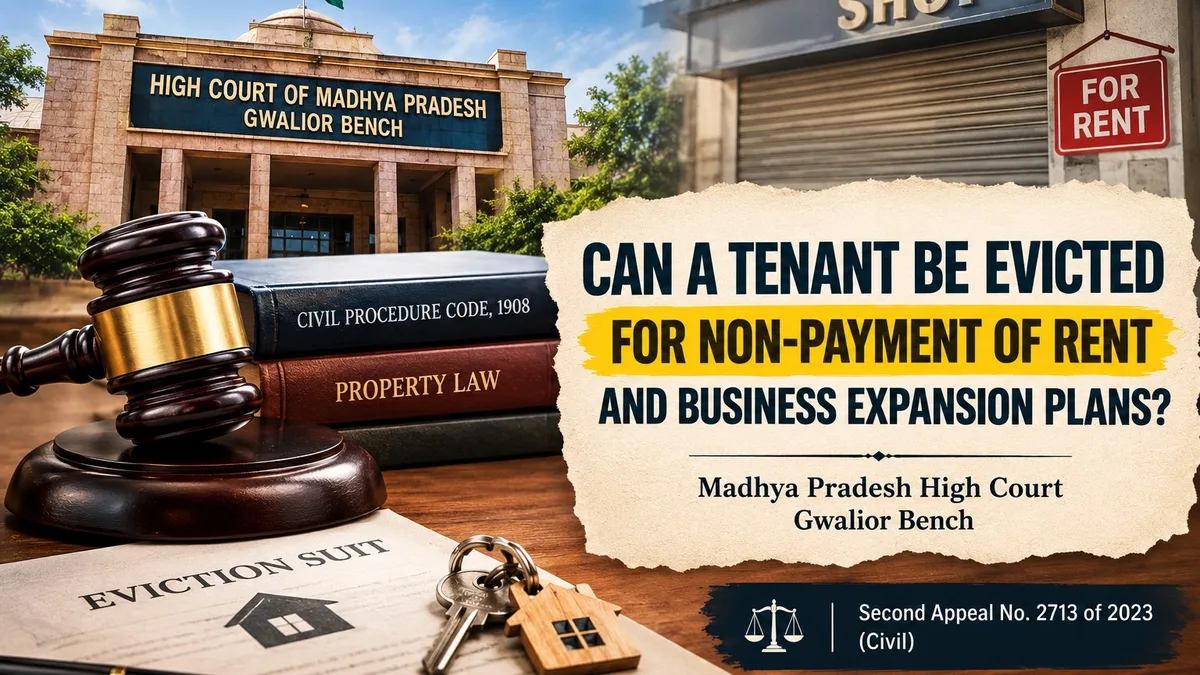
The Madhya Pradesh High Court held that an unregistered document recording a purported sale of the shop did not transfer title and did not terminate the tenancy where termination…
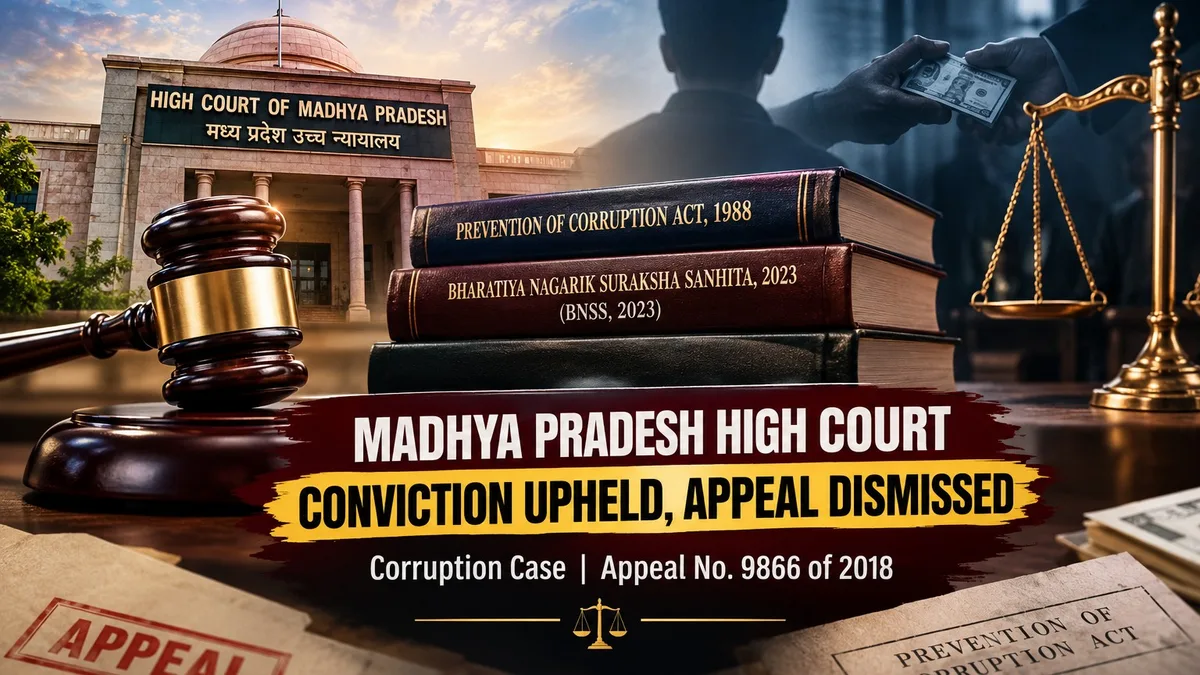
The Madhya Pradesh High Court set aside Bharat Bairagi’s conviction under Section 7 of the Prevention of Corruption Act, 1988, holding that the prosecution failed to prove a clear…

Case Header Case / Party Name: Moiz Dawoodbhai Palitanawala & Ors. v. The Municipal Corporation of Greater Mumbai & Ors. Court Name: High Court of Judicature at Bombay – Ordinary…
A large batch of writ petitions concerned the engagement and proposed disengagement of Gram Rozgar Sevaks and supporting staff under the MGNREGA Scheme in the erstwhile State of…
The Division Bench of the High Court of Jammu & Kashmir and Ladakh reversed a Single Judge decision that had struck down Rule 129 of the Border Security Force Rules, 1969. The…
The Division Bench considered an appeal and writ petition arising from consumer complaints involving claims above Rs. 50 lakh. The J&K State Consumer Disputes Redressal Commission…

The Bombay High Court held that where MahaRERA had dismissed a complaint only on the preliminary issue of maintainability, the Maharashtra Real Estate Appellate Tribunal could…

The Bombay High Court dealt with five connected Criminal Writ Petitions challenging orders issuing bailable or non-bailable warrants against the petitioners. The petitioners,…

The Bombay High Court considered cross-appeals against an Appellate Tribunal order continuing provisional attachment of two properties to the extent of Rs. 25 crore in proceedings…