Failure to Communicate Specific Grounds of Arrest Violates Article 22(1): Bail Granted Under Section 47 BNSS — News & Judgements | White Collar Professional
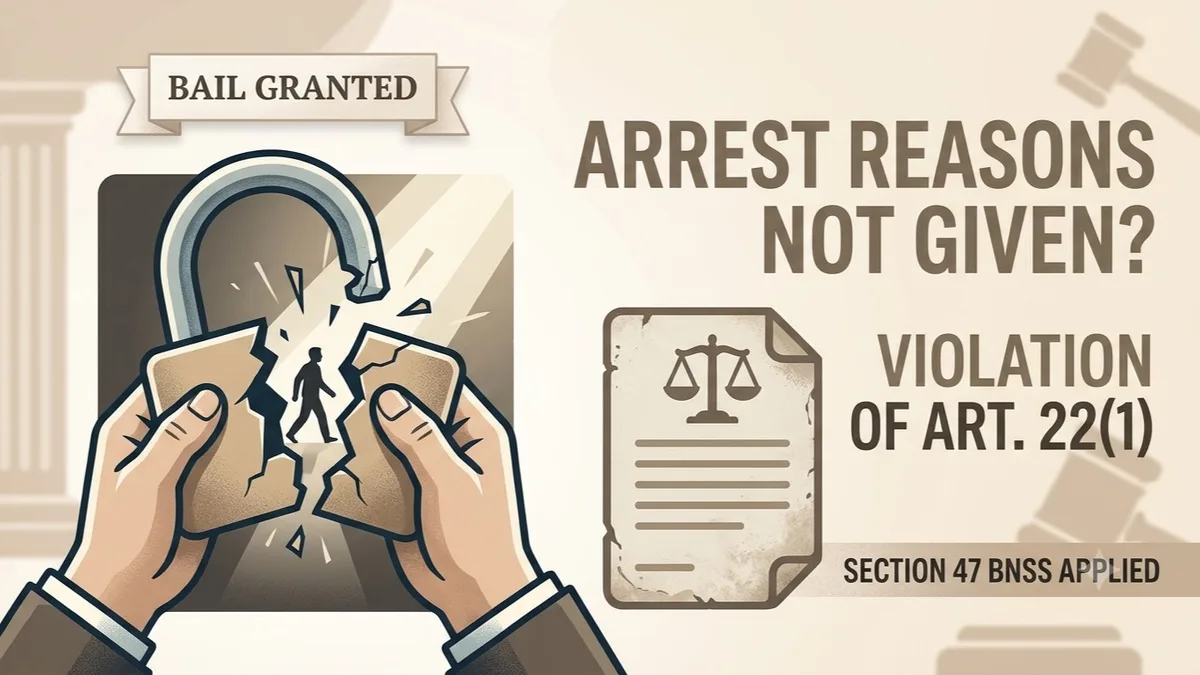
Failure to Communicate Specific Grounds of Arrest Violates Article 22(1): Bail Granted Under Section 47 BNSS
Court / Authority
Gauhati High Court
Update / Judgement Date
26 Oct 2026
Date of Publication
29 Oct 2026
Case No.
Bail Application No. 24/2026
Source
WCP News Bulletin
Author
Pranjal Jha — WCP Legal Desk
Reading Time
7 min read
View Count
9
Criminal Law
Gauhati High Court · WCP News Bulletin
A. CASE HEADER
Case / Party Name: Chotsaba Sangtam v. The State of Nagaland
Court Name: Gauhati High Court, Kohima Bench
Case Number(s): Bail Application No. 24/2026
Citation: 2026:GAU-NL:564
Coram / Judges: Hon’ble Mrs Justice Helen Dawngliani, Single Judge
Judgment Authored By: Justice Helen Dawngliani, order
Date of Decision: 26 October 2026
Nature of Proceedings: Bail application under Section 483 of the Bharatiya Nagarik Suraksha Sanhita, 2023 (BNSS)
Letters Patent / Appeals: None
Counsel Appearances: Toshitemjen Pongener for the petitioner; S. Mere, Public Prosecutor, for the State
Outcome: Bail granted; application disposed of
Record discrepancy: The case caption identifies Chotsaba Sangtam as the petitioner, but the order repeatedly identifies Repongli as the accused seeking and receiving bail. The PDF does not explain this discrepancy. It should be flagged rather than silently corrected.
B. HEADNOTE Key Proposition- Failure to communicate sufficiently specific, individualised grounds of arrest in writing under Section 47 BNSS may violate Article 22(1) of the Constitution and justify bail.
Catchwords:
BNSS, 2023 – Section 47 – Grounds of arrest – Whether generic information satisfies the statutory requirement – Held, prima facie no. (Paras 8–12)
Constitution of India – Article 22(1) – Communication of grounds of arrest – Whether inadequate grounds infringe constitutional safeguards – Held, yes. (Paras 9–12, 14–15)
BNSS, 2023 – Section 483 – Bail – Whether alleged non-compliance with arrest safeguards justified bail after an earlier refusal – Held, yes, in the circumstances. (Paras 13–16)
Headnote: The applicant sought bail in connection with a criminal case registered at Kiphire Women Police Station, Nagaland, alleging offences under Sections 74, 79, 109, 115(2) and 351(2) of the Bharatiya Nyaya Sanhita, 2023. The principal challenge concerned the sufficiency of the written grounds of arrest furnished under Section 47 BNSS. The Court examined the distinction between general reasons for arrest and specific grounds particular to the accused, relying on Supreme Court decisions concerning Article 22(1). It found prima facie non-compliance with Section 47 BNSS and held that the constitutional safeguard had been violated. Bail was granted subject to a bond of ₹1,00,000, one solvent surety, and specified conditions. (Paras 3–16)
Full Judgement / Attachment
Full Judgement
C. BACKGROUND / SYNOPSIS Key facts
On 4 May 2026, the victim's father lodged an FIR at Kiphire Women Police Station, Nagaland.
The case was registered under Sections 74, 79, 109, 115(2) and 351(2) BNS.
The accused was arrested on 5 May 2026 at 11:00 hours.
The grounds of arrest referred to physical assault and attempted murder but were challenged as insufficiently specific.
The investigation had been completed and the charge-sheet filed, although the trial had not commenced. (Paras 3–4, 7–8)
Procedural history
FIR registered on 4 May 2026.
Accused arrested on 5 May 2026.
Earlier bail application rejected by the trial court despite the objection concerning Section 47 BNSS.
Fresh bail application filed before the Gauhati High Court under Section 483 BNSS.
High Court granted bail on 26 October 2026. (Paras 3–7, 13–17)
Impugned action and relief sought
The applicant challenged the adequacy of the written grounds of arrest and sought release on bail. The State opposed the application, arguing substantial compliance and absence of prejudice.
D. ISSUES FOR CONSIDERATION
Whether the information supplied to the accused complied with Section 47 BNSS and adequately communicated the grounds of arrest.
Whether inadequate communication of grounds of arrest violated Article 22(1) of the Constitution.
Whether the alleged non-compliance justified granting bail despite the earlier rejection by the trial court.
E. SUBMISSIONS OF PARTIES
Petitioner / Applicant
The written grounds of arrest did not satisfy Section 47 BNSS.
Failure to communicate adequate grounds violated Article 22(1) of the Constitution.
Relied on Sakib Choudhury v. State of Assam, reported at 2025 (3) GLT 399.
Relied on Pankaj Bansal v. Union of India, (2024) 7 SCC 576, and Prabir Purkayastha v. State (NCT of Delhi), (2024) 8 SCC 254, concerning communication of grounds of arrest.
The earlier rejection of bail did not prevent reconsideration on the relevant legal grounds. (Paras 5, 9–10, 13)
Respondent / State
The Public Prosecutor argued that Section 47 BNSS had been substantially complied with.
The State contended that no prejudice had been caused and that there was no delay in furnishing the notice.
It submitted that the trial court had correctly rejected bail and requested dismissal of the application. (Paras 6, 8)
F. COURT'S OBSERVATIONS & ANALYSIS
Re: Issue (i): Sufficiency of grounds of arrest
The Court examined the written notice provided to the accused.
It relied on the distinction between generic reasons for arrest and individualised grounds explaining the facts necessitating the arrest.
The notice referred to physical assault and attempted murder but, in the Court's prima facie assessment, did not contain all the details required from the investigating officer.
The Court considered the reasoning in Pankaj Bansal and Prabir Purkayastha. (Paras 8–12)
Held: The information supplied appeared insufficient to satisfy Section 47 BNSS. (Paras 12, 14–15)
Re: Issue (ii): Article 22(1) safeguards
The Court relied on the Supreme Court's interpretation of the constitutional right to be informed of the grounds of arrest.
It treated meaningful communication as necessary to enable the arrested person to consult legal counsel, oppose custodial remand and seek bail.
The Court considered the inadequacy of the written grounds a violation of the constitutional safeguard. (Paras 9–12, 14)
Held: The alleged non-compliance with Section 47 BNSS infringed Article 22(1) in the circumstances of the case. (Paras 14–15)
Re: Issue (iii): Entitlement to bail
The Court noted that the earlier bail application had been rejected.
It referred to Babu Singh v. State of U.P., (1978) 1 SCC 579, for the proposition that a previous refusal does not necessarily prevent a subsequent bail application based on further material or different considerations.
The Court considered the arrest-related violation sufficient to grant bail in the circumstances. (Paras 13–16)
Held: Bail was granted subject to specified conditions. (Paras 15–16)
Notable Observations: No separate short judicial remark is necessary for this summary. The order's reasoning is adequately captured through its findings in paragraphs 9–15.
G. DECISION & DIRECTIONS
The bail application was disposed of by granting bail to Repongli. Conditions imposed (para 16):
The accused must attend court regularly.
The accused must not influence witnesses or tamper with evidence.
The accused must not commit any offence or similar offence while on bail.
The accused must not leave the trial court's jurisdiction without prior permission.
Bond: ₹1,00,000 with one solvent surety for the like amount, to the satisfaction of the trial court.
Costs: None specified.
Separate opinions: None.
H. LEGAL PROVISIONS DISCUSSED Provision Relevance
Constitution of India, Article 22(1): Constitutional safeguard requiring communication of grounds of arrest.
BNSS, 2023, Section 47: Statutory obligation concerning information about grounds of arrest.
BNSS, 2023, Section 48, mentioned in the discussion of the requirement to provide written information about grounds of arrest.
BNSS, 2023, Section 483, provision under which the bail application was filed.
BNS, 2023, Sections 74, 79, 109, 115(2), and 351(2) provisions under which the FIR was registered.
Doctrines / principles: Meaningful communication of grounds of arrest; distinction between reasons for arrest and grounds of arrest; reconsideration of bail on subsequent or different considerations.
I. PRECEDENTS CITED
Sakib Choudhury v. State of Assam, 2025 (3) GLT 399- Relied on by the applicant. (Para 5)
Pankaj Bansal v. Union of India, (2024) 7 SCC 576 - Relied on for meaningful written communication of grounds of arrest. (Para 9)
Prabir Purkayastha v. State (NCT of Delhi), (2024) 8 SCC 254 - Relied on for distinguishing reasons for arrest from individualised grounds of arrest. (Paras 10–12)
Babu Singh v. State of U.P., (1978) 1 SCC 579 - Relied on regarding subsequent bail applications based on additional material or different considerations. (Para 13)
An 85-year-old senior citizen sought eviction of his son and daughter-in-law from his self-acquired home under the Maintenance and Welfare of Parents and Senior Citizens Act,…
A batch of writ appeals was brought by educators engaged on a contractual/guest-faculty basis in Madhya Pradesh Government Colleges, who sought regularisation, pay parity and…
Labour LawsOther Legal MattersPSU's AND Govt. Undertakings
The Madhya Pradesh High Court directed that the petitioner’s bank account be unfrozen while preserving the disputed sum of ₹23,425.21 in a fixed deposit. Following earlier…
The Karnataka High Court quashed a private complaint, the Magistrate’s referral order and the resulting FIR alleging medical negligence against an eye hospital and its doctors.…
The Karnataka High Court allowed an appeal and granted anticipatory bail in a case invoking the SC/ST Prevention of Atrocities Act. The Court took note of the 13-day delay in…
The Karnataka High Court quashed criminal proceedings against two former Karnataka State Open University functionaries after holding that the Magistrate had exceeded jurisdiction…
The Orissa High Court held that a registering authority cannot refuse registration of an arbitral award in its entirety merely because one of the properties covered by the award…
The Bombay High Court granted bail to an accused charged in a dacoity case involving the MCOC Act, taking into account his limited alleged role as a lookout, the absence of…
The petitioner, a retired employee of the Indian Institute of Public Administration IIPA , sought continuation of Central Government Health Scheme CGHS facilities that he had…
Following an inter-corporate deposit of Rs. 1,00,00,000/- made by the complainant company to M/s. Tantia Constructions Limited, a cheque of Rs. 1,00,00,000/- issued towards…