High Court Permits Termination of a Minor Victim’s Approximately 24-Week Pregnancy
Court / Authority
Madhya Pradesh High Court
Update / Judgement Date
02 Nov 2026
Date of Publication
04 Nov 2026
Case No.
Writ Petition No. 45961 of 2026
Source
WCP News Bulletin
Author
Dipanshi Bansal — WCP Legal Desk
Reading Time
10 min read
View Count
6
Other Legal Matters
Madhya Pradesh High Court · WCP News Bulletin
The High Court considered a Medical Board report concerning a 15-year-old victim whose pregnancy was approximately 24 weeks and which could be terminated under specialist supervision. Relying on the Division Bench’s standard operating procedure for pregnancies exceeding 24 weeks in cases of sexual assault, the Medical Termination of Pregnancy Act and Rules, and the Supreme Court’s decision in X v. Principal Secretary, Health and Family Welfare Department, the Court granted permission for termination. It directed constitution of a specialist medical team, preservation of a foetal sample for DNA examination, and sensitive medical and administrative handling that prioritised the victim’s emotional and mental health and strictly followed the prescribed SOPs. (Paras 1–9)
Key Proposition: The High Court may grant permission for termination of pregnancy in a case involving a minor survivor of sexual assault after considering the Medical Board’s report and applicable safeguards, and must ensure specialist medical care, preservation of forensic material and sensitive treatment of the victim.
Medical Termination of Pregnancy Act, 1971 – Sections 3(2), 3(2B) and 5(1) – Termination of pregnancy – Whether termination could be permitted in the circumstances of a minor survivor’s approximately 24-week pregnancy? – Held, yes. (Paras 4–8)
Medical Termination of Pregnancy Rules, 2003 – Rule 3B – Eligibility of survivors of sexual assault or rape and minors for termination up to 24 weeks – Considered with the applicable procedure for pregnancies exceeding 24 weeks. (Paras 3, 5)
Constitution of India – Article 21 – Reproductive autonomy and a woman’s right to decide whether to continue a pregnancy – Applied in light of the Supreme Court’s decision in X v. Principal Secretary. (Para 6)
POCSO Rules, 2020 – Rule 6(6) – Preservation of forensic evidence/foetal material for DNA profiling or investigation. (Para 3)
Background / Synopsis :
The writ petition was considered on the basis of the State’s submissions and a Medical Board report dated 02 November 2026. The report stated that the fetus was approximately 24 weeks and that the victim was about 15 years old at the time of medical examination
The Medical Board reported that termination of the pregnancy was possible under the supervision of specialists at M.T.H. Hospital, Indore. The judgment does not disclose the victim’s identity, and this summary preserves that anonymity.
Full Judgement / Attachment
Full Judgement
The Court referred to the Division Bench decision dated 20 February 2025 in W.P. No. 5184/2025, In Re (Suo Motu) v. State of Madhya Pradesh and Others, which prescribed SOPs for cases where the pregnancy of a survivor of sexual assault, rape or incest exceeded 24 weeks.
The SOP required referral from the police station to the District Court, preferably the Special Judge/POCSO; medical assessment by the concerned medical officer/Board; onward reference to the High Court Registry; registration as a suo motu writ petition under Article 226; and urgent listing before the appropriate Bench.
The SOP further required termination, if directed by the High Court, to be carried out by an expert medical team after explaining risks to the victim and family, with necessary specialist and post-operative care, preservation of a foetal sample for DNA examination, and strict protection of the victim’s privacy.
The Court also considered Section 3(2) of the Medical Termination of Pregnancy Act, 1971, Rule 3B of the Medical Termination of Pregnancy Rules, 2003, and the Supreme Court’s decision in X v. Principal Secretary, Health and Family, reported in (2023) 9 SCC 433.
The relief sought and granted was permission to terminate the pregnancy, subject to specialist medical supervision, the Division Bench SOP and safeguards for the victim’s physical and emotional well-being.
Issues For Consideration :
Whether permission should be granted for termination of the approximately 24-week pregnancy of a 15-year-old victim, in light of the Medical Board’s report and applicable legal framework.
Whether the termination procedure should be conducted under specialist supervision and in compliance with the SOP laid down by the Division Bench for pregnancies exceeding 24 weeks in sexual-assault cases.
What safeguards were required for preservation of forensic material, DNA examination, privacy and the victim’s emotional and mental health.
Submissions Of Parties :
Petitioner / Appellant:
The matter was considered in the suo motu writ proceedings. The judgment records the appearance of Ms. Bhagyashree Gupta, Government Advocate for the State, and states that the Court heard the State’s counsel and perused the Medical Board report dated 02 November 2026.
The judgment does not record separate submissions by an identified petitioner or the victim; no additional submissions are attributed to them.
Respondent / State:
The State was represented by the Government Advocate. The order records that the Court heard learned counsel for the State and considered the Medical Board report.
The Medical Board reported that the pregnancy was approximately 24 weeks and that termination was possible under the supervision of specialists at M.T.H. Hospital, Indore.
Court's Observations & Analysis :
Re: Medical Board report and permission for termination
The Medical Board report dated 02 November 2026 recorded that the fetus was approximately 24 weeks and that the victim was about 15 years old.
The Board opined that termination was possible under specialist supervision at M.T.H. Hospital, Indore. (Paras 1–2)
The Court considered the report alongside the Division Bench SOP, the statutory provisions and the Supreme Court’s decision in X v. Principal Secretary, Health and Family Welfare Department. (Para 7)
Held: Permission for termination of pregnancy was granted. (Paras 7, 9)
Re: SOP for pregnancies exceeding 24 weeks in sexual-assault cases
The Court reproduced the Division Bench directions in W.P. No. 5184/2025 dated 20 February 2025.
The SOP provided for prompt referral by the police to the District Court, preferably the Special Judge/POCSO, followed by medical assessment and reference of the report to the High Court Registry.
The Registry was required to register the matter suo motu as a writ petition under Article 226 and list it immediately before the appropriate Bench to avoid undue delay.
If termination was directed, an expert medical team was to conduct the procedure after explaining the risks to the victim and family. Necessary medical attention, specialist facilities and post-operative care were to be provided. (Para 3)
Held: The termination was required to be conducted in strict compliance with the Division Bench SOP. (Paras 3, 8)
Re: Statutory framework and reproductive autonomy
The Court reproduced Section 3(2) of the Medical Termination of Pregnancy Act, 1971, which sets out the statutory framework for termination by registered medical practitioners within the specified gestational periods. (Para 4)
It reproduced Rule 3B of the Medical Termination of Pregnancy Rules, 2003, which identifies categories eligible for termination up to 24 weeks, including survivors of sexual assault, rape or incest and minors. (Para 5)
The Court referred to X v. Principal Secretary, Health and Family Welfare Department, (2023) 9 SCC 433, particularly paragraphs 94, 101 and 114. Those passages addressed the effect of changed circumstances on mental and physical health, the scope of reproductive rights and autonomy, and the recognition under Article 21 of a woman’s right to decide whether to undergo termination where her mental or physical health is at stake. (Para 6)
The Court considered the totality of the circumstances, the Medical Board’s opinion, the Division Bench directions and the Supreme Court’s decision in granting permission. (Para 7)
Held: The statutory framework, reproductive-autonomy principles and medical opinion supported granting permission in the circumstances of the case. (Paras 6–7)
Re: Medical safeguards, DNA preservation and sensitive treatment
The Chief Medical and Health Officer was directed to constitute a team of specialists comprising at least one gynaecologist, one paediatrician, one anaesthesiologist and one medical officer from M.T.H. Hospital, Indore.
The team was directed to carry out termination in strict compliance with the Division Bench judgment and its SOPs.
The doctors were directed to preserve a sample from the fetus for DNA examination and hand it over to the prosecution when required for use in the criminal case.
The Court required all necessary care and caution during the procedure and directed the hospital and medical team to ensure sensitive treatment and handling of the victim in all medical and administrative procedures, keeping her emotional and mental health at the forefront. (Paras 8–9)
Held: Termination was permitted subject to specialist supervision, forensic preservation, sensitive handling and strict compliance with the applicable SOPs. (Paras 8–9)
Notable Observations: None recorded as separate obiter dicta. The order reproduces and applies the relevant passages from the Supreme Court decision and the Division Bench SOP.
Decision & Directions :
Permission was granted for termination of the pregnancy. (Paras 7, 9)
The Chief Medical and Health Officer was directed to constitute a specialist team comprising at least one gynaecologist, one paediatrician, one anaesthesiologist and one medical officer from M.T.H. Hospital, Indore. (Para 8)
The procedure was to be conducted in strict compliance with the SOPs prescribed by the Division Bench in W.P. No. 5184/2025. (Para 8)
A sample from the fetus was to be preserved for DNA examination and handed over to the prosecution as and when required for use in the criminal case. (Para 8)
All necessary care and caution were to be taken, with sensitive medical and administrative treatment prioritising the victim’s emotional and mental health. (Para 8)
The writ petition was disposed of with the above directions. (Para 9)
Legal Provisions Discussed & Precedents Cited :
Constitution of India – Article 21 – Right to life and personal liberty; the Supreme Court authority cited by the Court recognised reproductive autonomy and the right to terminate pregnancy where mental or physical health is at stake.
Constitution of India – Article 226 – Basis for registration of the relevant category of cases as suo motu writ petitions under the Division Bench SOP reproduced in the order.
Medical Termination of Pregnancy Act, 1971 – Section 3(2) – Statutory framework for termination by registered medical practitioners within the prescribed gestational periods.
Medical Termination of Pregnancy Act, 1971 – Section 3(2B) – Referred to in the reproduced Division Bench directions as a provision under which medical termination may be necessitated.
Medical Termination of Pregnancy Act, 1971 – Section 5(1) – Referred to in the reproduced Division Bench directions concerning termination in applicable circumstances.
Medical Termination of Pregnancy Act, 1971 – Section 5A – Privacy of the woman whose pregnancy is terminated; strict confidentiality was directed.
Medical Termination of Pregnancy Rules, 2003 – Rule 3B – Categories of women, including minors and survivors of sexual assault, rape or incest, eligible for termination up to 24 weeks under Section 3(2)(b).
Protection of Children from Sexual Offences Rules, 2020 – Rule 6(6) – Preservation of forensic evidence/foetal material for DNA profiling or other investigative purposes.
Standard Operating Procedure – Division Bench of the Madhya Pradesh High Court in W.P. No. 5184/2025 – Referral, medical assessment, urgent High Court consideration, specialist procedure, post-operative care, DNA preservation and privacy safeguards.
X v. Principal Secretary, Health and Family, (2023) 9 SCC 433 – Relied on, particularly paragraphs 94, 101 and 114, for reproductive autonomy, the scope of reproductive rights and the role of mental and physical health in decisions concerning termination of pregnancy.
In Re (Suo Motu) v. State of Madhya Pradesh and Others, W.P. No. 5184/2025, decided 20 February 2025 – Followed/applied; Division Bench SOP for cases where pregnancy of a survivor of sexual assault, rape or incest exceeds 24 weeks.
Case Details :
Case / Party Name: In Re Suo Motu v. State of Madhya Pradesh
Case Number(s): Writ Petition No. 45961 of 2026; CNR No. MPHC020440702026
Coram / Judges: Justice Sandeep N. Bhatt – Single Judge
Counsel Appearances: For the State: Ms. Bhagyashree Gupta, Government Advocate. Other appearances: Not stated in judgment.
Disclaimer: This summary is an editorial aid and does not form part of the judgment. Refer to the original judgment before citing.
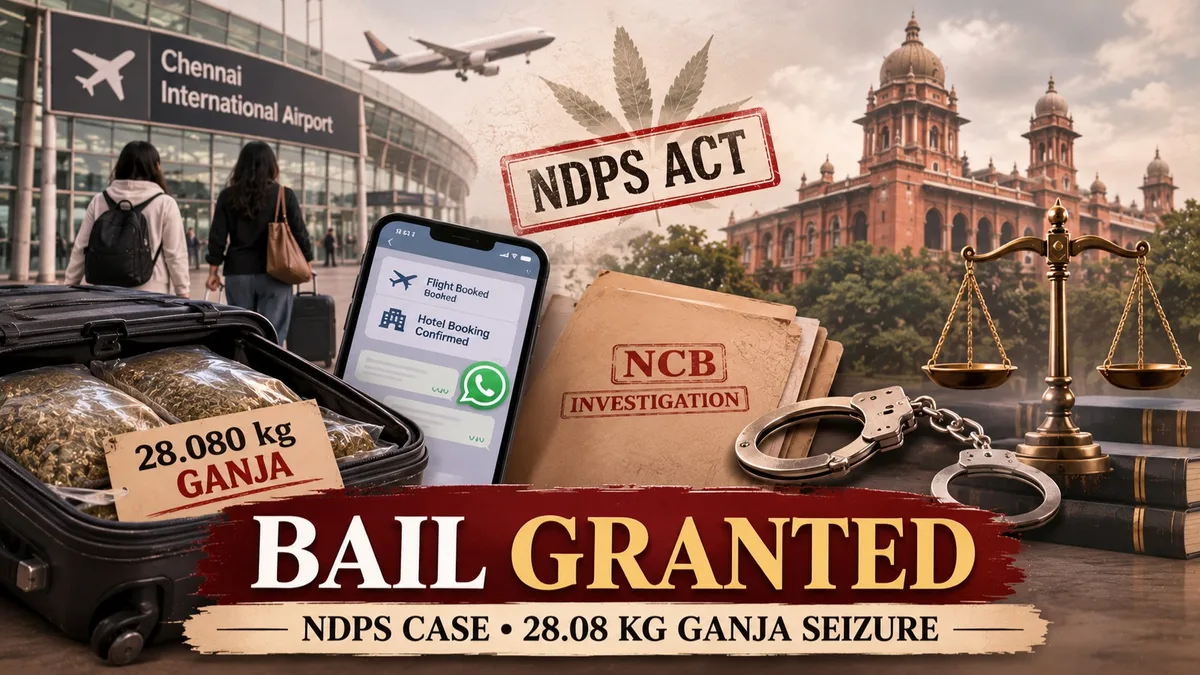
Abdul Kalam, the second accused in a ganja prosecution, sought bail after approximately 11 kg was allegedly recovered from his bag and a separate 12 kg recovery was made from a…
The petitioner-mother sought a direction to process her minor son’s passport application after the Regional Passport Officer sought the biological father’s consent. A Family Court…
Sandhya, the third accused in an alleged international ganja-trafficking case, sought regular bail after two earlier applications had been rejected. No contraband had been…
Summary Background and facts JM Baxi Ports and Logistics Pvt. Ltd. challenged its disqualification from participating in a tender floated by Paradip Port Authority for the…
Case details Court: High Court of Orissa at Cuttack Case No.: W.A. No. 909 of 2026 Citation: 2026:OHC:284-DB Date: 10 November 2026 Bench: Chief Justice Harish Tandon and Justice…
IBBI’s Disciplinary Committee has suspended the registration of insolvency professional Alok Kailash Saksena for two years over multiple failures in the CIRP of Associate Decor…
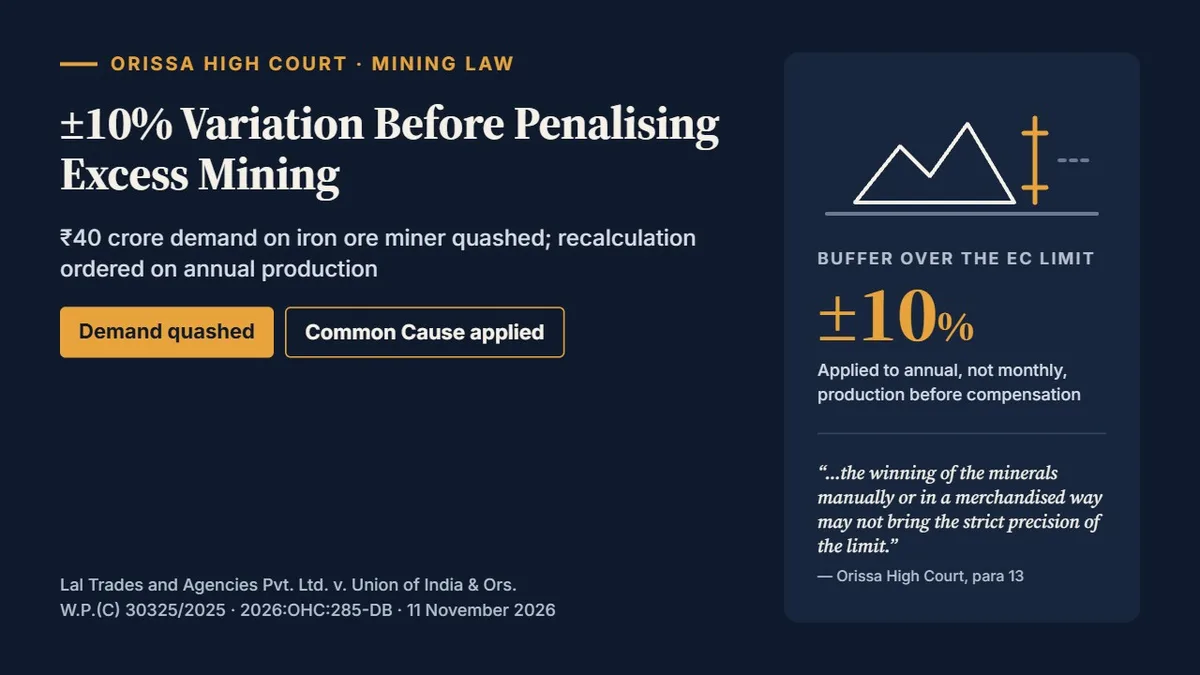
The petitioner, an iron ore beneficiator in Mayurbhanj, had its EC enhanced from 0.72 MTPA to 1.5 MTPA in 2019, and its 2019-20 production and royalty were accepted without…
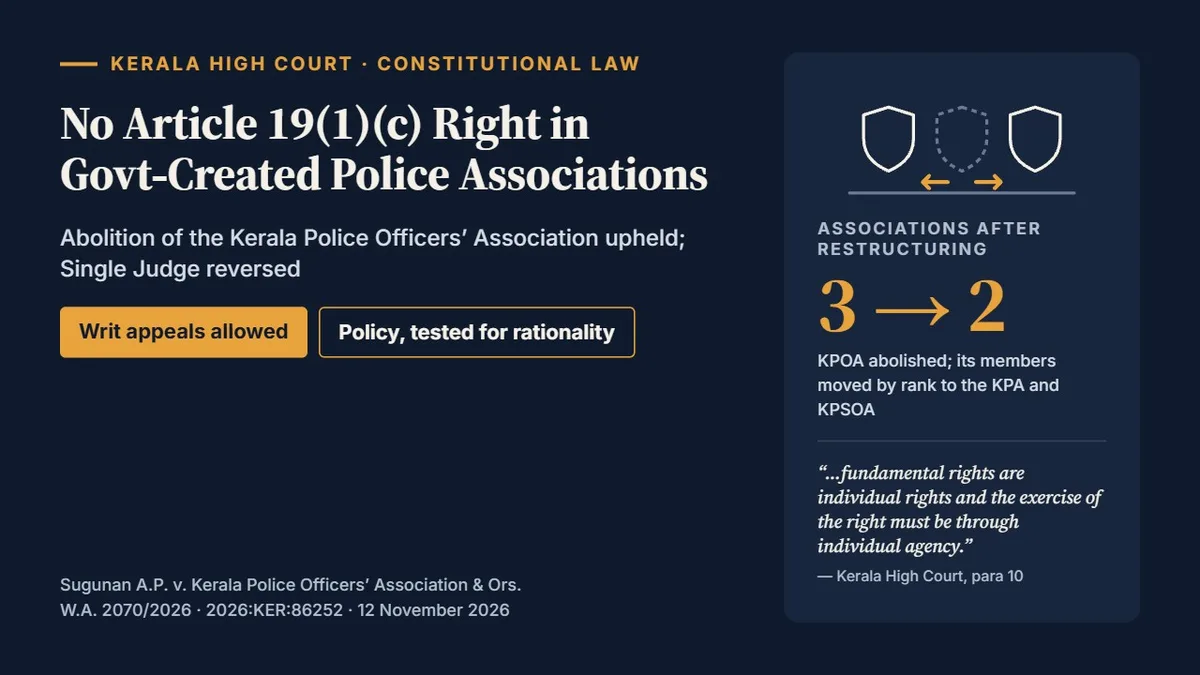
By G.O. dated 27.07.2026, the State abolished the Kerala Police Officers' Association KPOA and moved its members, by rank, into the Kerala Police Association KPA and the Kerala…
The petitioner-father sought a writ of habeas corpus after a court in Maryland, USA, passed an emergency custody order in his favour concerning the parties’ minor son, who had…
The High Court of Orissa considered whether a long-standing mining lease for China Clay could be treated as a lease for captive use for the purpose of obtaining the extended lease…